Starting HIV Treatment (ARV) for the First Time: What to Know, How to Prepare, and What to Expect
On learning you have HIV, starting antiretrovirals or ARV is an important step that changes your health path for the better. Many about to start ARV for the first time may feel worried or unsure how to prepare, what to know, and how life will change. These feelings are understandable. The good news is that modern ARV treatment is highly effective, keeping people with HIV healthy with a life expectancy close to the general population, and once the virus is controlled, they don't transmit HIV sexually. This article explains in detail what to know when starting ARV for the first time — from preparing, tests before starting, choosing a regimen with a doctor, to what to expect after starting, the important consistency, monitoring, and caring for yourself through the process — so you can begin treatment confidently.
What is ARV
ARV, or antiretrovirals, are medicines used to control HIV in the body by suppressing the virus's multiplication, lowering the viral level and letting the immune system recover. Modern ARVs are usually taken continuously every day, and many regimens are a combination pill taken once daily. ARVs don't remove the virus entirely from the body but control it to a very low level so it does no harm and isn't transmitted sexually when well controlled. ARV treatment thus changes HIV from a once-serious disease into a manageable chronic condition, like other chronic diseases needing ongoing care. Understanding how ARVs work helps you see the importance of consistent dosing and view treatment with hope. Read HIV basics in what HIV is.
Why start ARV
Starting ARV matters for several reasons. First, ARVs help control the virus and protect the immune system from damage, preventing the disease from progressing to a serious stage. Second, treatment helps people with HIV be healthy and live normally, with a life expectancy close to the general population. Third, once the viral level is undetectable, a person with HIV doesn't transmit HIV sexually, per U=U, benefiting both themselves and those around them. Starting ARV is therefore not just treating a disease but restoring quality of life and confidence. Understanding why treatment matters helps you decide to start confidently and view dosing as long-term self-care. Whatever the situation, entering treatment is always the best path.
Starting early is better than waiting
Current HIV treatment guidance recommends starting ARV as soon as possible after diagnosis, without waiting for the immune system to decline or symptoms to appear. The reason is that starting early protects the immune system before it's significantly damaged, letting the body recover better and reducing the risk of complications. Also, starting early helps the viral level fall faster, leading to viral control and U=U sooner. Waiting or hesitating to start may mean missing the chance to protect health when it's still at its best. Although learning you have HIV takes emotional adjustment, starting treatment promptly is an investment in long-term health. If you have worries or questions about starting, talking to a doctor helps you understand and decide. Starting early is the approach with the best outcomes for long-term health.
Preparing before starting ARV
Good preparation helps starting ARV go smoothly and confidently.
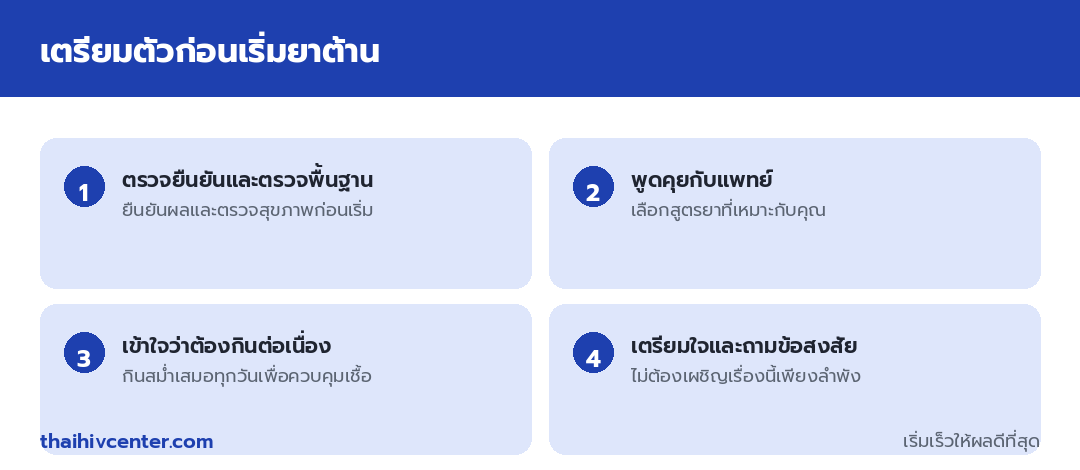
First, confirm the result and do baseline health tests before starting, helping a doctor assess health status and choose appropriate treatment. Second, talk with a doctor to choose a regimen that suits you, considering health and personal factors. Third, understand that treatment requires taking medicine continuously every day, the key to controlling the virus. And fourth, prepare emotionally and ask your questions, because starting ARV is a new step that may bring questions or worries. Preparing both information and mindset helps you enter treatment steadily. Importantly, you don't have to face this alone; a doctor and care team are ready to advise and support throughout. Good preparation is the start of successful treatment.
Tests before starting
Before starting ARV, various tests are usually done to assess health status and plan treatment. Confirming infection is the first step to ensure the result. There are usually tests of values indicating immune status and viral level, such as CD4 and viral load, helping a doctor understand the infection level and plan monitoring. There may be other general health tests, such as liver and kidney function, to assess regimen suitability and safety, plus testing for other conditions that may need co-management. These tests help treatment be appropriate and safe for each person. These results are also baseline values used to compare in tracking treatment progress. Understanding that tests before starting matter helps you see treatment is designed to suit your specific situation. Read more about these values in what CD4 and viral load are.
Choosing a regimen with a doctor
Choosing an ARV regimen is a decision made with a doctor, considering many factors. Modern ARVs have several regimens, each possibly differing in pill count, dosing frequency, and specific characteristics. A doctor considers your overall health, baseline test results, other medicines you take, and other personal factors to choose a suitable, convenient regimen. Many modern regimens are a combination pill taken once daily, making continuous dosing easier. Participating in the discussion with your doctor about the regimen — such as dosing convenience and side-effect worries — helps you get a regimen you can take consistently long term. Choosing a regimen that suits your lifestyle is a key factor in treatment success. If you have questions or dosing problems, communicate with your doctor to find an appropriate solution.
What to expect after starting
Once you take ARVs consistently, the body gradually changes for the better.
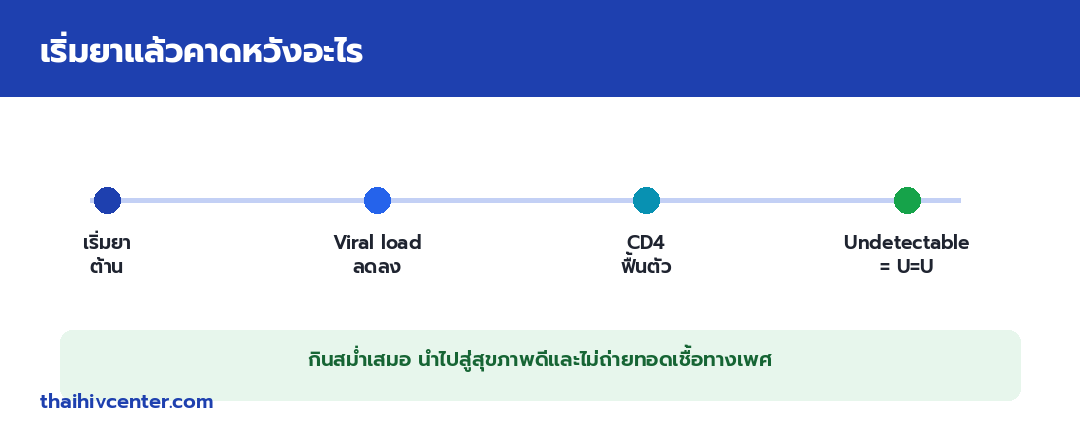
| Period | What happens |
|---|---|
| Starting the medicine | The medicine starts suppressing viral multiplication |
| After consistent dosing | The viral load falls |
| Continued | The immune system (CD4) gradually recovers |
| Well controlled | Undetectable = no sexual transmission (U=U) |
After starting ARV, the medicine starts suppressing viral multiplication, so the viral load falls with consistent dosing. Over time, the immune system measured by CD4 gradually recovers and strengthens, and once the virus is well controlled with the viral level undetectable, there's no sexual transmission per U=U. These changes take time and depend on consistent dosing. Each person's progress may differ slightly, but overall, consistent treatment leads to better health. Understanding what to expect helps motivate you to take medicine and track your own progress. Read more in life expectancy with HIV.
Consistency is the key
The most important factor in treatment success is consistency in taking medicine. Taking it on time every day keeps the level steady and controls the virus effectively. Conversely, inconsistent dosing or frequent misses may let the virus multiply again and risk resistance, making control harder. Building a consistent dosing habit is therefore important. Helpful methods include taking it at the same time each day, tying dosing to a routine, setting phone reminders, and preparing medicine for travel. If you have obstacles to consistency, such as side effects or memory issues, consult a doctor for help, not stop on your own. Viewing consistent dosing as part of a healthy routine helps you sustain it long term. Consistency is the key that makes treatment work and leads to U=U.
Early side effects and adjustment
Some may have mild side effects early on starting ARV, usually mild and improving as the body adjusts. Possible side effects include nausea, headache, or fatigue, usually easing within a few days to two weeks. Modern ARVs usually have fewer side effects than in the past, making them easier to take. If side effects are bothersome or don't improve, consult a doctor, who may have ways to manage them or in some cases consider adjusting the regimen. Importantly, don't stop on your own out of side-effect worry, but communicate with your doctor for a solution. Understanding that most side effects are only temporary and manageable helps you get through the adjustment period. Enduring early on and general health care, like resting and eating well, help the body adjust better. Once past this, dosing becomes a smooth part of your routine.
Monitoring after starting
After starting ARV, monitoring is an important part of treatment. A doctor schedules periodic tests to track whether treatment works, especially viral load testing to see whether it falls as expected and reaches undetectable, plus CD4 testing to track immune recovery. Early on may be more frequent, and once stable may be less frequent as a doctor sets. Monitoring also assesses side effects and medicine safety. If values aren't as expected, a doctor can adjust care promptly. Attending follow-up appointments consistently is very important and shouldn't be overlooked, because it ensures treatment works and health is fine. Monitoring is also a chance to talk with a doctor about problems or questions during treatment, getting appropriate ongoing care.
U=U — a life-changing goal
One important treatment goal is reducing the viral level to undetectable, leading to U=U — Undetectable = Untransmittable. When a person with HIV takes ARVs consistently until undetectable, they don't transmit HIV sexually. This has great meaning for their life, because it lets them have relationships, partners, and families with confidence, including planning to have children safely. U=U is not only a measure that treatment works but also restores confidence and dignity, reducing fear and stigma. Having U=U as a tangible goal helps motivate consistent dosing and view treatment with hope. Understanding that treatment leads to U=U helps change the view of living with HIV from fear to living normally. Read more in what U=U is.
Preparing emotionally and support
Starting ARV isn't just about the body but also mental health. Learning you have HIV and starting treatment is a process that may come with various feelings — worry, fear, or uncertainty — which are normal and understandable. Accepting these feelings without blaming yourself is important. Having someone you trust to talk to, whether friends, family, or a support group, helps you get through this. Also, clinic staff and counselors are ready to help with both information and emotions. If worry disrupts daily life a lot, talking to a mental-health professional is a good option. Caring for your mind alongside your body helps starting treatment go smoothly. Importantly, you're not alone, and support is ready to help at every step of treatment.
Getting free ARV under entitlements
In Thailand, ARV treatment is accessible free under entitlements for people with HIV, part of efforts to care for and control the epidemic. Entitlements covering treatment help reduce cost barriers and let people access necessary treatment. Treatment usually comes with monitoring and care from a health team. Conditions and details of entitlements may vary; ask a facility which entitlements you can use and the procedures. Knowing free treatment under entitlements exists is good news helping cost not be a barrier to starting, because continuous treatment matters for long-term health. To start treatment or learn more about entitlements, consulting a facility or clinic helps you get accurate information. Read more in free ARV under entitlements.
Precautions and using other medicines
In starting and taking ARV, there are some precautions to know. Some medicines, supplements, or herbs may interact with ARVs, so inform your doctor about everything you take, so the doctor can assess and avoid possible interactions. If you need to start a new medicine during treatment, tell your doctor or pharmacist you're on ARVs. Also, take medicine as prescribed and don't adjust the dose on your own. If you have abnormal symptoms suspected from the medicine, consult a doctor. General health care, like eating well, exercising, and avoiding smoking and heavy drinking, also supports treatment and overall health. Communicating openly with your doctor about medicines and health helps treatment be safe and effective. Following advice and monitoring help manage these precautions appropriately.
Frequently asked questions
Do I take ARV for life
Yes, you take it continuously to control the virus, but modern medicines are easy to take with few side effects, making it feasible long term.
When should I start ARV
Current guidance recommends starting as soon as possible after diagnosis, because starting early protects immunity and gives the best outcomes.
When will I feel better after starting
The viral load falls and CD4 recovers with consistent dosing; each person's progress differs, and a doctor tracks it with tests.
What should I do if I have side effects
Most side effects are mild and improve with adjustment; don't stop on your own, and if very bothersome consult a doctor for a solution.
Do ARVs really mean no transmission
Yes, once the viral level is undetectable, there's no sexual transmission per U=U, which is evidence-based.
Can I get ARV for free
In Thailand, ARV treatment is free under entitlements; ask a facility which entitlements you can use and the procedures.
Summary
Starting HIV treatment (ARV) for the first time is an important step that changes your health path for the better. Current guidance recommends starting as soon as possible after diagnosis. Good preparation — baseline tests, choosing a regimen with a doctor, and preparing emotionally — helps starting go smoothly. With consistent dosing, the viral load falls, CD4 recovers, and it leads to U=U so there's no sexual transmission. Consistency is the key to treatment, most early side effects are manageable, and monitoring ensures treatment works. In Thailand, treatment is free under entitlements, and there's support for both information and emotions. You're not alone. To start treatment or consult, find a clinic near you.