What Are CD4 and Viral Load? Reading HIV Blood Results and Understanding Treatment Goals
For people with HIV who have entered treatment, or those understanding this topic, two frequently heard and very important terms are CD4 and viral load. These two values are like a compass showing whether treatment is going well and how the person's health is. Many may feel confused seeing numbers in blood results and unsure which values are good or bad. Understanding what CD4 and viral load mean helps people with HIV and those around them understand the situation, track treatment, and participate in their own health care. This article explains in detail what CD4 and viral load are, how they differ, how to read results, what the treatment goals are, and why tracking these values matters, so you understand HIV blood results clearly.
What is CD4
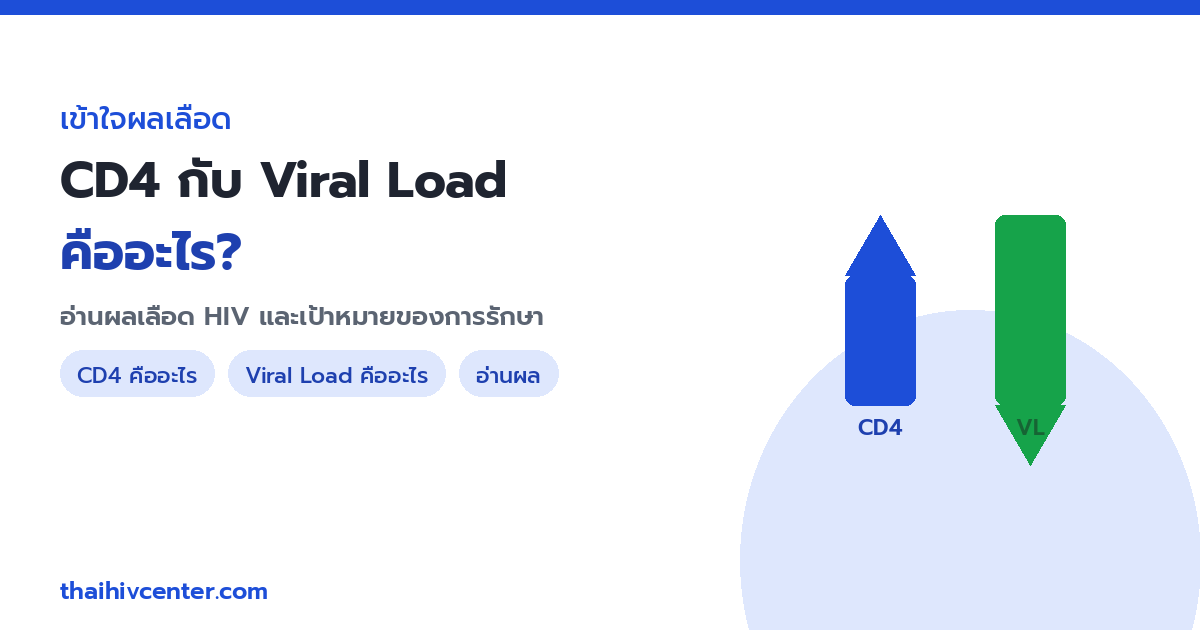
CD4 is a type of white blood cell playing an important role in the immune system, acting like a commander that helps coordinate the fight against germs in the body. The CD4 count is therefore an indicator of how strong a person's immune system is. When HIV enters the body untreated, it gradually destroys CD4 cells, reducing the count and weakening immunity. The higher the CD4, the stronger the immune system; conversely, a very low CD4 means immunity is significantly damaged and at risk of opportunistic infections. Measuring CD4 helps a doctor assess immune status and plan care. Overall, CD4 is a value where higher is better, because it reflects the strength of the body's defense system.
What is viral load
Viral load is the value showing how much HIV is in the blood, measured by the number of copies of the virus in the blood. This reflects the level of viral activity in the body. When untreated, the virus multiplies and viral load is high, but with consistent antiretroviral treatment, the medicine suppresses viral multiplication, so viral load steadily falls to an undetectable level. Unlike CD4, viral load is a value where lower is better, because it shows less virus in the body. The ultimate treatment goal is reducing viral load to undetectable, which not only shows treatment is working well but also means the person won't transmit HIV sexually — the U=U concept explained later.
How CD4 and viral load differ
Although both are measured from blood and used to track treatment, they tell different things and have different good directions.
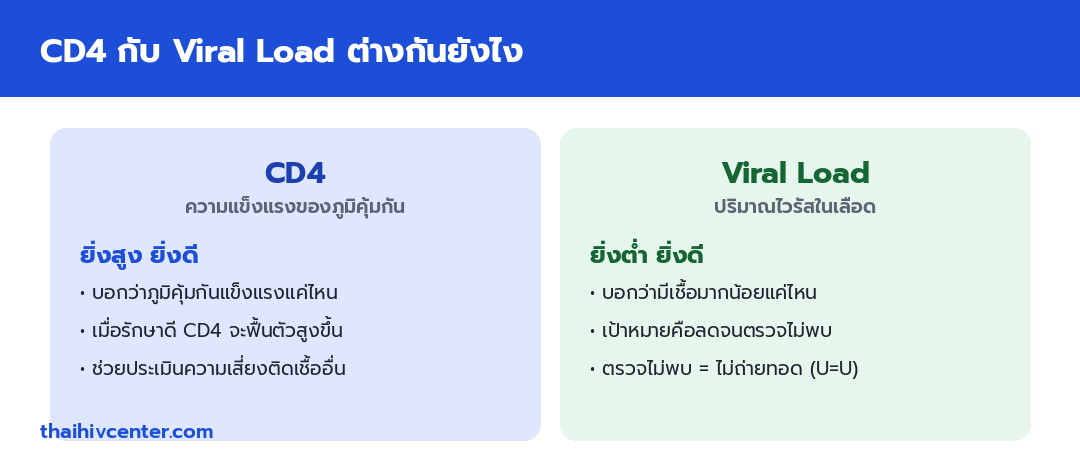
| Aspect | CD4 | Viral load |
|---|---|---|
| Measures | Immune strength | Amount of virus in blood |
| Good direction | Higher is better | Lower is better |
| Tells you | How well the body defends itself | How well treatment suppresses the virus |
| Goal | Recover and stay high | Reduce to undetectable |
Simply put, CD4 tells how strong immunity is — higher is better — while viral load tells how much virus there is — lower is better. Both work together to show the overall picture of health and treatment. When treatment works, viral load falls to undetectable and CD4 gradually recovers. Read HIV basics in what HIV is.
How to read CD4
CD4 is measured as a number of cells per volume of blood. Generally, in a healthy person with a normal immune system, CD4 is in a fairly high range. When CD4 is high, immunity is strong and can prevent infections well. When it falls low, especially very low, the body is more at risk of opportunistic infections. In those starting treatment, CD4 usually gradually rises as treatment works and the virus is suppressed. CD4 recovery may take time, and the level recovered depends on many factors, such as the starting value before treatment and consistency of taking medicine. What matters is that a trend of rising CD4 is a good sign. A doctor interprets CD4 in the context of each person's overall health; you shouldn't interpret the number alone without guidance.
How to read viral load
Viral load is measured as a number of copies of the virus in the blood. When untreated, this may be high, but with consistent antiretrovirals, it falls steadily. The goal is reducing viral load to a level so low the test can't measure it, called undetectable. Undetectable viral load doesn't mean the virus is entirely gone from the body but means the amount is so small it's well controlled — a goal showing treatment is working excellently. Maintaining undetectable viral load continuously is important, because if you stop medicine or take it inconsistently, the virus may multiply again and viral load may rise. Tracking this value consistently ensures treatment is still working.
Treatment goals
The main goals of HIV treatment can be understood through these two values.
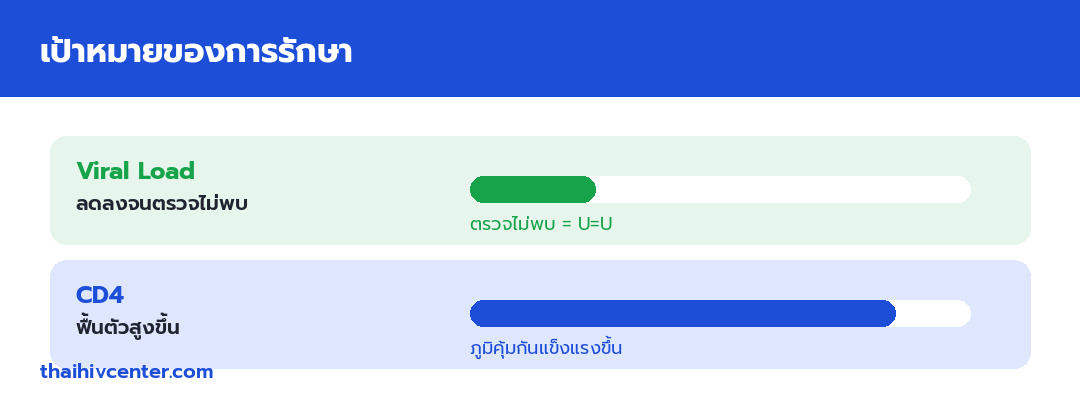
The first goal is reducing viral load to undetectable, showing antiretrovirals suppress the virus effectively and leading to the important benefit of not transmitting HIV sexually, per U=U. The second goal is CD4 recovering higher, showing the immune system is recovering and strengthening, better able to protect the body from other infections. When both goals are achieved, the person is healthy and can live normally. Successful treatment is therefore measured by undetectable viral load and good CD4, achievable through consistent medicine and ongoing care. Read more in what U=U is and life expectancy with HIV.
How often to test CD4 and viral load
How often to test CD4 and viral load depends on treatment status and a doctor's advice. Early in treatment, testing may be more frequent to track that treatment works and viral load falls as expected. Once treatment is stable and viral load is consistently undetectable, testing frequency may reduce to intervals a doctor sets. Viral load testing confirms treatment still works, while CD4 testing tracks immune recovery. A doctor sets an appropriate testing schedule for each person. What matters is attending appointments consistently, because it helps a doctor track the situation and adjust care promptly if needed. Not missing follow-up is an important part of successful treatment.
What undetectable means
On hearing that viral load is undetectable, many may wonder whether it means cured. The answer is that undetectable doesn't mean cured of infection but means the amount of virus in the blood is so small the test can't measure it, resulting from effective treatment. What's important and very good news is that when viral load is consistently undetectable, the person won't transmit HIV sexually — the principle of U=U, scientifically confirmed. However, to maintain undetectable, you must take medicine consistently; if you stop, the virus may multiply again. So undetectable is a goal to maintain through ongoing medicine and care.
If values aren't on target
Sometimes CD4 or viral load may not be as expected — such as viral load not falling or rising again, or CD4 recovering slowly. In these cases, don't panic but consult a doctor to find the cause and adjust the approach. A common cause is inconsistent medicine, the most important factor affecting these values. There may also be other factors, such as resistance or other health issues. A doctor may consider adjusting the regimen or finding ways to help take medicine more consistently. What matters is communicating honestly with your doctor about taking medicine and any symptoms, to get appropriate care. Values not on target isn't an ending but a signal to adjust care, usually fixable with correct advice.
Why track these values
Tracking CD4 and viral load consistently matters for several reasons. First, it helps a doctor and the person know whether treatment is working; if viral load falls and CD4 recovers, treatment is going well. Second, it helps detect problems early; if values aren't as expected, a doctor can adjust care promptly. Third, it helps confirm U=U status, important for confidence in life and relationships. And fourth, it helps the person participate in their own health care, because understanding these values shows progress and motivates consistent medicine. Tracking is therefore not just numbers but an important tool in long-term health care, alongside getting free ARV under coverage.
Frequently asked questions
Is high or low CD4 good
Higher CD4 is better, showing strong immunity; when treatment works, CD4 usually gradually recovers higher.
Does undetectable viral load mean cured
Not cured, but means the virus is so small it's undetectable, resulting from good treatment, and meaning no sexual transmission (U=U).
Which matters more, CD4 or viral load
Both matter and tell different things — CD4 shows immune strength, viral load shows viral suppression; a doctor uses both together.
How often should I test CD4 and viral load
It depends on treatment status and a doctor's advice; early on may be more frequent, and once stable may be less frequent as a doctor sets.
What if viral load rises again
Don't panic; consult a doctor to find the cause, usually related to inconsistent medicine, and adjust care.
Can low CD4 still improve with treatment
Yes — starting ARVs and taking them consistently helps CD4 recover in many cases; even starting from a low value, you should start treatment.
Summary
CD4 and viral load are two key values for tracking HIV treatment. CD4 shows immune strength — higher is better — while viral load shows the amount of virus in the blood — lower is better. The treatment goal is reducing viral load to undetectable, meaning treatment works well and no sexual transmission per U=U, alongside CD4 recovering higher. Tracking these values consistently helps you know treatment is working, detect problems early, and participate in your own health care. If values aren't on target, consulting a doctor helps find the cause and adjust care. To start treatment or consult, find a clinic near you.