Starting PrEP: What to Do, a Beginner's Guide
PrEP (Pre-Exposure Prophylaxis) is medicine taken before exposure to prevent HIV in advance, and one of the most effective prevention tools available today. Taken consistently, PrEP is up to about 99% effective at preventing HIV. But many people interested in starting PrEP are unsure how to prepare, what to test for first, and how to begin safely and effectively. This guide walks you through every step, from before you start, to day one, to monitoring while you use it, so you can begin PrEP with confidence.
What is PrEP, a quick recap
PrEP is for people who do not have HIV but face ongoing risk, such as having partners of unknown status, a partner with HIV, or regular condomless sex. PrEP works by keeping enough medicine in the body to stop HIV from taking hold and multiplying if exposure occurs. However, PrEP protects only against HIV, not other sexually transmitted infections.
Before starting PrEP: what to do
Before starting PrEP, some important tests keep you safe. You should not buy and take the medicine on your own without testing and a doctor's guidance.
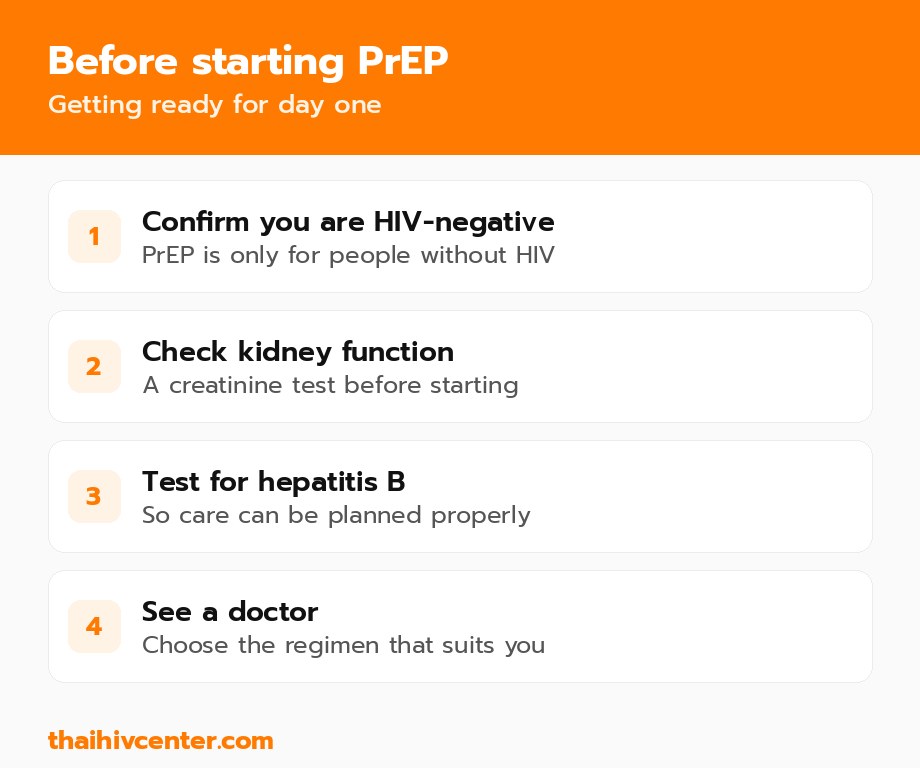
Confirm you are HIV-negative
The most important step is confirming you do not have HIV, because PrEP is designed only for people without the virus. Starting PrEP while unknowingly having HIV can lead to drug resistance. If you've never tested, read how to prepare at Preparing for your first HIV test.
Check kidney function
A doctor checks your kidney function (a creatinine test) before you start, because PrEP medicine is cleared through the kidneys. Knowing your baseline helps monitor safety throughout use.
Test for hepatitis B
Testing for hepatitis B before starting matters, because the medicine used in PrEP also affects hepatitis B. Your doctor will plan appropriate care based on the result.
See a doctor to choose the right regimen
A doctor discusses your risk and lifestyle to recommend whether daily PrEP or on-demand PrEP (for suitable groups) fits you. Choosing a regimen that fits your daily life helps you take it consistently.
Starting PrEP: day one and the first week
Once your tests are ready and your doctor approves, you can begin. It's important to understand that the medicine needs time to build up before it protects fully.
Daily PrEP
Daily PrEP means taking one pill at the same time every day. This suits people with ongoing risk and is the most widely used approach.
How long until full protection
PrEP does not protect the moment you take the first pill. Generally, protection for anal sex reaches a high level after about 7 days of consistent use, while protection for vaginal sex may take around 20 days. During this early period, use condoms as well for safety.
While using PrEP: monitoring
PrEP is not a take-and-forget medicine, it requires periodic monitoring for safety and effectiveness.
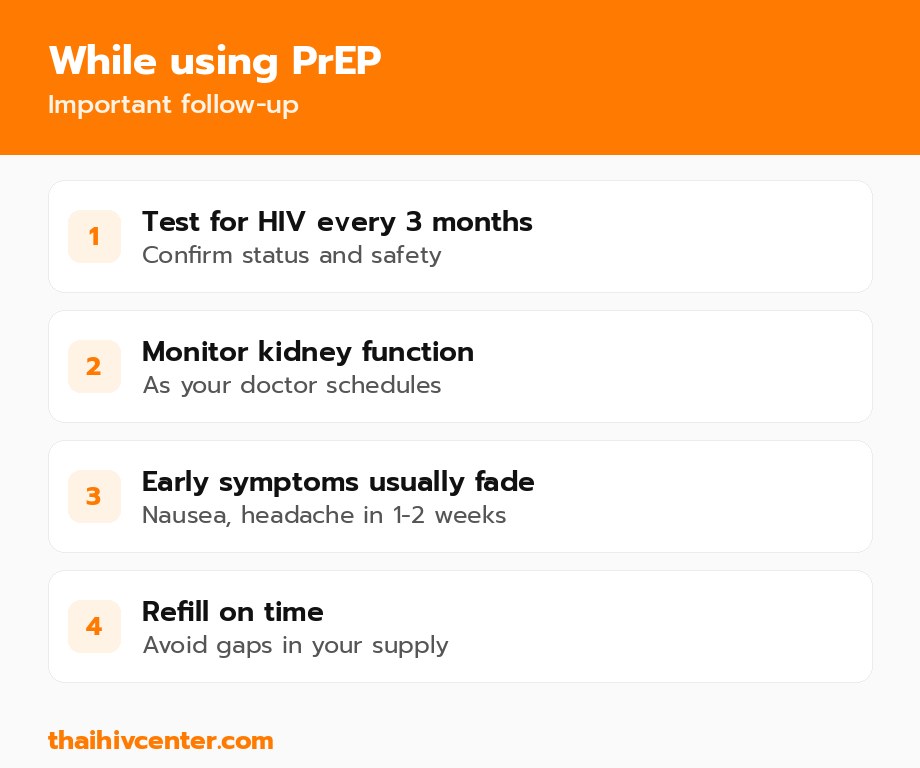
| What to monitor | How often | Why |
|---|---|---|
| HIV test | Every 3 months | Confirm you remain HIV-negative |
| Kidney function | As scheduled by your doctor | Watch for safety |
| Other STIs | Based on risk | PrEP does not cover other STIs |
Early symptoms usually fade
Some people have mild symptoms in the first 1-2 weeks, such as nausea, headache or stomach upset, which usually settle as the body adjusts. Read more at What it's like to take PrEP.
Tips to take PrEP consistently
PrEP's effectiveness depends on taking it consistently, the more regularly and on time, the better the protection.
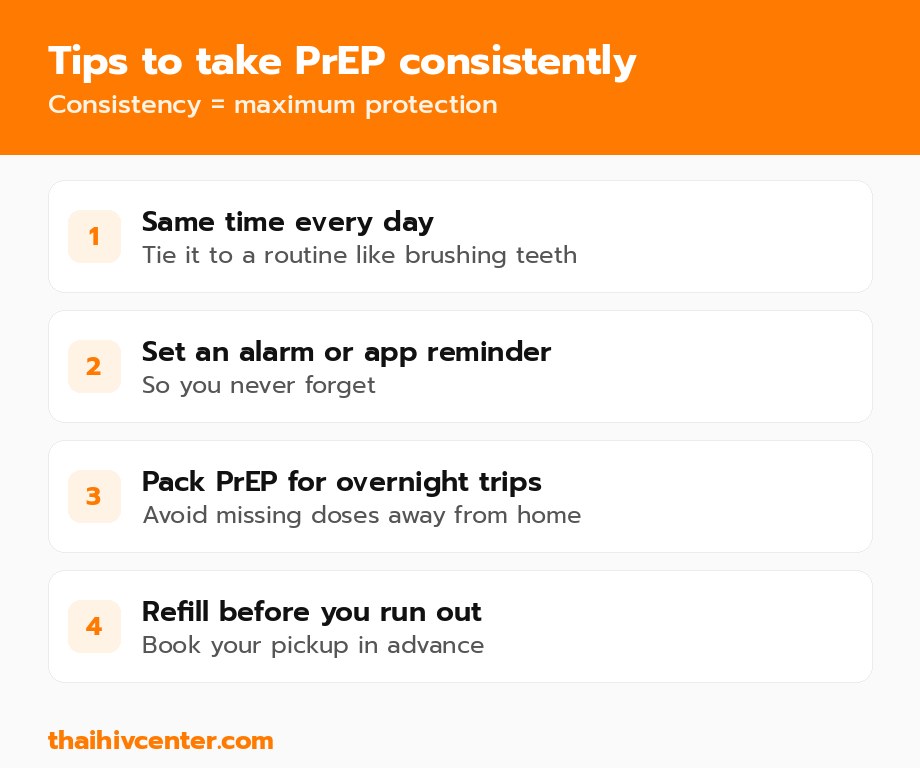
Try tying your dose to a daily routine, such as with breakfast or when brushing your teeth. Set an alarm or reminder app, pack PrEP for overnight trips, and always refill before you run out. These small habits help you never miss a dose and stay fully protected.
PrEP does not protect against everything
It's important to understand that PrEP protects only against HIV, not other STIs such as gonorrhoea, syphilis or herpes. Using condoms alongside PrEP remains the best approach for comprehensive protection. If you want an option that doesn't require daily dosing, read about on-demand PrEP (2-1-1), or see PEP emergency medication for sudden high-risk situations.
Who should consider PrEP
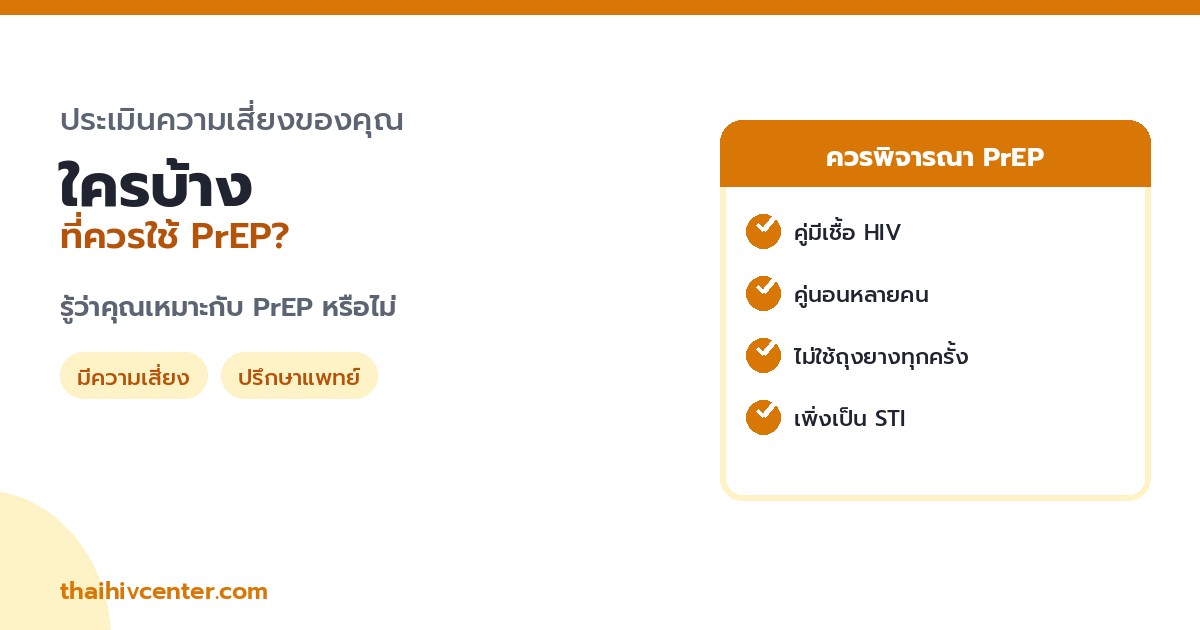
PrEP isn't necessary for everyone, but it suits people with ongoing risk of acquiring HIV, such as those with multiple partners, those whose partner has HIV and a detectable viral load, those who regularly have condomless sex, those with repeated STIs, or those who inject drugs with shared needles. Talking openly with a doctor about your lifestyle helps assess whether PrEP is right for you. Risk also changes across different life stages, so reviewing with your doctor periodically is a good idea.
PrEP and holistic sexual health
PrEP works best as part of well-rounded sexual health care, not a single tool that replaces everything else. Seeing the bigger picture keeps you safe and healthy in the long run.
Screen for other STIs alongside
Because PrEP does not protect against other STIs, periodic STI screening matters, especially if you have multiple partners. Finding and treating STIs early prevents complications and reduces onward spread, and your quarterly PrEP visits are a good opportunity to test for STIs at the same time.
Care for your mental health and communication
Using PrEP reduces worry about infection, helping many people feel more confident and relaxed in their relationships. Talking openly with a partner about prevention and testing also builds mutual trust and understanding. Good sexual health is not only physical, it includes emotional wellbeing and relationships too.
Common myths about PrEP
PrEP is still misunderstood in several ways, which sometimes makes people who would benefit hesitate to start. Let's look at the facts.
"PrEP is a drug for promiscuous people"
Not true. PrEP is a preventive health tool, like wearing a helmet or a seatbelt. Choosing to protect yourself deserves support, not judgement.
"On PrEP you don't need condoms"
PrEP protects only against HIV, not other STIs or pregnancy. Using condoms as well remains the best approach for comprehensive protection.
"PrEP is harmful to the body"
PrEP is very safe when used under medical care with scheduled monitoring. Most side effects are mild and settle on their own, while kidney or bone effects are uncommon and usually reversible.
Frequently asked questions
Once I start PrEP, do I take it forever?
Not necessarily. You can stop when your risk decreases, but consult a doctor about how to stop safely.
Where can I get PrEP in Thailand?
At hospitals, sexual health clinics, and many community organisations, some offering it free or at low cost.
Is it a problem if I miss one day?
For daily PrEP, an occasional missed dose still keeps protection at a good level, but aim to be as consistent as possible.
Does PrEP have long-term side effects?
PrEP is very safe under medical care. Kidney or bone effects are uncommon and usually mild, which is why there is periodic monitoring.
Can women and transgender people use PrEP?
Yes. PrEP can be used by anyone at risk of acquiring HIV, women, men and transgender people alike. However, the time until full protection may differ by the type of sex, and transgender people on hormones should discuss combining PrEP with hormones with their doctor, which is generally safe. A clinician will help plan what suits each individual.
How much does PrEP cost, and is it free anywhere?
In Thailand, access to PrEP has become much easier in recent years. Many hospitals and clinics within the health system provide PrEP free or at an affordable price, as do several community organisations with support programmes. Offering PrEP free is a deliberate part of public health policy aimed at reducing new infections. If you're worried about cost, ask a sexual health clinic or community organisation near you, and staff will help point you to the right option. Don't let cost stand in the way of looking after yourself.
Conclusion
Starting PrEP is a great decision for your sexual health. Just begin with tests for HIV, kidney function and hepatitis B, see a doctor to choose the right regimen, understand that the medicine needs time before full protection, and take it consistently with scheduled follow-ups. With that, you gain highly effective HIV protection. Remember, PrEP works best when combined with other prevention such as condoms, regular STI screening, and open communication with your partners. Above all, PrEP puts the power to protect your own health directly in your hands, and that is something worth taking up with confidence. If you have any questions along the way, your doctor and local sexual health services are there to support you at every step.
References
- World Health Organization (WHO) — HIV/AIDS
- CDC — PrEP
- European AIDS Clinical Society (EACS)
- International AIDS Society (IAS)
- HIV Prevention — Thai HIV Center
This article is for educational purposes and is not a medical diagnosis. Please consult a healthcare provider before starting or changing PrEP.