Preparing for Your First HIV Test: The Complete Guide
Deciding to take your first HIV test is an important step in caring for your own health. Many people feel anxious or unsure about how to prepare, where to go, or what the process involves. That uncertainty often leads people to keep putting it off, even though testing is simple, quick and confidential. This guide walks you through every step, from before you go, to the day of the test, to reading your result and what comes next, so you can test with confidence and peace of mind.
Why your first HIV test matters
HIV testing isn't only for people who feel "at risk", it is part of basic health care that everyone should do. Knowing your status has more benefits than you might think.
Testing early is better for your health
If HIV is found early and treatment begins promptly, a person with HIV can stay healthy with a life expectancy close to the general population. Starting antiretrovirals early protects the immune system from damage. Left unknown for a long time, the virus can weaken the immune system to a stage that is harder to treat.
Knowing your status protects those you love
Once you know your status, you can make sound decisions about prevention. If your result is negative, you can plan to keep it that way. If it is positive, treatment to an undetectable viral load means you won't pass HIV to a partner, the principle of U=U. Testing protects both you and those around you.
How to prepare before you go
The good news is that preparing for an HIV test requires almost nothing special, but a few things help everything go smoothly.
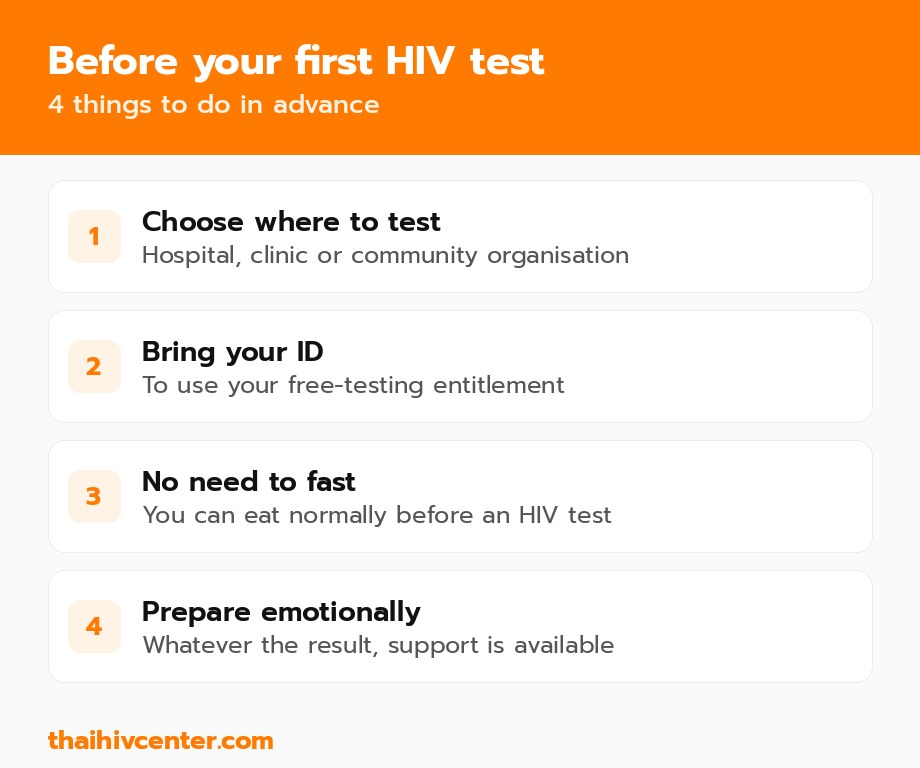
Choose a place that suits you
You can test in many places: public and private hospitals, specialist sexual health clinics, and community organisations that offer free, friendly testing. Some people feel more comfortable at community organisations because the atmosphere is less formal. Choose wherever you feel most at ease.
Bring your ID and entitlement documents
In Thailand, nationals can test for HIV free twice a year under universal coverage. Bringing your ID card makes it easy to use that entitlement. Many community organisations also test free with little paperwork.
No need to fast
Unlike some blood tests, an HIV test does not require fasting. You can eat and drink normally before you go.
Prepare emotionally
Feeling anxious before a test is natural. Remind yourself that whatever the result, support is available. A negative result brings peace of mind; a positive result is the start of treatment that lets you live normally. Bringing a friend or someone you trust can help you feel more comfortable.
Types of HIV test
There are several kinds of HIV test, each with its own strengths and detection window. Understanding the differences helps you choose what fits your situation.
| Test type | Detects from | Strength |
|---|---|---|
| Rapid test (fingertip) | ~23-90 days | Fast result, about 20 minutes |
| 4th-gen Antigen/Antibody (blood draw) | ~18-45 days | Highly accurate, common in clinics |
| NAT (viral genetic material) | ~10-33 days | Earliest detection |
| Self-test kit | ~23-90 days | Private, done at home |
If your risk was recent, ask staff about the right timing to test, because testing too early during the "window period" can give a negative result even when the virus is present. Read more at How long after a risk can you test for HIV?
What happens on the day
Many people worry the test day will be complicated or embarrassing, but the process is simple and quick.
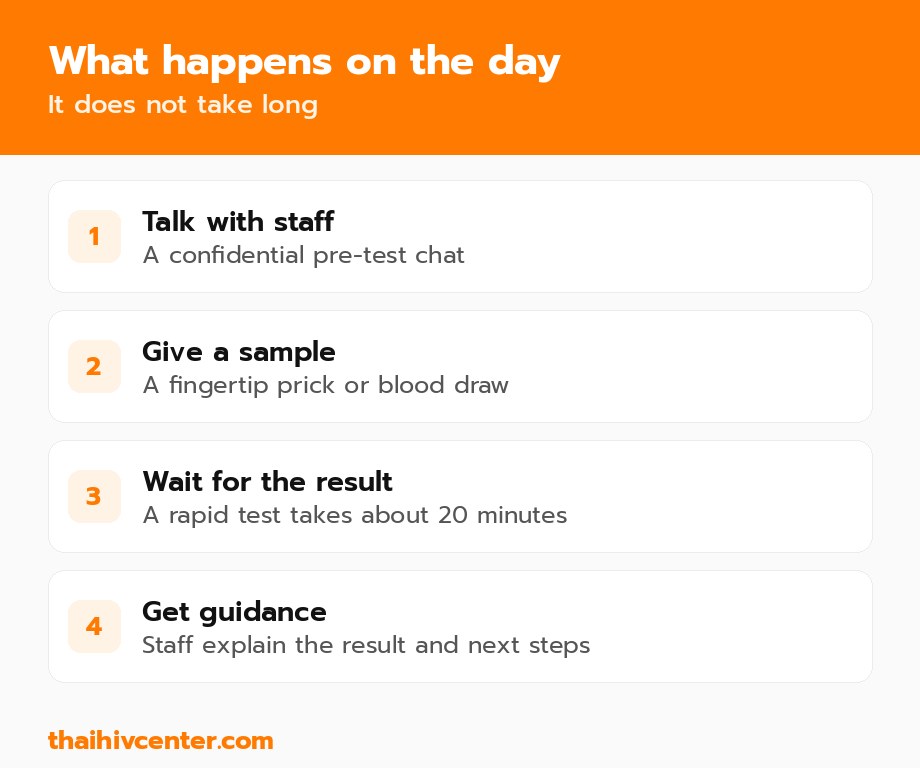
A confidential chat with staff
Before testing, staff usually have a short conversation with you to assess risk and offer advice. This is confidential, and you can ask any questions openly, without judgement.
Giving a sample and waiting for the result
Taking a sample takes only a few minutes, a fingertip prick or a blood draw depending on the test. With a rapid test, you get a preliminary result in about 20 minutes.
After the test: understanding your result
Understanding what your result means greatly reduces anxiety.
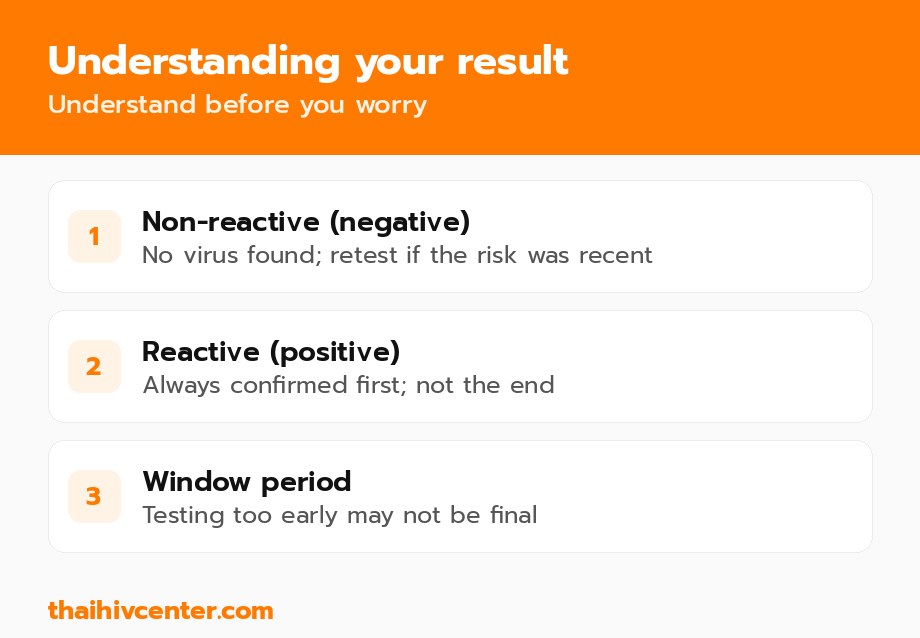
Non-reactive (negative)
A negative result means no virus was found. If you had no risk in the past three months, this is reliable. If your risk was recent, retest after the window period for certainty.
Reactive (positive)
A reactive screening result is not the final word, it must always be confirmed. And importantly, a positive result is not the end, but the start of treatment that lets you live normally. A clinician starts antiretrovirals promptly.
The window period
If you test before the window period ends, a negative result may not be final. Staff will advise when to retest.
HIV testing in Thailand: access and places
Thailand offers accessible HIV testing, much of it free. Nationals can test free twice a year at hospitals under universal coverage. There are also clinics and community organisations offering anonymous testing. You can find testing locations and book through our clinic directory, or read about free and anonymous testing in the Testing section.
Regular HIV testing: turning it into a good habit
Your first HIV test shouldn't be a one-off, but part of routine health care, like a dental check-up or a blood pressure reading. Testing regularly keeps you confident about your status and means you find out quickly if anything changes.
Test at intervals that match your risk
If you have ongoing risk, such as multiple partners or not using condoms regularly, testing every 3-6 months is a sensible approach. Those with lower risk should still test at least once a year for peace of mind. Scheduling tests in advance helps you remember and makes it an easy routine.
Invite your partner to test together
Testing together not only helps both of you know your status, but builds trust and open communication in the relationship. Many people find that testing together eases anxiety and makes them feel they aren't facing it alone.
Common worries before testing, and how to handle them
Feeling hesitant before testing is something almost everyone experiences. Understanding that these fears are natural, and that there are ways to handle them, helps you move past them.
Fear that the result will be positive
This is the most common fear, but consider another angle: knowing your result early is an advantage, not a punishment. HIV today is a treatable condition, and people who start antiretrovirals early stay healthy with a life expectancy close to the general population. Not knowing is the more dangerous option, because the virus can weaken the immune system while it goes unaddressed.
Fear that others will find out
Your HIV result is protected health information kept confidential. Facilities and testing organisations are obliged to protect it. If you're especially concerned, you can choose anonymous testing, available in many places.
Fear of pain or needles
If you fear needles, a rapid test that only pricks a fingertip hurts far less, and some kits use an oral sample. Tell staff that you're afraid of needles and they will help make the experience smoother.
Frequently asked questions
Does an HIV test take long?
No. Taking a sample takes a few minutes, and a rapid test gives a preliminary result in about 20 minutes.
Does it hurt?
Only slightly, like an ordinary blood test. Some kinds only prick a fingertip.
Is my result confidential?
Your health information is protected, and facilities keep your result confidential.
How often should I test?
It depends on personal risk. People with ongoing risk may test every 3-6 months; others should test at least once a year.
Can young people test on their own?
Young people can access testing, and many places offer youth-friendly, confidential services.
If my result is negative, is there anything else to watch for?
A negative result is good news, but prevention still matters. If you remain at risk, consider added protection such as using condoms consistently, or ask your doctor about PrEP, the pre-exposure prevention medicine, to keep your negative status. Regular testing combined with good prevention is the most complete approach.
Conclusion
Your first HIV test is not as frightening as it may seem. Just choose a place you feel comfortable with, bring your ID, skip the fasting, and prepare emotionally. The whole process is simple, quick and confidential. Most importantly, knowing your status is the first step toward good health. Whatever the result, you always have options to care for yourself, so don't let worry stand in the way of this important step.
References
- HIVinfo (NIH) — HIV Testing
- ClinicalInfo HIV (NIH)
- National HIV Curriculum (University of Washington)
- British HIV Association (BHIVA)
- HIV Testing — Thai HIV Center
This article is for educational purposes and is not a medical diagnosis. If in doubt, consult a healthcare provider or public health worker.