Does Doxy-PEP Prevent STIs? How It Differs from HIV PEP

Doxy-PEP means taking the antibiotic doxycycline after condomless sex to reduce the chance of acquiring bacterial sexually transmitted infections. The evidence is clearest for syphilis and chlamydia; results for gonorrhoea are inconsistent. And the point that matters most: Doxy-PEP offers no protection against HIV whatsoever.
The shared name causes real confusion. People hear "PEP" and assume it is the same thing as emergency HIV medication, when in fact it is a different drug, for different infections, with a different purpose. This guide separates the two clearly, covers which infections are actually addressed, who the evidence applies to, and why antimicrobial resistance is the concern that keeps this from being recommended for everyone.

What Doxy-PEP actually is
Doxy-PEP stands for Doxycycline Post-Exposure Prophylaxis: a single dose of the antibiotic doxycycline taken after condomless sex. Guidance is to take it as soon as possible, and no later than 72 hours afterwards.
The principle is that the antibiotic acts on bacteria in the period just after exposure, before they establish themselves and cause infection. This differs from treatment, which is given after infection is present and usually runs for several days.
- What it is - doxycycline, a tetracycline-class antibiotic long used for many infections
- What it targets - certain bacterial sexually transmitted infections
- When it is taken - after condomless sex, as soon as possible
- How often - a single dose per event, not a daily preventive medication
- Prescription required - not something to buy and self-administer based on your own reading
A useful way to picture it: cleaning a cut immediately rather than treating a wound that has already become infected. Acting while bacterial numbers are low gives a better chance of stopping things - but the trade-off is using antibiotics more often than before, which is the source of the entire debate around this approach.
One more distinction worth catching: Doxy-PEP is not the same as Doxy-PrEP, the concept of taking the antibiotic continuously in advance. That approach raises considerably greater resistance concerns and is not standard practice. When reading about this online, check which one you are actually looking at.
How it differs from HIV PEP
This is the point to get straight, because despite the shared abbreviation almost nothing about them is alike.
| Feature | HIV PEP | Doxy-PEP |
|---|---|---|
| What it is | A combination of antiretroviral medications | The antibiotic doxycycline |
| What it prevents | HIV | Certain bacterial infections |
| Protects against HIV | Yes | No |
| Duration | 28 continuous days | A single dose per event |
| Starting window | Within 72 hours | As soon as possible, within 72 hours |
| Urgency | Highest-level emergency | Important, but not the same kind of emergency |
| Interchangeable | Absolutely not - entirely different drug classes | |
If you have had a possible HIV exposure within 72 hours, the urgent matter is HIV PEP, not Doxy-PEP. See our PEP information page, and if exposures recur, read about moving from PEP to PrEP.
Which infections it covers
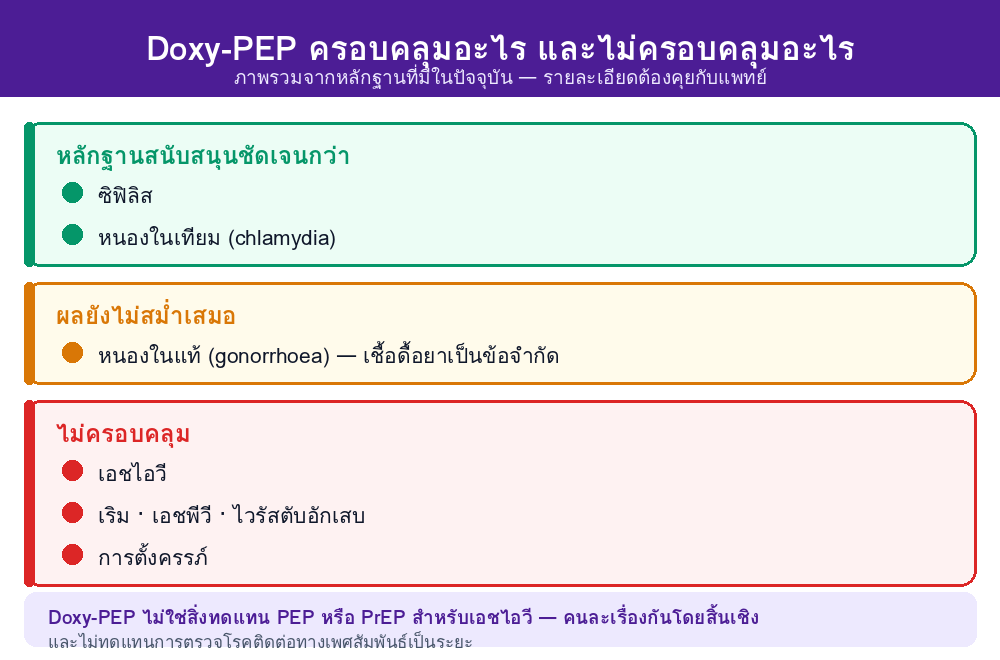
Syphilis has the strongest supporting evidence. Multiple studies found meaningful reductions in syphilis acquisition among the populations studied.
Chlamydia shows results pointing in the same direction, since these organisms respond well to tetracycline-class antibiotics.
Gonorrhoea is where findings are inconsistent. Some studies show reduction, others do not. The main reason is that gonorrhoea in many regions is already resistant to this drug class - a picture that varies considerably from country to country.
What it does not cover at all is anything viral: HIV, herpes, HPV, and hepatitis. Antibiotics have no effect on viruses. It does not prevent pregnancy either.
It is also worth being precise about language. "Reduces the chance" is not "prevents entirely." Even following guidance exactly, infection remains possible. Using Doxy-PEP is therefore not a reason to stop testing or to drop other forms of protection - it is an additional layer for people it suits.
Why the gonorrhoea picture is less clear
Gonorrhoea is notorious for adapting around antibiotics. Over recent decades it has developed resistance to one drug class after another, leaving progressively fewer treatment options.
Where local strains are already resistant to tetracyclines, Doxy-PEP will naturally do less for that infection in that setting. This explains why studies from different countries reach different conclusions, and why national guidance differs too.
This matters for readers in Thailand, because the resistance picture here need not match that of the countries where the original studies were conducted. Decisions should follow advice from a clinician who knows the local situation, rather than conclusions drawn from overseas study results.
Who the evidence actually applies to
The strongest data come from studies in men who have sex with men and in transgender women who had a recent bacterial STI - populations with high enough incidence for differences to show clearly in a trial.
By contrast, a study among cisgender women in Africa did not find a clear benefit. That may relate to adherence, to differences in how infection occurs, or to other factors still being investigated. The result means findings cannot simply be generalised to everyone.
The practical conclusion is that Doxy-PEP is not a measure recommended for everyone. It is an option a clinician may consider individually, weighing history, risk, and the local resistance picture together.
Doxy-PEP does not protect against HIV
This bears repeating, because it is the most dangerous misunderstanding. Antibiotics have no activity against viruses. No matter how quickly or how consistently it is taken, it does not reduce the chance of acquiring HIV at all.

Anyone at risk of HIV still needs a separate plan: condoms, PrEP for ongoing risk, or access to PEP within 72 hours when something happens. For more on choosing a testing method, see NAT/PCR versus antibody HIV testing.
How it is taken, and the timing
The approach used is a single dose after condomless sex, taken as soon as possible - the sooner the better - and no later than 72 hours. Dose and specifics must follow what your clinician prescribes.
There are limits on frequency. It is not a medication to repeat without restriction within a single day. If sex occurs several times close together, ask your clinician specifically what to do rather than increasing the dose yourself.
Something often overlooked: this drug class has practical requirements around how it is taken - with plenty of water, not lying down immediately afterwards, and with absorption potentially affected by certain products. Ask the pharmacist or clinician when you collect it so you get it right the first time.
Four things to weigh before using it
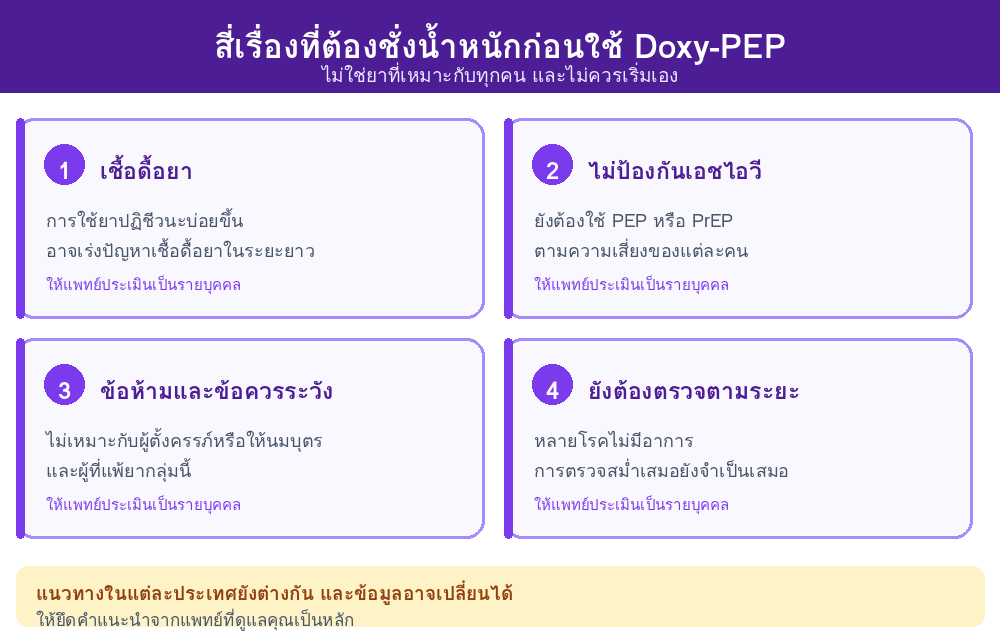
One, antimicrobial resistance - the leading concern, covered in detail below.
Two, no HIV protection - if using it produces a sense of safety that leads to dropping other precautions, the overall result can be worse than before. That behavioural risk is worth discussing openly.
Three, individual contraindications - particularly pregnancy, breastfeeding, allergy history, and other medications in use.
Four, testing still applies - reducing risk is not eliminating it, and many infections show no symptoms.
Deciding about Doxy-PEP is not simply a question of whether it works. It means weighing individual benefit against wider consequences, which is exactly why this belongs in a conversation with a clinician rather than being settled from internet reading alone.
Why resistance is the central concern
Every use of an antibiotic, whether for treatment or prevention, puts pressure on the bacteria in your body to adapt. Organisms that tolerate the drug survive and multiply. That is the basic mechanism by which resistance develops.
The concern is not limited to organisms causing STIs. It extends to unrelated bacteria elsewhere in the body - in the respiratory or digestive tract, for example - which may also become resistant, with consequences when this drug class is needed for something else later.

At a population level, antibiotics that still work are a limited resource and extremely difficult to replace. Widespread unnecessary use accelerates the loss of that resource for everyone, not just the person taking it. This is the principal reason many countries have not recommended it for general use.
In practice this does not mean "never use it." It means use it where the expected benefit is large enough to justify that cost. Someone with several bacterial STIs in a year weighs this differently from someone who has never had one, and that assessment is what a clinician provides.
What users can contribute is straightforward: take it exactly as prescribed, do not exceed the dose, do not share it, do not save it for a future occasion without advice, and attend follow-up appointments so there is data on whether the approach still suits you.
Common side effects
- Digestive symptoms such as nausea or stomach discomfort - the most frequently reported
- Sun sensitivity - skin may burn more easily than usual, which deserves particular attention in Thailand
- Oesophageal irritation if taken with too little water or if lying down immediately afterwards
- Effects on the body's bacterial balance, which can produce other symptoms in some people
- Interactions with other medications, so always tell your clinician what else you take, supplements included
Most effects are mild and resolve on their own. But anything clearly abnormal - a rash, difficulty breathing, or significant pain on swallowing - warrants seeing a clinician promptly.
The sun-sensitivity point is easy to underestimate in a country where strong sunlight is simply normal. While taking it, use sunscreen, cover up, and avoid midday sun where you can - especially if you have beach plans or outdoor activities coming up.
Who should not use it
Some groups should not take this drug class, particularly people who are pregnant or breastfeeding and anyone with a history of tetracycline allergy, along with young children, for whom specific cautions apply.
People with certain underlying conditions or on other medications may also need individual assessment - another reason clinical evaluation matters more than general information.
Do you still need regular STI testing
Yes, and arguably more than before. Doxy-PEP lowers the chance of infection but does not reduce it to zero, and many infections cause no symptoms until testing finds them.
- Early syphilis is often painless - a sore may heal on its own while the infection remains
- Chlamydia frequently has no symptoms, particularly at certain body sites
- Throat and rectal infections are missed when testing does not cover those sites
- Finding infections early makes treatment simpler and reduces onward transmission
- Regular testing also monitors whether the current approach is still appropriate
Worth asking directly: are all relevant sites being tested? Throat and rectal infections are not detected by a urine sample alone. Tell your clinician plainly what kinds of sex you have, so samples match your actual risk.
Do you still need condoms
Yes - and they remain the broadest single tool available, reducing risk across both bacterial and several viral infections at once, including HIV, which Doxy-PEP does not touch at all. They prevent pregnancy too.
The right mental model is layers of protection stacked together, not options to choose between. For more, see how well condoms protect against HIV, and our STI hub for the wider picture.
Vaccines worth asking about
Something often left out of this conversation: some infections already have vaccines - protection that requires no antibiotics and creates no resistance problem.
Worth asking your clinician about HPV and hepatitis B vaccination: whether they suit you, and whether you have completed them. For many people this is a better and more durable investment than any per-event measure.
Talking to a clinician without the awkwardness
Many people hesitate to raise this because it means discussing personal details, or because they fear being categorised. That feeling is understandable - but honest information is the only thing that lets a clinician assess accurately. Leaving things out usually leads to advice that does not fit your actual situation.
It gets easier if you prepare a short list: any previous infections and when, how often risk occurs, what protection you currently use, and what medications you take. That is enough to start, and you need not go into more detail than is relevant.
Sexual health staff have seen every situation. Their role is to find the safest path from where you are, not to judge. And if a particular service feels uncomfortable, going elsewhere is entirely your right.
Availability in Thailand
Guidance on Doxy-PEP varies internationally. Some countries have incorporated it for specific populations, others are still considering it, and recommendations continue to shift as new evidence emerges.
In Thailand, access is not yet routine in the way PEP and PrEP are. The most direct route is asking a specialist sexual health clinic or a community-based service whether it is offered and under what conditions. Find services near you through our clinic finder.
This is a fast-moving topic. What this article can offer is the underlying principles and the questions to ask; what is currently recommended in your particular context has to come from a clinician with up-to-date information.
What you should not do is buy antibiotics and self-administer based on what you have read. Beyond the risk of an incorrect dose or formulation, it skips the assessment of whether this suits you at all, with no follow-up in place.
Questions worth asking
- Given my history, is Doxy-PEP appropriate, and are there other options to consider first?
- What is the local resistance picture, particularly for gonorrhoea?
- What testing is needed before starting, and how often afterwards?
- What should I do if sex occurs several times close together? - do not guess
- Are there vaccines I should have, such as HPV or hepatitis B?
- Is my HIV prevention plan adequate? - since Doxy-PEP does not cover it
Common misconceptions
- "Doxy-PEP is a newer, better version of PEP." No - different drug, different infections, and absolutely not a substitute for HIV PEP.
- "On Doxy-PEP I do not need condoms." No - it covers no viral infections and does not prevent pregnancy.
- "It prevents every STI." No - only certain bacterial infections, and the gonorrhoea picture is unclear.
- "Buying antibiotics from a pharmacy is the same thing." No - dose, appropriateness, and follow-up all differ.
- "Using it often has no downside." No - both side effects and resistance are real considerations.
- "If other countries recommend it, Thailand should follow." Not necessarily - resistance patterns differ by region.
In summary
Doxy-PEP has a legitimate place, but it is a specialised tool rather than a shortcut that replaces everything else. The benefit is clearest for syphilis and chlamydia, among people at high risk who are under clinical care.
The single thing to remember above all: it does not protect against HIV. Anyone at risk of HIV needs a separate plan every time - condoms, PrEP, or timely access to PEP.
And the point most easily forgotten: several of the best protections require no antibiotics at all - condoms, the vaccines that already exist, and regular testing so infections are found and treated early. See the full range of options at our prevention hub.
Finally, whether you conclude that this is or is not for you, what this article should leave you with is sharper questions for your clinician rather than a ready-made answer. The right response genuinely depends on your history, your risk, and the situation where you live.
Frequently asked questions
Does Doxy-PEP protect against HIV?
No, not at all. It is an antibiotic and has no activity against viruses. If you are at risk of HIV, you need PEP or PrEP separately. Whether or not you use Doxy-PEP, an HIV prevention plan still has to be in place - no exceptions.
Can it be taken alongside PrEP?
They are different medications for different purposes, and in practice some people use both - but a clinician must assess and prescribe. Do not add medication without telling them.
Can I still take it after 72 hours?
Beyond that window the preventive benefit drops substantially. The better step is testing as your clinician advises, since treating an established infection is a different matter from preventing one.
Is frequent use harmful?
The main issues are cumulative side effects and resistance, both individually and at population level. If you find yourself needing it often, discuss your overall prevention strategy rather than simply repeating it.
Can women use it?
Evidence in cisgender women is less clear than in the main study populations, and there are important contraindications in pregnancy and breastfeeding. It requires individual clinical assessment.
Do I have to tell a partner I am using it?
There is no requirement; it is a personal decision. That said, talking about protection and testing generally makes planning together easier.
Can I buy doxycycline from a pharmacy and use it myself?
You should not. It skips assessment of whether it suits you, risks an incorrect dose or formulation, and leaves no follow-up in place - a risk both to you and to the wider resistance problem.
If I am worried about both HIV and other infections after a recent exposure, what comes first?
The urgent item is being assessed for HIV PEP within 72 hours. Bacterial infections can be discussed in the same visit. Do not let researching one question cause you to miss the deadline on the other.
References and further reading
- BASHH - British Association for Sexual Health and HIV
- IUSTI - International Union against Sexually Transmitted Infections
- NHS - Sexually transmitted infections
- ASHM - Australasian Society for HIV, Viral Hepatitis and Sexual Health Medicine
- Department of Disease Control, Ministry of Public Health (Thailand)
The content on this website is for educational purposes only. It cannot replace diagnosis, examination, treatment, or medical advice from a qualified healthcare professional. If you have had a high-risk exposure or have concerning symptoms, please see a doctor promptly.