How Effective Is PEP at Preventing HIV? How Well It Works, and How Quickly to Start
PEP, or Post-Exposure Prophylaxis, is antiretroviral medicine taken after a risk of HIV to prevent the virus from establishing. Many wonder how effective PEP is at prevention. The important answer is that PEP is highly effective at reducing the risk of HIV when started quickly and taken correctly for the full course as advised. However, PEP's effectiveness depends on key factors, especially starting as soon as possible within 72 hours after a risk — the sooner the better — and taking it for the full 28 days. Rather than fixating on a set percentage, what to understand is that PEP significantly reduces risk when used correctly but doesn't prevent 100%, so it should be used with other prevention long term. This article explains in detail how well PEP works, factors that make it effective, why you must start quickly, why you must complete 28 days, and what to do after completing it, so you understand and use PEP appropriately if needed.
How effective is PEP
PEP is highly effective at reducing the risk of HIV when used correctly, but its effectiveness depends on starting quickly and completing the course as advised.
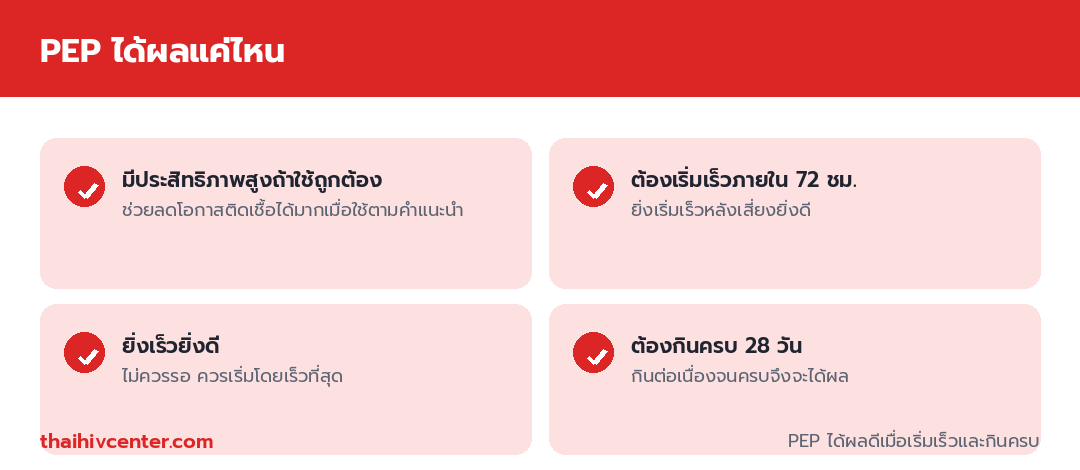
Rather than stating an exact percentage, what's more important to understand is that PEP significantly reduces the risk of HIV when used correctly — that is, started quickly within the set time frame and completed as advised. PEP's effectiveness isn't a single fixed number but depends on various factors, especially the speed of starting and consistency in completing the course. When used correctly, PEP is an effective tool for preventing infection after a risk. However, PEP doesn't prevent 100%, so it shouldn't be seen as a complete guarantee, and should be used with other prevention long term. Understanding that PEP is highly effective when used correctly but not 100% helps you use PEP appropriately and not be careless. Read more about the difference between PrEP and PEP in how PrEP and PEP differ.
Why you must start quickly
The most important factor in PEP's effectiveness is the speed of starting. PEP must be started as soon as possible after a risk, within 72 hours, and the sooner the better. The reason is that PEP works by preventing HIV from establishing and multiplying in the body after exposure. If started quickly, the medicine has a chance to inhibit the virus before it establishes, but if you wait too long, the virus may have established in the body, making PEP less effective or ineffective. For this reason, time matters greatly. If you have a risk and are considering PEP, don't wait but get counseling and start PEP as soon as possible. The 72-hour time frame is the maximum limit, but starting within a few hours after a risk is better than waiting until nearly 72 hours. Understanding why you must start quickly helps you realize the urgency of getting care if you have a risk. Importantly, if you think you may have a risk, promptly consult a facility to assess and start PEP if appropriate. Read more about a broken condom in what to do if a condom breaks.
Factors that make PEP effective
PEP's effectiveness depends on several key factors users should understand and follow.
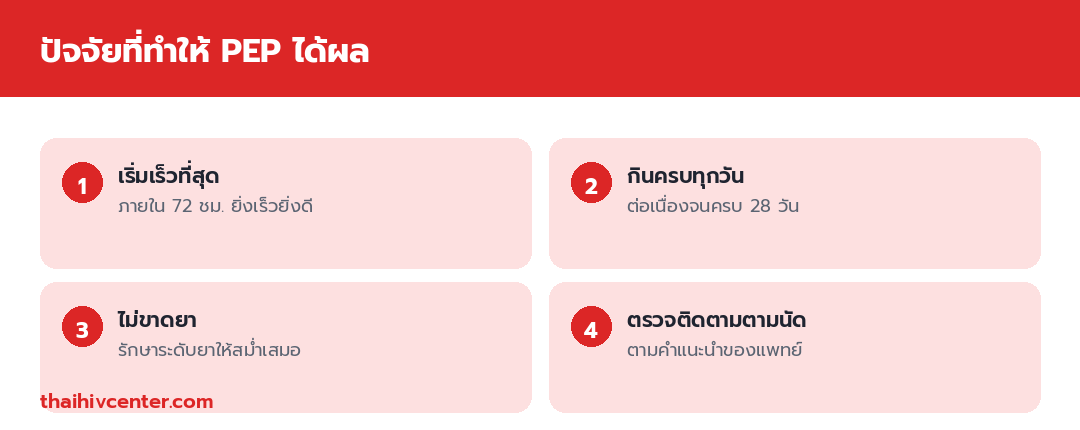
| Factor | Why it matters |
|---|---|
| Start as soon as possible | Within 72 hours, the sooner the better, before the virus establishes |
| Take it every day | Continuously until 28 days as advised |
| Don't miss doses | Keep the medicine level steady throughout the course |
| Monitor on schedule | Test for HIV and health as a doctor advises |
Factors that make PEP effective:
- Start as soon as possible — starting within 72 hours and the sooner the better is the most important factor.
- Take it every day — taking it consistently until 28 days helps the medicine work fully.
- Don't miss doses — missing doses during the course may reduce PEP's effectiveness.
- Monitor on schedule — attending appointments helps track results and care for health.
Understanding these factors helps you use PEP effectively. The most important factors are the speed of starting and consistency in completing. Following a doctor's advice in every aspect helps PEP give the best protection. Read more about taking PEP in how to take PEP.
You must complete 28 days
Besides starting quickly, completing 28 days of PEP is another key factor in effectiveness. PEP is a course of medicine that must be taken continuously every day for 28 days as advised. Completing the whole course matters because it helps the medicine work to inhibit the virus continuously throughout the necessary period. If you stop before completing or miss doses frequently, PEP may be less effective, because the medicine isn't working continuously as it should. So even if you feel well or have no symptoms, complete the medicine as a doctor advises. During PEP, if you have side effects or problems making dosing difficult, consult a doctor for help, don't stop on your own. Completing 28 days is an important part of making PEP effective. Understanding that you must complete the whole course helps users realize the importance of taking the medicine consistently until the end and not stopping midway. Viewing completing the course as an investment in effective protection helps you follow through.
When PEP is used
PEP is medicine for emergency use after a risk of HIV. Situations that may warrant considering PEP:
- After sex with a risk — such as a broken condom or no protection with someone who may have the virus.
- After contact with blood that may have the virus — such as a needlestick or blood contact.
- After another risk event — that may involve exposure to the virus.
- When within the 72-hour time frame — PEP must start within this time frame to be considered.
If you're in a situation with a possible risk, what to do is promptly consult a facility as soon as possible to assess whether PEP is appropriate. Staff assess risk and consider whether to start PEP. Understanding when PEP is used helps you know that when you have a risk, you should act promptly, because time matters. Read more about blood contact in needlestick or blood exposure and assess the time frame with the PEP calculator tool.
PEP isn't routine prevention
What's important to understand is that PEP is medicine for emergencies after a risk, not routine prevention for those with ongoing risk. PEP is designed for occasional use after an unexpected risk, such as a broken condom or an accident with exposure, not for regular use. For those with ongoing or regular HIV risk, more appropriate prevention is PrEP, medicine taken to prevent in advance continuously. This difference matters, because PEP and PrEP have different purposes and uses. PEP is used after a risk in emergencies, while PrEP is used before a risk for ongoing prevention. If you find yourself needing PEP frequently, that may be a sign you have ongoing risk and should consult a doctor about PrEP, more appropriate prevention for ongoing risk. Understanding that PEP isn't routine prevention helps you use PEP appropriately in emergencies and consider PrEP if you have ongoing risk, for prevention suiting your situation.
When effectiveness is reduced
Although PEP is highly effective when used correctly, there are factors that may reduce its effectiveness, which you should understand to avoid:
- Starting too late — starting after 72 hours may make PEP ineffective, because the virus may have established.
- Missing doses during the course — forgetting or missing doses frequently reduces PEP's effectiveness.
- Stopping before 28 days — not completing the course keeps the medicine from working continuously as it should.
- Not following advice — not following a doctor's advice may affect effectiveness.
Understanding what reduces PEP's effectiveness helps you avoid these factors and use PEP effectively. The most important things are starting quickly and completing as advised. If you have problems with dosing, such as side effects, consult a doctor instead of stopping on your own. Paying attention to following advice helps PEP give the best protection.
What to do after completing PEP
After completing the PEP course, there are steps to take to care for your health and confirm your status:
- Test for HIV as scheduled — testing for HIV at the time a doctor advises helps confirm your status after PEP use.
- Follow a doctor's advice — about monitoring and ongoing care.
- Consider future prevention — if you have ongoing risk, consult about PrEP.
- Care for overall sexual health — including using protection and periodic health checks.
Following these steps after completing PEP helps ensure your status and care for your health appropriately. Testing for HIV as scheduled matters because it helps confirm PEP worked and track your status. Understanding what to do after completing PEP helps you care for yourself thoroughly and plan future prevention appropriately.
PEP and future prevention
Using PEP addresses a risk that already occurred, but planning future prevention matters too. If you've used PEP and have ongoing HIV risk, consulting a doctor about PrEP is an option to consider, because PrEP is prevention in advance more suitable for those with ongoing risk than repeatedly using PEP. Also, using other prevention, such as condoms, helps prevent both HIV and other STIs. Planning future prevention reduces risk and the need for PEP in the future. Talking with a doctor about your risk and prevention options helps you get an approach suiting your situation. Understanding that PEP is immediate management and planning future prevention matters helps you care for sexual health thoroughly, both managing a risk that occurred and preventing long term. If you want to consult about prevention, finding a facility that offers services helps you get appropriate advice.
Misconceptions about PEP
There are several misconceptions about PEP to correct:
- "PEP prevents 100%" — false, PEP is highly effective when used correctly but not 100%; use it with other prevention.
- "You can start PEP anytime" — false, PEP must start within 72 hours and the sooner the better.
- "Taking PEP for a few days is enough" — false, PEP must be completed for 28 days as advised to work.
- "You can use PEP instead of PrEP if you have frequent risk" — false, for ongoing risk, PrEP is more appropriate; consult a doctor.
Knowing these facts helps you use PEP correctly and understand that PEP is highly effective when started quickly and completed but isn't a complete guarantee and isn't routine prevention. Correct understanding helps you use PEP appropriately and plan future prevention well.
Frequently asked questions
How effective is PEP at preventing HIV
PEP is highly effective at reducing risk when started quickly and completed, but doesn't prevent 100%, so use it with other prevention.
How quickly must I start PEP
You must start within 72 hours after a risk, and the sooner the better; don't wait, promptly consult a facility.
How many days is PEP
You must complete 28 days as advised; completing the course matters for effectiveness; don't stop before completing.
What reduces PEP's effectiveness
Starting later than 72 hours, missing doses, and stopping before 28 days all reduce effectiveness; start quickly and complete.
Can I use PEP frequently
PEP is emergency medicine, not routine prevention; if you have ongoing risk, consult a doctor about PrEP, which is more appropriate.
What do I do after completing PEP
Test for HIV as scheduled to confirm your status, follow a doctor's advice, and consider future prevention if you have ongoing risk.
Summary
PEP, or emergency antiretroviral medicine, is highly effective at reducing the risk of HIV when started quickly within 72 hours after a risk and completed for 28 days as advised, and the sooner the better. However, PEP doesn't prevent 100%, so it should be used with other prevention long term. Factors that make PEP effective are starting quickly, taking it every day, not missing doses, and monitoring on schedule. PEP is medicine for emergencies, not routine prevention; if you have ongoing risk, consult about PrEP. After completing PEP, test for HIV as scheduled to confirm your status. If you think you may have a risk, promptly consult a facility. Find a clinic near you.