PEP and PrEP: Can You Swap Them, and When Should You Switch from PEP to PrEP?
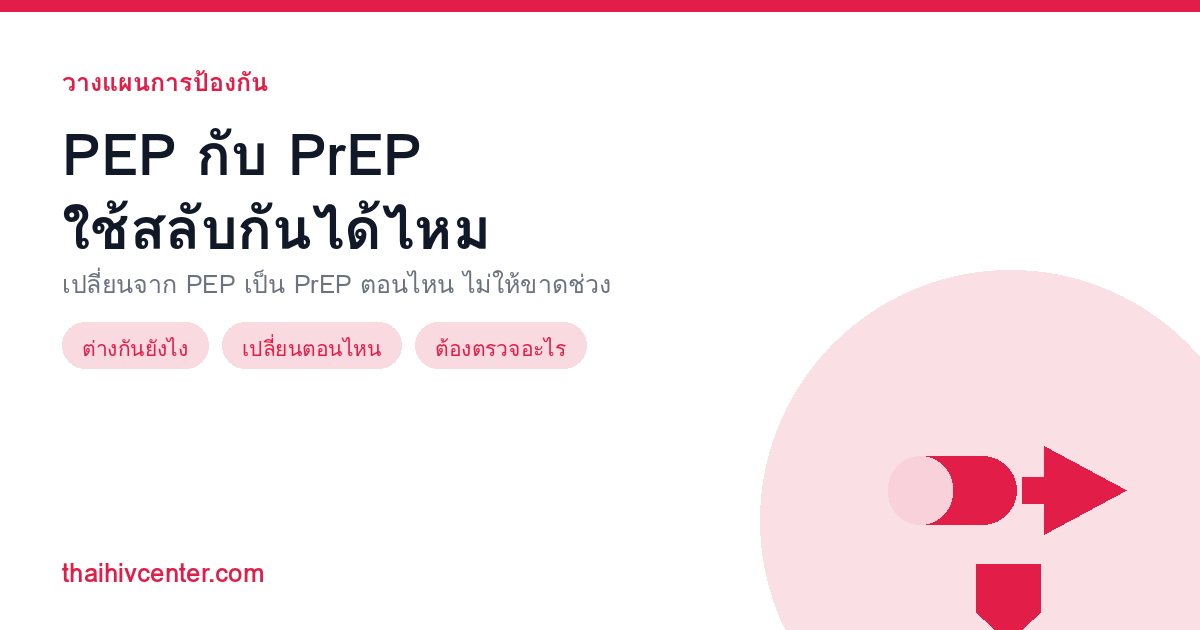
PEP and PrEP are not interchangeable, because they are designed for different moments. PEP is taken after a possible exposure and must be started within 72 hours. PrEP is taken in advance, so protection is already in place before an exposure happens. They do connect to each other, though, and moving from PEP to PrEP after finishing the course is often the most sensible next step - particularly when the underlying risk has not gone away.
A great many people take one course of PEP, complete it, test negative, and consider the matter closed - only to find themselves in the same situation again some months later. This guide explains how to move from chasing every incident after the fact to protection that is planned in advance: what testing comes first, whether there needs to be a gap between the two, and which points people most often get wrong.

What actually separates PEP from PrEP
Both are antiretroviral medications, and both protect against HIV specifically. What differs is when they are used and what they are for.
PEP stands for Post-Exposure Prophylaxis - prevention after exposure. It is an emergency measure used once a possible exposure has already happened, to stop the virus from establishing itself. It must begin within 72 hours, the sooner the better, and must be taken continuously for 28 days.
PrEP stands for Pre-Exposure Prophylaxis - prevention before exposure. It means taking medication in advance so that protective drug levels are already present when a risk arises. It is intended for people with ongoing risk, not as a one-off.
An easy way to remember it: "post" means after, "pre" means before. If something has already happened and it has been under 72 hours, PEP is the urgent question. If nothing has happened yet but you know it might, PrEP is the one to plan for.
- PEP = after exposure - an emergency response with a hard deadline you cannot miss
- PrEP = before exposure - planned in advance, without that same time pressure
- Both cover HIV only - neither protects against other STIs, and neither prevents pregnancy
- Both belong inside a care system - testing beforehand and follow-up testing are part of using them
- Both depend on adherence - effectiveness comes from taking them as prescribed, not from simply having them
Something many people do not realise is that both are usually offered at the same services. Picking up PEP is therefore the best possible moment to ask about PrEP, rather than waiting for the next incident and starting your research from scratch.
Why you cannot simply swap one for the other
Two questions come up constantly. "I have PrEP already - if something happens, can I just take extra as PEP?" And the reverse: "I have leftover PEP from a previous course - can I use it as PrEP?" The answer to both is no, for several reasons.
- The drug combinations differ - PEP regimens typically combine several medications, unlike those used for PrEP
- Dosing and duration differ - PEP is a short intensive 28-day course; PrEP is taken on an ongoing schedule
- The starting conditions differ - beginning PrEP requires confirming you do not already have HIV, and that step cannot be skipped
- Leftover medication is never enough for a different purpose, and incomplete or incorrect use can affect future treatment options
- Monitoring schedules differ - each has its own follow-up plan, and using medication with no monitoring is a risk in itself
There is also the common scenario of getting medication from a friend or from a source outside a health service. Beyond not knowing which regimen or dose you are actually taking, that route skips the confirmatory testing that underpins the whole thing. The time saved is not worth what is given up.
In short, these are two different tools built for two different situations. Substituting one for the other risks both failed protection and longer-term consequences.
PEP and PrEP side by side
| Feature | PEP | PrEP |
|---|---|---|
| When it is used | After a possible exposure | Before exposure occurs |
| Starting deadline | Within 72 hours, as early as possible | Started in advance on a planned schedule |
| Duration | 28 continuous days | Ongoing while risk continues |
| Who it suits | Someone facing an unexpected incident | Someone with ongoing or foreseeable risk |
| Testing before starting | Tested on the day; treatment is not delayed for results | Must confirm HIV-negative status first |
| Follow-up | Testing on schedule after the course ends | Regular testing throughout use |
| Covers other infections | No - HIV only | No - HIV only |
Signs it is time to discuss switching to PrEP
PEP was designed as an emergency route, not as a repeatable prevention strategy. If any of the following describes your situation, that is a signal to raise planned prevention with a clinician.
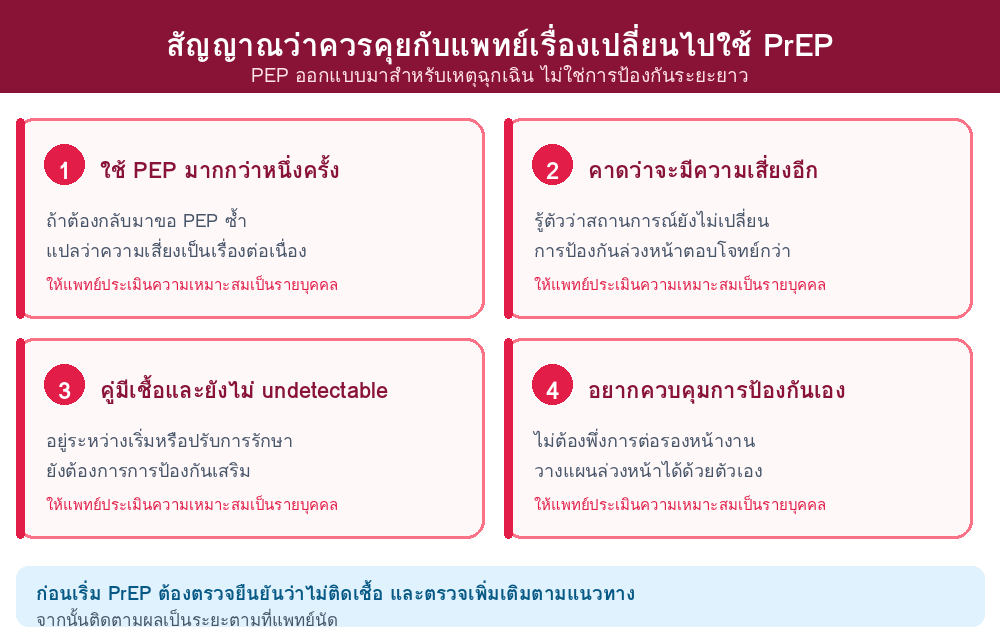
You have used PEP more than once. Coming back for a second course is a clear indication that risk is not a one-off event. Prevention in advance is a better fit, both practically and in terms of peace of mind.
You expect further risk. Whether because of the shape of a relationship, the nature of your work, or circumstances that have not changed, waiting for something to happen and then racing to find medication within 72 hours every time is a fragile plan.
A partner has HIV and is not yet undetectable. Perhaps they have recently started treatment or are adjusting regimens. Additional protection during this period reduces anxiety for both people. Once a partner is on consistent treatment and undetectable, they do not pass HIV on sexually - the principle of U=U - and this is worth discussing together with a clinician.
You want prevention within your own control. Some people are in situations where negotiating condom use is difficult. PrEP means protection no longer depends on someone else's decision in the moment.
When to make the switch, and whether a gap is needed
The guiding principle is that there should be no unprotected gap in between. If you have completed 28 days of PEP, your follow-up test confirms you do not have HIV, and risk is continuing, starting PrEP straight afterwards is what guidance supports.
What you should not do is simply stop and think about PrEP several months later. That interval is a stretch with nothing protecting you at all - and it is exactly when many people end up needing PEP again.
The reason gaps matter so much is that risk rarely arrives on the schedule we plan for. People who intend to "sort out PrEP when things settle down" often find that something happens first, and they restart the whole PEP cycle - costing more time, money, and emotional energy than simply continuing from a course that was ending anyway.
Practically speaking, the follow-up appointment after finishing PEP is the ideal moment to have this conversation. You are already in the system, your results are already in hand, and the clinician already understands your situation. Postponing usually means starting from zero.
That said, the exact timing has to be set by a clinician, based on your test results, your most recent exposure history, and your individual health factors. Do not start on your own without testing.
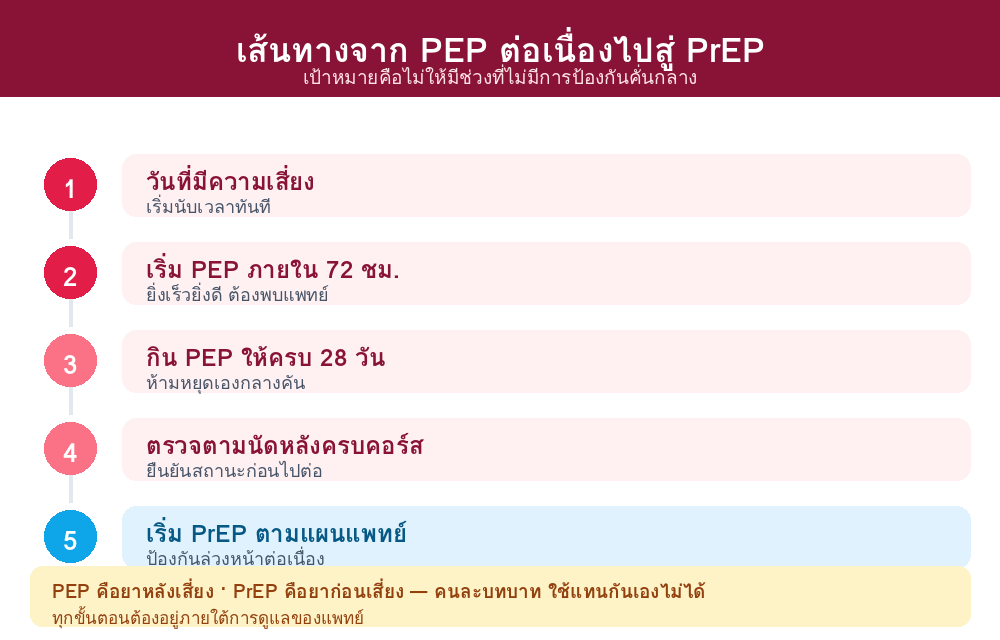
The transition step by step
- Complete all 28 days of PEP - do not stop early even if you feel fine, because an incomplete course does not give full protection
- Attend the follow-up test after the course ends, to confirm your status before moving on - this is a prerequisite for starting PrEP
- Talk openly about future risk, since this is what determines whether PrEP is appropriate for you
- Have the additional checks that guidance recommends before beginning PrEP
- Start PrEP in the regimen your clinician specifies, understanding that consistency is what makes it work
- Attend follow-up appointments throughout - this is not a case of collecting medication and disappearing
For the details of each medication, see how to complete a 28-day PEP course and how and when to take PrEP, and what to do if you miss a dose.
What testing comes before starting PrEP
The most important step is confirming that you do not already have HIV. The reason is that taking a PrEP regimen while already living with HIV means taking medication that is not a complete treatment, which can affect how well treatment works in the long run. This step has no exceptions.
There is a particular consideration for people who have just finished PEP: results during this period have to be interpreted alongside the medication history. Your clinician may choose a different testing method or a different interval than for someone else. That is another reason this belongs in a clinical setting rather than being handled with a self-test kit followed by self-started medication. For more on how methods differ, see NAT/PCR versus antibody HIV testing.
Your clinician will also assess other aspects of health according to guidance - kidney function and hepatitis B status among them - along with testing for other STIs where appropriate. These are routine checks available through normal services, not a complicated process.
It is also worth asking on the day about the follow-up schedule: when to return, what will be tested, and what to do if you cannot make an appointment. Knowing this in advance makes it easier to plan around, and reduces the chance of dropping out of care midway - which is the most common reason protection lapses.
What if you did not finish the PEP course
Tell your clinician honestly how many days you took and when you stopped. Do not leave it out, because it directly affects which test is chosen and when. An incomplete course does not deliver full protection, which changes how the situation is assessed.
Many people stay quiet because they fear being told off. In practice, staff working in this field encounter this constantly - side effects, running out, forgetting, travel problems. Their job is to find the safest path forward from where you actually are, not to pass judgement.
What if you are on PrEP and an exposure happens
If you have been taking PrEP consistently as prescribed, additional PEP is generally not needed, because protection is already in place. But if you have missed several doses, stopped for a while, or are unsure whether your adherence has been good enough, contact a clinician as soon as possible - the 72-hour window still applies.
Do not guess, and do not wait to see whether symptoms appear. A phone call or a walk-in assessment takes very little time and gives a far better answer than spending the night searching online.
It helps to have this prepared in advance: the number of the clinic supplying your medication, its online contact channel, and a backup service that opens outside normal hours. Saving these to your phone on day one means you are not looking them up while panicking.
Common misconceptions
- "On PrEP I can stop using condoms." Not advisable - PrEP covers HIV only, not other STIs, and does not prevent pregnancy.
- "PEP can be kept on hand like a painkiller." No - PEP must be started under clinical assessment and taken as a full 28-day course.
- "Switching to PrEP means admitting I am reckless." No - it is preventive health planning, like putting a helmet on before riding.
- "Once on PrEP, you are on it for life." Not necessarily - it is used while risk exists and can be stopped when circumstances change, after discussing it with a clinician.
- "They are the same drugs, so they are interchangeable." No - the regimens, dosing, and prerequisites are clearly different.
- "Starting PrEP today protects me tonight." No - protective levels build according to the regimen your clinician prescribes, so ask exactly when yours takes effect.
Side effects and longer-term monitoring
Both PEP and PrEP can cause side effects early on - nausea, headache, or fatigue among them - which often settle as the body adjusts. The right response is to tell your clinician rather than stopping on your own, since stopping midway undermines protection and may mean restarting the whole process.
Report anything clearly unusual or disruptive without waiting for your next appointment. In many cases there are adjustments that make continuing far more comfortable - changing the time of day, taking doses with food, or considering alternatives where appropriate. Staying silent and quietly stopping is the worst of the available options.

For ongoing PrEP, regular monitoring is not a formality. It covers HIV status, other aspects of health, and the chance to pick up other STIs early. Many people find the regular appointments an unexpected benefit, because it is the first time their sexual health has been looked after systematically.
PrEP does not protect against other STIs
This deserves emphasis, because it is the source of the most common misunderstanding. PrEP protects against HIV only. It does not prevent gonorrhoea, syphilis, herpes, HPV, or other sexually transmitted infections.
- Many STIs have no symptoms, so periodic testing is the only way they are found
- Several are curable when caught early, which makes regular testing clearly worthwhile
- Condoms still reduce risk across multiple infections and prevent pregnancy as well
- Vaccines exist for some infections, such as HPV and hepatitis B - ask whether they are appropriate for you
- Being on PrEP is not a reason to stop testing - if anything, the PrEP schedule makes regular testing easier
For more on condoms specifically, see how well condoms protect against HIV.
Access and cost in Thailand
Both PEP and PrEP are available through public hospitals, specialist clinics, and a number of community-based services. Some groups can access them under existing entitlements, so costs vary considerably by provider and by individual circumstances.
This article does not quote figures that could quickly go out of date. Ask services directly. Useful questions: is PrEP available here, what testing is required first, which costs apply, how often is follow-up needed, and who should be contacted in an emergency outside opening hours. You can find services near you through our clinic finder.
Worth planning in advance: what you would do if something happened outside working hours or while travelling, since the 72-hour PEP window does not wait for office days. Knowing which services open late, or which helpline to call, makes decisions much faster in the moment - and is one more reason having PrEP already in place removes a great deal of pressure.
For anyone concerned about privacy, community-based services are often easier to approach. Staff are used to discussing this without judgement, and referral systems exist where needed.
Looking after yourself during the transition
The period just after a risky incident, while taking PEP, is often intensely stressful. Some people feel guilt, some blame themselves, some feel unable to tell anyone. These reactions are common and say nothing about your worth as a person.
What helps is shifting from "I made a mistake" to "how do I handle this systematically?" Having a clear plan - knowing the test date, the start date, and the next appointment - reduces anxiety far more effectively than turning it over repeatedly in your head.
If stress is clearly affecting sleep, eating, or work, asking to speak with a counsellor at the clinic is a reasonable step. Many services have counsellors trained specifically for this, and a single conversation often helps more than people expect.
In summary
PEP and PrEP are not substitutes for one another. They are two stages of looking after yourself that connect naturally: PEP deals with what has already happened, PrEP plans for what might happen next.

If you have just finished a course of PEP, the question worth asking is not "am I in the clear?" but "how will I handle this next time?" Raising it at your follow-up appointment takes a few minutes and can change how you look after yourself for the rest of the year.
And if you are reading this on behalf of someone else who is going through it, the most useful thing you can offer is not medical advice - it is helping them reach a service quickly, and making it clear this can be talked about without judgement.
Was the exposure within the last 72 hours? The urgent priority is being assessed for PEP right away - see our PEP information page. If risk is something that recurs, start with what to do before starting PrEP, or see the full picture at our prevention hub. If you are unsure about testing intervals, see the HIV window period explained.
Frequently asked questions
Can I start PrEP immediately after finishing PEP?
Generally yes, if your follow-up test confirms you do not have HIV and risk is continuing - guidance supports continuing without a gap. The exact timing must be set by your clinician based on your results. If possible, raise it on the day you start PEP, so it can be planned in advance rather than decided in a hurry.
Can leftover PEP be used as PrEP?
No. The regimens, dosing, and method of use differ, and starting PrEP always requires confirmatory testing first.
Do I have to tell a partner I am taking PrEP?
There is no requirement - it is a personal decision. Some people find it makes conversations about protection easier; others choose not to for reasons of privacy or safety. Either is a legitimate choice and neither affects how well the medication works.
How should I protect myself while waiting to start PrEP?
Use condoms and avoid higher-risk situations during that period. If an exposure does occur while waiting, contact a clinician within 72 hours to be assessed for PEP again.
Is using PEP repeatedly dangerous?
The main issue is not danger so much as fit: it is not the right tool for ongoing risk, given the 72-hour deadline that is easy to miss and the burden of a 28-day course each time. PrEP is usually the better long-term option.
Does PrEP protect immediately?
No. Protective levels build according to the regimen prescribed, so ask your clinician specifically when yours takes effect and use other protection until then.
Can I stop PrEP if the risk is over?
Yes, but discuss it with your clinician first, since there are details about how to stop and what follow-up is needed. Do not simply stop abruptly on your own.
My partner is on treatment and undetectable - do I still need PrEP?
A partner on consistent treatment who is undetectable does not pass HIV on sexually - this is U=U. It is worth discussing together with a clinician, taking any other sources of risk into account. Remember too that undetectable does not mean cured; treatment must continue.
References and further reading
- WHO - HIV and AIDS
- aidsmap - Pre-exposure prophylaxis
- UNAIDS
- Terrence Higgins Trust - HIV and sexual health
- Institute of HIV Research and Innovation (IHRI)
The content on this website is for educational purposes only. It cannot replace diagnosis, examination, treatment, or medical advice from a qualified healthcare professional. If you have had a high-risk exposure or have concerning symptoms, please see a doctor promptly.