Can One Time of Unprotected Sex Give You HIV? What Are the Odds Per Act?
One of the most common and worrying questions is can one time of unprotected sex give you HIV. The short answer is yes, it can. Although the per-act odds are statistically not very high, they are not zero, and in some situations the risk rises significantly. Misunderstanding this can lead to carelessness or, conversely, excessive worry. This article explains in detail what the per-act odds are, why the numbers aren't fixed, what raises or lowers the risk of a single act, and what to do if you recently had a risk, so you understand the risk realistically and care for yourself appropriately.
Can a single act transmit HIV
The answer is yes. HIV transmission doesn't require multiple exposures, because the virus can transmit from even a single act if conditions allow. Many mistakenly think you must have sex with an infected person many times to get it, which is not true. Although the per-act odds may look statistically low, because it is a matter of probability, a single risk can still cause infection — like how a low-probability event can still happen the first time. So don't be careless thinking "just once is fine." Conversely, a single risk doesn't mean you're definitely infected. The only way to know your status is to test. Read more in how HIV is transmitted.
What are the odds per act
Medically, there are estimates of HIV transmission risk per single exposure, which are statistical averages from studies, not numbers that predict an individual's case precisely. Generally, the odds per single exposure are not very high as a percentage per act, but the key point is that these are averages in general situations. The real risk of each act depends on many factors, such as the route of sex, the viral level of the infected partner, and whether there are sores or other STIs. So fixating on a percentage alone can be misleading. What matters more is understanding which factors raise or lower the risk.
Risk per act by route
The route of sex is an important factor affecting per-act risk.
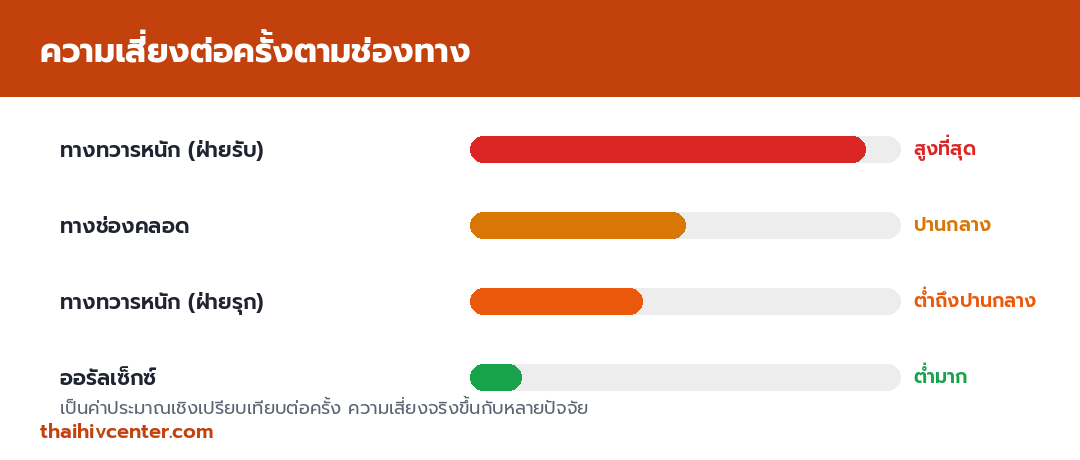
| Route | Per-act risk level |
|---|---|
| Anal (receptive) | Highest, because the lining is thin and tears easily |
| Vaginal | Moderate |
| Anal (insertive) | Low to moderate |
| Oral sex | Very low, but not zero |
Anal sex, especially receptive, has the highest risk, because the lining there is thin and small injuries occur easily, letting the virus enter more easily. Oral sex has very low but still not zero risk. These are comparative figures for illustration, not a guarantee that lower-risk routes are always safe. Read more in can oral sex transmit HIV.
Why the numbers aren't fixed
The reason we can't precisely say what percentage a single act carries for each person is that the real risk is the sum of many factors that differ per situation. Average numbers from studies are a big-picture view of large populations, but in a specific case, factors like the infected partner's viral level can make the risk differ several-fold. If the infected partner takes ARVs and is undetectable, the risk of sexual transmission is effectively none (U=U). Conversely, with a high viral level and sores present, the risk is much higher. For this reason, asking "what percentage" has no single answer for everyone. What you can do is assess the risk factors of that situation.
What raises the risk of a single act
Several factors raise the risk of a single exposure.
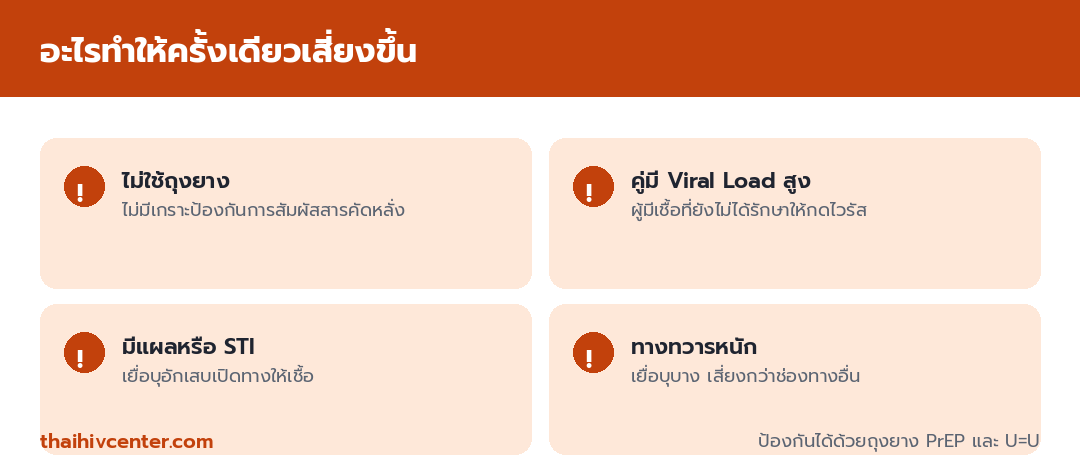
The first is not using a condom, which means no barrier against direct fluid contact. The second is the infected partner having a high viral load, usually the case when untreated or newly infected. The third is having sores or other STIs, such as herpes or syphilis, which inflame the lining and make it easier for the virus to enter. And the fourth is anal sex, where the lining is thin and injures easily. When these factors combine, the risk of a single exposure can rise significantly. Understanding these factors helps you assess your own situation better.
What reduces the risk
Conversely, there are factors and methods that greatly reduce the risk. Using condoms correctly is an effective prevention method that also protects against other STIs. Using PrEP for people with ongoing risk greatly reduces the chance of infection when taken consistently. And the U=U concept — that an infected person taking ARVs to undetectable doesn't transmit HIV sexually — is powerful prevention. If an infected partner is treated to undetectable, the transmission risk is effectively none. Combining these methods as appropriate makes sex much safer, even in risky situations.
Even once deserves attention
Although the per-act odds may look statistically low, thinking "just once is fine" is a risky attitude, because infection is a matter of probability that can happen even the first time, and the consequence of infection matters for long-term health. Conversely, paying attention doesn't mean excessive panic but assessing risk realistically, using appropriate protection, and testing when you have a risk. Having a balanced attitude — not careless but not overly anxious — is the best approach to caring for your sexual health.
What to do after a single risk
If you recently had a single risk and are worried, there is a clear order of steps. First, if the risk was within 72 hours, promptly go to a clinic or hospital to consult about emergency PEP, because it can still prevent infection — the sooner the better. Second, if more than 72 hours have passed, PEP may not work, so plan to test for HIV at the appropriate time. Third, while waiting to test, avoid additional risks and use protection if you have sex. Acting promptly in this order helps you handle the situation best. You can find a clinic near you to get care.
When to test for HIV
After a risk, choosing an appropriate testing time is important, because testing too early during the window period can give a false negative. Generally, NAT can detect earliest, around 10 days after exposure; 4th-gen is usually accurate at about 1 month; and the result is conclusive at 3 months. If you test early and it is negative, a doctor may recommend retesting to confirm. Understanding this helps you not panic over early results and plan testing appropriately. Read more in the HIV window period and how many days after a risk to test.
Common misconceptions
There are several misconceptions about a single risk. The first is "you can't get it from just once," which is false, because infection can happen even once. The second is "if the other person looks healthy, it's safe," which is false, because many infected people have no symptoms and look normal. The third is "pulling out first is safe," which doesn't prevent HIV, because the virus is in fluids contactable before ejaculation. And the fourth is "washing after sex makes it safe," which doesn't prevent infection. Knowing these facts helps you decide to care for yourself correctly and not fall into carelessness from false beliefs.
Managing worry after a single risk
It's normal to feel worried after a risk, especially before knowing the result. What helps is taking the steps you should — such as consulting about PEP if in time and planning to test on schedule. Having a clear plan reduces feeling stuck. Avoid repeatedly searching symptoms online, because early symptoms are non-specific and usually increase worry unnecessarily. If worry disrupts daily life a lot, talking to a health professional or seeking counseling at a clinic is a good option. Caring for your mental health alongside correct action helps you get through this period better.
Frequently asked questions
What percentage is the risk from a single act
There is no single number for everyone. The per-act odds depend on the route, the partner's viral level, and any sores or STIs. Assessing risk factors matters more than a number.
Just once but I pulled out first — is it safe
Not safe from HIV, because the virus is in fluids contactable before ejaculation. Pulling out is not an HIV prevention method.
My partner looks healthy — does that mean no HIV
No, many infected people have no symptoms and look healthy. Appearance can't tell status.
I had a single risk yesterday — what should I do
If within 72 hours, promptly consult about PEP, because it can still prevent infection — the sooner the better.
Testing 3 days after the risk — will I know
Too early to conclude; test at the appropriate time, with a conclusive result at 3 months.
If my partner is undetectable on ARVs, is there still risk
If the partner is undetectable (U=U), the risk of sexual transmission is effectively none, which is evidence-based prevention.
Summary
A single act of unprotected sex can transmit HIV, even though the per-act odds are statistically not very high and vary by many factors. There is no single percentage for everyone, because risk depends on the route, the partner's viral level, and any sores or STIs. Factors that raise risk include not using condoms and having sores, while condoms, PrEP, and U=U greatly reduce it. If you recently had a risk within 72 hours, promptly consult about PEP, and in any case test for HIV on schedule. To consult or test, find a clinic near you.