Condom Broke or Slipped? What to Do and How to Get Emergency PEP Within 72 Hours
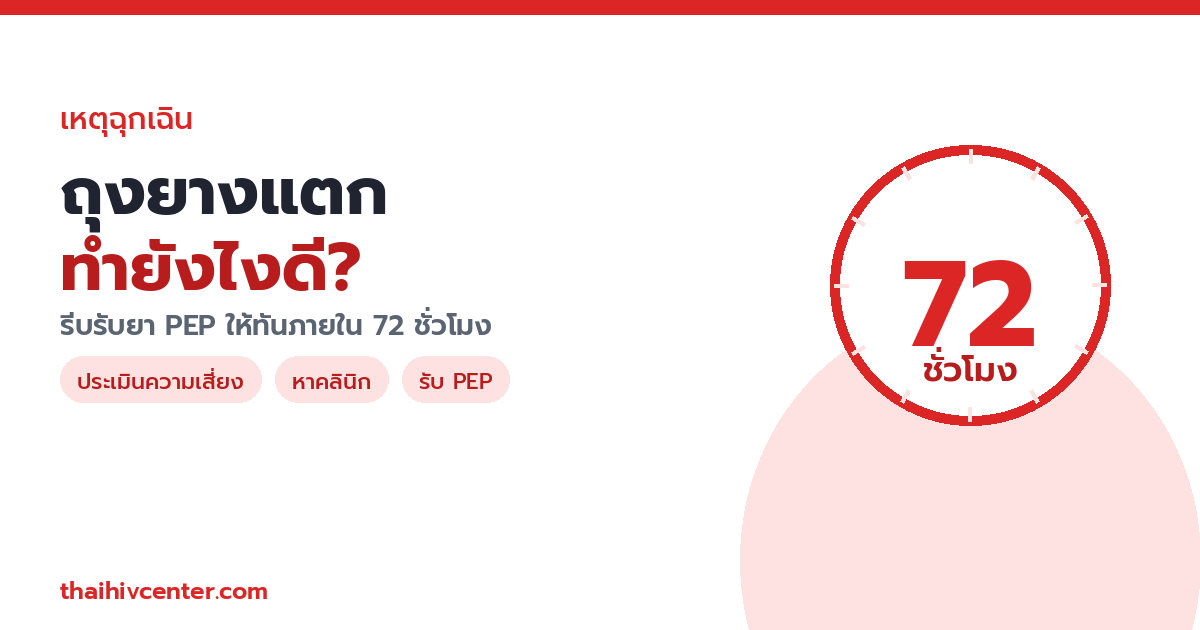
A broken condom or a condom slipping off during sex is common and can be alarming. Many people immediately worry about HIV. The good news is that PEP (emergency post-exposure antiretrovirals) can effectively reduce the chance of infection if started early enough — but it must begin within 72 hours of the risk. This article covers what to do right away, where to get PEP, and how to care for yourself afterward, so you can respond correctly without panicking.
How risky is a broken condom for HIV
The risk from a broken condom depends on several factors: the partner's HIV status, how much fluid was exchanged, and the type of sex. If your partner has untreated HIV, the risk is higher; but if they take antiretrovirals and are undetectable (U=U), there is effectively no transmission risk. If you don't know your partner's status, treat it as a risk to be safe and quickly consider PEP. Receptive anal sex carries the highest risk, followed by vaginal sex, while oral sex is very low risk.
The most accurate risk assessment is done by a clinician. So rather than worrying alone, going promptly to get assessed and receive PEP if needed is the best choice.
4 steps to take immediately when a condom breaks
When you realize a condom has broken or slipped, don't panic — follow these steps calmly.
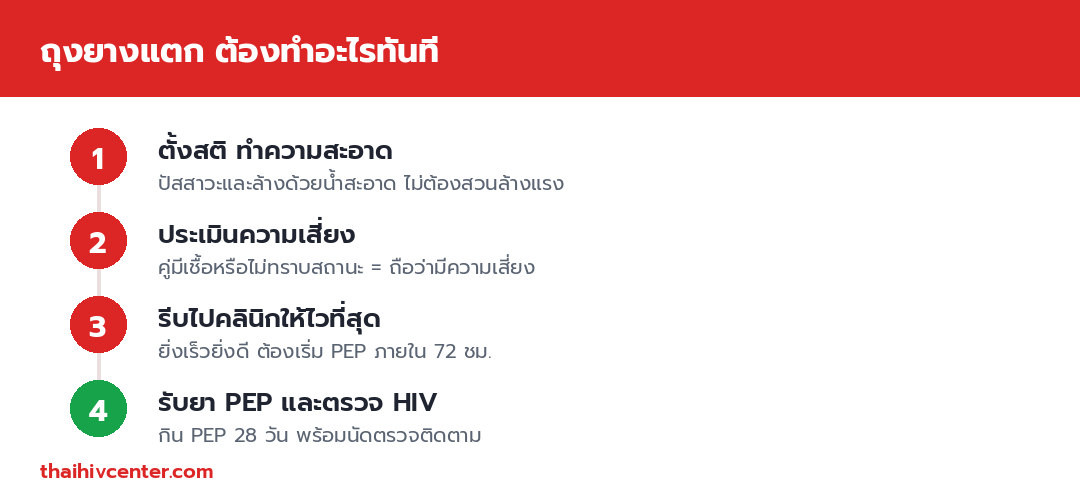
1. Stay calm and clean up — withdraw and wash the genitals with water or mild soap. Women can urinate to help flush, but do not douche the vagina or rectum forcefully, as this can cause abrasions and increase risk instead.
2. Assess the risk — consider whether your partner has HIV or is of unknown status. If unsure, treat it as a risk and proceed to the next step.
3. Get to a clinic or hospital as fast as possible — this is the most important step, because PEP must start within 72 hours, and the sooner the better. Don't wait until the deadline.
4. Receive PEP and a baseline HIV test — the clinician assesses your risk, tests for HIV to confirm you are not infected, and prescribes a 28-day course of PEP with follow-up.
What is PEP and why the urgency
PEP stands for Post-Exposure Prophylaxis — taking HIV antiretrovirals after a risk to stop any virus that entered the body from establishing a permanent infection. It must be taken daily for 28 days. The urgency exists because HIV takes an early window to spread from the exposure site into the bloodstream and lymph system. Starting the medicine quickly in this window gives it a high chance of stopping the virus, but after 72 hours the virus has spread and PEP is no longer useful.
To check whether you are still within the 72-hour window, try our test date and PEP time calculator for a quick estimate.
How many hours to start PEP
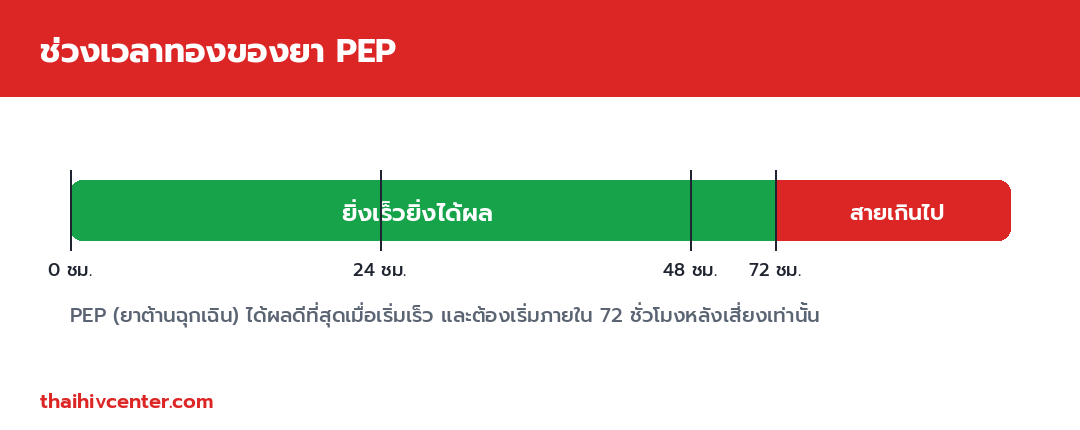
The PEP timeframe matters a lot. The table below makes it simple.
| Time after risk | Effect of starting PEP |
|---|---|
| Within 24 hours | Best — start as soon as possible |
| 24–48 hours | Still effective — get to a clinic soon |
| 48–72 hours | Can still start, but effectiveness drops near 72h |
| Over 72 hours | Too late — PEP not recommended; focus on testing instead |
Time is the most important factor. Don't delay or wait for symptoms, because early HIV usually has none. Getting PEP promptly is the right proactive step.
Where to get PEP
PEP is available at public hospitals (especially emergency departments or STI clinics), specialized HIV clinics, and many community clinics. At night or on holidays, a hospital emergency room is always accessible. For speed, call ahead to confirm the site has PEP ready, and bring your ID card. You can find the clinic closest to you to arrive in time, or see the full clinic list by province.
During and after taking PEP
Once you have PEP, take it on time every day for the full 28 days. Missing doses or stopping early greatly reduces effectiveness. Some people have mild side effects such as nausea, headache, or fatigue, which are usually mild and improve as the body adjusts. If symptoms are bothersome, consult a clinician rather than stopping on your own. Also use protection during sex while on PEP and avoid additional risks.
When to test for HIV after finishing PEP
After completing 28 days of PEP, your clinician will schedule repeat HIV testing to confirm the result — usually after stopping the medicine and again for certainty. Because PEP can shift the detection window, following your clinician's testing schedule is important. Read more about the HIV window period and how many days after a risk to test.
Preventing a repeat
After this experience, many people look for more reliable long-term protection. If you have ongoing risk or frequent sex, using PrEP — medicine taken before exposure to prevent HIV — greatly reduces worry. Unlike PEP, PrEP is taken in advance, not after a risk. Learning to put on a condom correctly, choosing the right size, and storing it properly also reduces breakage.
Do's and don'ts
| Do | Don't |
|---|---|
| Get to a clinic within 72 hours | Wait for symptoms first |
| Clean gently with water | Douche forcefully and cause abrasions |
| Finish all 28 days of PEP | Stop when you feel better |
| Test for HIV as scheduled | Assume no symptoms means safe |
Frequently asked questions
The condom broke but there was no ejaculation — is there risk
There can still be risk, because pre-ejaculate may contain virus. If unsure, consult a clinic to assess.
Does PEP cost money
Costs vary by location; some have coverage or support programs — ask the clinic directly. Importantly, don't let cost cause a delay past 72 hours.
It's already past 72 hours — what can I do
Although PEP is not recommended past 72 hours, you should test for HIV as scheduled, and if you have ongoing risk, consider PrEP for the future.
Can I have sex while taking PEP
Use protection every time and avoid additional risks, since PEP only covers the past event, not new risks.
Summary
A broken condom is not something to panic over. The most important thing is to get PEP within 72 hours — the sooner the better. Clean gently, assess the risk, then go to a clinic for the medicine and an HIV test, complete the full course, and follow up as scheduled. If you have frequent risk, PrEP is a great preventive option. Don't wait — find a clinic near you and act now.