PrEP vs Condoms — Which Should You Use? How They Differ, and Should You Use Both?
When it comes to HIV prevention, two methods often compared are PrEP and condoms. Many wonder which to use, how they differ, and whether to use both. The short answer is that both methods have different strengths and limitations, and in many cases using both gives the most comprehensive protection. PrEP is a medicine taken to prevent HIV in advance, while a condom is a physical barrier preventing HIV, other STIs, and pregnancy. This article explains in detail the differences between PrEP and condoms, each one's pros and cons, who should use what, and why using both is the approach giving the best protection, so you can choose a prevention method suiting your situation and needs with understanding.
How PrEP and condoms differ
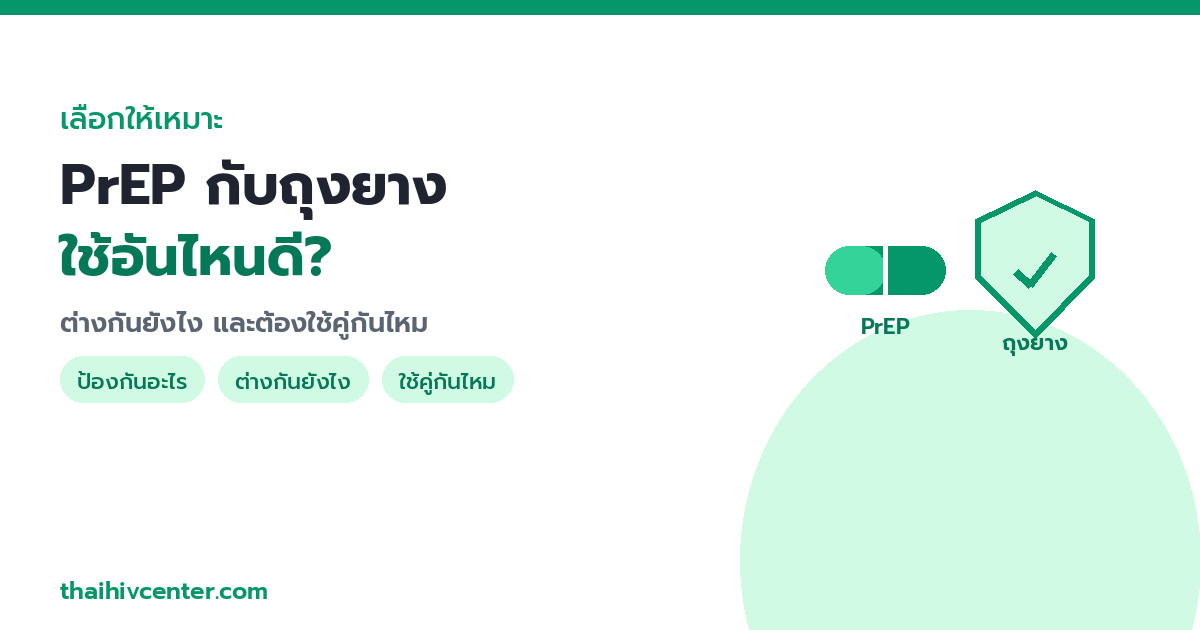
PrEP and condoms work differently and cover different protection.
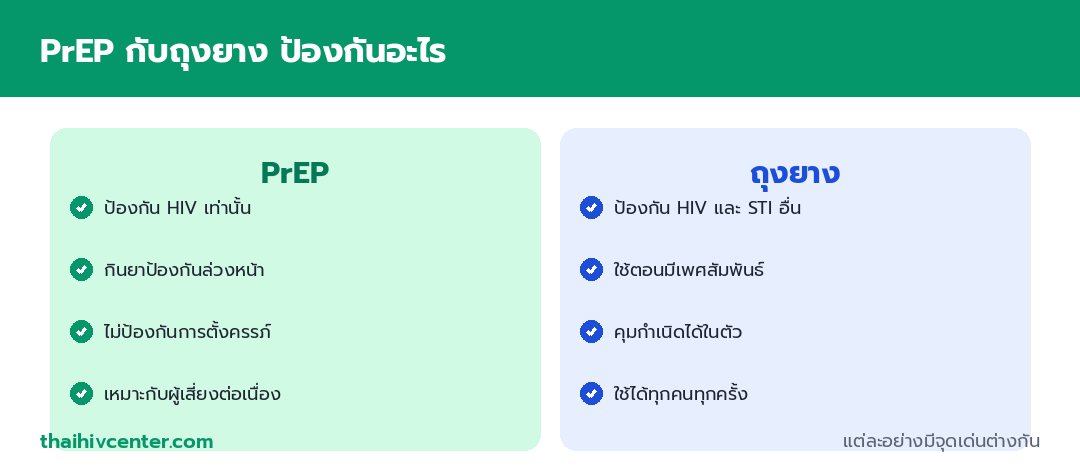
| Aspect | PrEP | Condoms |
|---|---|---|
| How to use | Take medicine in advance | Use during sex |
| Prevents HIV | Yes | Yes |
| Prevents other STIs | No | Yes |
| Prevents pregnancy | No | Yes |
| Suits | People with ongoing risk | Everyone, every time you have sex |
From the table, the most important difference is that PrEP prevents HIV only, while condoms prevent more broadly — HIV, other STIs, and pregnancy. Also, the way of use differs, with PrEP taken in advance consistently and condoms used only during sex. Read more basics in what PrEP is and how effective condoms are at preventing HIV.
What is PrEP and what does it prevent
PrEP, or Pre-Exposure Prophylaxis, is taking antiretroviral medicine to prevent HIV infection in advance, for those who aren't infected but have a risk. Key points about PrEP:
- Prevents HIV specifically — taken consistently, the medicine builds up to a level that effectively prevents HIV infection.
- Must be taken consistently — consistency is the key to effectiveness; inconsistent dosing reduces protection.
- Doesn't prevent other conditions — PrEP doesn't prevent other STIs or pregnancy.
- Requires monitoring — PrEP users must test for HIV and have health checks periodically per a doctor's advice.
PrEP is therefore a highly effective tool for preventing HIV, especially for those with ongoing risk, but because it prevents HIV only, using it with other methods helps make protection more comprehensive. Read about taking PrEP in how to take PrEP effectively.
What do condoms prevent
Condoms are a physical barrier with the benefit of preventing several things at once:
- Prevent HIV — greatly reduce the risk of HIV infection when used correctly and every time.
- Prevent other STIs — such as gonorrhea, syphilis, and chlamydia, an important advantage over PrEP.
- Contraception — prevent unplanned pregnancy.
- Usable immediately every time — no need to prepare in advance like taking medicine.
This ability to prevent several things at once makes condoms a valuable tool, worth continuing to use even with other HIV prevention methods, because those don't prevent other conditions or pregnancy. Read more in how HIV is transmitted.
Benefits of PrEP
PrEP has benefits making it an attractive option for those with ongoing risk:
- Prevents HIV even if a condom fails — if a condom breaks or slips, PrEP still helps protect.
- In the user's control — taking PrEP is something the user manages, not dependent on negotiation during sex.
- Suits ongoing risk — for those with regular risk, PrEP gives continuous protection.
- Adds confidence — helps reduce worry about getting HIV for those with a risk.
These benefits make PrEP an important HIV prevention tool, especially when used with other methods. However, PrEP must be taken consistently and comes with monitoring, so it suits those ready to manage this.
Benefits of condoms
Condoms also have unique benefits PrEP doesn't:
- Broad protection — prevent HIV, other STIs, and pregnancy at once.
- Easy and accessible — easy to find, inexpensive, and usable immediately.
- No continuous medicine — used only during sex, no daily preparation.
- No regular monitoring — unlike PrEP which needs periodic health checks.
The most important benefit of condoms is broader protection, covering other STIs PrEP doesn't prevent, making condoms an important part of thorough sexual health care.
Limitations of each
Both PrEP and condoms have limitations to understand, to use appropriately.
Limitations of PrEP:
- Prevents HIV only, not other STIs or pregnancy
- Must be taken consistently to work; missing doses reduces protection
- Requires periodic HIV testing and health checks
- Takes time to build up in the body before it protects
Limitations of condoms:
- May break or slip if used incorrectly
- Must be used every time and correctly to protect well
- Effectiveness depends on consistent use
Understanding these limitations helps you see why using both complements each other's weaknesses.
Why use both
Although PrEP and condoms both prevent HIV, using both gives the most comprehensive and safe protection.
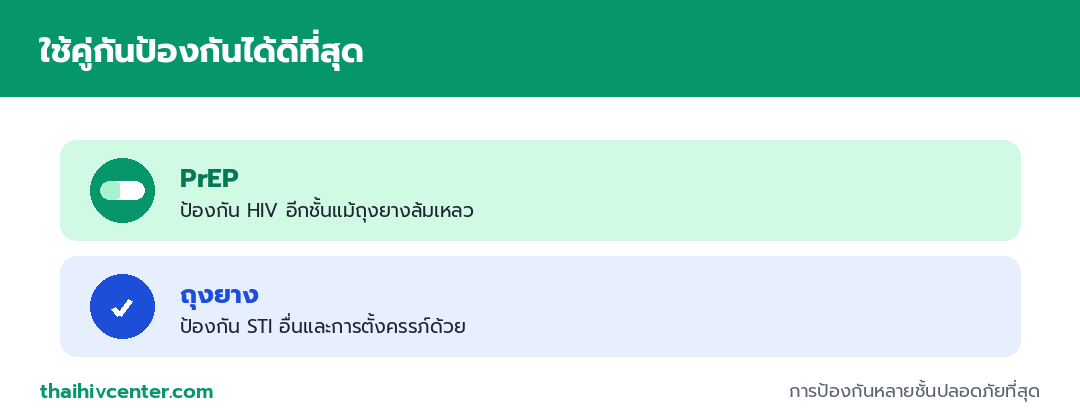
Reasons using both is the best approach:
- Layered HIV protection — if a condom breaks or slips, PrEP still protects against HIV, and if you miss PrEP occasionally, condoms still help.
- Protection against other STIs — PrEP doesn't prevent other STIs, but condoms do, so using condoms too closes this gap.
- Pregnancy prevention — condoms provide contraception, which PrEP doesn't.
- More overall confidence — having layered protection reduces worry and adds safety.
Viewing prevention as a system with several layers, not relying on one method, provides maximum safety. For those with a risk, using PrEP with condoms is therefore the most comprehensive option.
Who should use PrEP
PrEP suits those with ongoing HIV risk. Examples of those who may benefit from PrEP:
- Those with a partner who has HIV, especially if the partner isn't virally controlled yet
- Those with multiple partners or ongoing risk
- Those who can't use condoms consistently
- Those with a risk who want additional protection
Deciding to use PrEP should be done with a doctor, who assesses risk and suitability and advises on monitoring. Understanding who should use PrEP helps those with a risk consider this option appropriately. Read about the difference between PrEP and PEP in how PrEP and PEP differ.
When condoms matter especially
Even while using PrEP, condoms matter especially in several situations:
- When you want to prevent other STIs — because PrEP doesn't prevent other STIs.
- When you want contraception — to prevent unplanned pregnancy.
- Early on starting PrEP — when the medicine hasn't built up to a protective level.
- If you take PrEP inconsistently — condoms add protection when the medicine level may be insufficient.
Understanding that condoms still matter even while using PrEP helps you see why using both is comprehensive. Condoms aren't replaced by PrEP, but the two complement each other well.
PrEP doesn't prevent other STIs
An important point to emphasize is that PrEP prevents HIV only, not other STIs, a common misconception. Other STIs PrEP doesn't prevent include gonorrhea, syphilis, chlamydia, and others. For this reason, PrEP users still have a risk of these if they don't use other protection. Using condoms with PrEP helps reduce the risk of other STIs. Also, PrEP users usually have periodic sexual health checks, helping detect and treat other STIs early. Understanding that PrEP doesn't prevent other STIs helps users realize the importance of using condoms too and having regular sexual health checks, to care for sexual health thoroughly, not just HIV prevention alone.
How to choose what suits you
Choosing an appropriate prevention method depends on each person's situation and needs. Considerations:
- If you have ongoing risk — using PrEP with condoms gives the most comprehensive protection.
- If you want to prevent other STIs and pregnancy too — condoms are necessary.
- If you can't use condoms consistently — PrEP adds HIV protection.
- If unsure — consulting a doctor helps assess risk and recommend an approach suiting you.
There's no single answer suiting everyone. Choosing should consider risk, convenience, and the need to prevent other conditions and pregnancy. Consulting a doctor or staff helps you get advice most matching your situation.
Common misconceptions
There are several misconceptions about PrEP and condoms to correct:
- "Using PrEP means no need for condoms" — false, because PrEP doesn't prevent other STIs and pregnancy.
- "Condoms already prevent everything, no need for PrEP" — condoms protect well, but if they break or slip, PrEP protects against HIV as another layer.
- "PrEP and condoms are interchangeable" — no, because they don't protect the same way, and complement each other better than being used interchangeably.
- "Using both is too much" — using both isn't too much but gives the most comprehensive protection.
Knowing these facts helps you decide about prevention correctly and understand that PrEP and condoms aren't an either-or choice but can be used together for the best protection.
Frequently asked questions
PrEP or condoms — which is better
Both have different strengths; PrEP prevents HIV in advance, condoms prevent more broadly; using both gives the most comprehensive protection.
Do I still need condoms if I use PrEP
You should, because PrEP doesn't prevent other STIs and pregnancy; condoms close this gap.
Does PrEP prevent other STIs
No, PrEP prevents HIV only; other STIs need condoms and periodic health checks.
If I use condoms every time, do I need PrEP
It depends on risk; using condoms correctly every time protects well, but PrEP adds HIV protection for those with ongoing risk.
Are PrEP and condoms interchangeable
Don't view them as interchangeable, because they don't protect the same; using both complements their strengths better.
Who should consider using PrEP
Those with ongoing risk, such as a partner with HIV, multiple partners, or inconsistent condom use, should consult a doctor.
Summary
PrEP and condoms are HIV prevention methods with different strengths. PrEP is a medicine taken in advance that prevents HIV only and must be taken consistently, while condoms prevent more broadly — HIV, other STIs, and pregnancy. Each has pros and cons, and using both complements their strengths, giving layered HIV protection along with protection against other conditions and pregnancy, the most comprehensive approach. Choosing a prevention method should consider each person's risk and needs, and consulting a doctor helps you get appropriate advice. To consult about prevention or start PrEP, find a clinic near you.