How Effective Are Condoms at Preventing HIV? Is There Still Risk, and Why They Sometimes Fail
Condoms are one of the most widely used methods to prevent HIV and other STIs. A common question is how effective are condoms at preventing HIV, and whether there's still a chance of risk after using them. The answer is that condoms are highly effective at preventing HIV when used correctly and consistently, but they don't prevent 100%, because there are factors that can cause failure — such as incorrect use, breaking or slipping, or not using them every time. Correct understanding helps you use condoms effectively and know when to use additional protection. This article explains in detail how effective condoms are, how they work, why there's sometimes still risk, how to use them correctly, and combination prevention for maximum safety.
How effective are condoms at preventing HIV
Condoms are highly effective at reducing the risk of HIV infection when used correctly and every time you have sex. Studies agree that consistent condom use significantly reduces the risk of infection. However, real-world effectiveness is usually lower than theoretical effectiveness, because in real life people may use them incorrectly or not every time. The difference between perfect use and typical use is therefore important — condoms used correctly every time protect much better than inconsistent use. So instead of fixating on a percentage alone, what matters more is correct and consistent use, the factor that most determines real effectiveness.
Why not 100 percent
Although condoms are highly effective, they can't guarantee 100 percent protection. The main reasons are real-world usage factors. Condoms may break or slip during sex, possibly from an ill-fitting size, not using appropriate lubricant, or poor storage. Also, people may use condoms incorrectly, such as putting them on late after contact has begun or removing them before finishing. Not using them every time is also a key factor, because even with frequent use, if there are times without one, there is still risk. These factors make real-world effectiveness less than 100 percent. However, understanding these factors helps us reduce risk from mistakes, and correct condom use remains a very valuable prevention method.
What condoms help prevent
Condoms have benefits covering more than just HIV prevention.
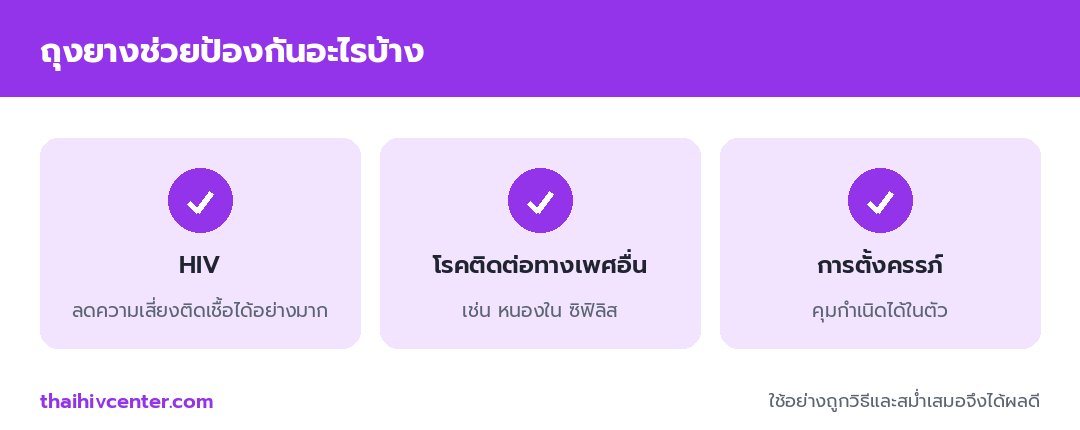
First, condoms greatly reduce the risk of HIV infection when used correctly. Second, they also help prevent other STIs such as gonorrhea, syphilis, and chlamydia, an important advantage over some methods that prevent HIV only. And third, condoms also serve as contraception, preventing unplanned pregnancy. This ability to prevent several things at once makes condoms a valuable tool worth continuing to use, even with other HIV prevention methods like PrEP or U=U, because those prevent HIV only, not other conditions or pregnancy. Read more in how HIV is transmitted.
How condoms work
The principle of condoms is being a physical barrier between contact with both parties' fluids. Because HIV transmits through fluids like semen, vaginal fluids, and blood, having a barrier that prevents these fluids from contacting the other's mucous membranes or sores reduces the risk of infection. A condom made of appropriate material and used correctly creates an effective barrier throughout sex. However, this barrier works only when the condom is in good condition, put on correctly, and used from start to finish. If any point of the barrier fails, such as breaking or slipping, protection drops. Understanding this principle shows why correct use matters for effectiveness.
Why there's sometimes still risk
Even using condoms, there's sometimes still risk, usually from usage factors.

| Possible cause of failure | How to reduce risk |
|---|---|
| Incorrect use | Put on the right way and squeeze out air at the tip |
| Breaking or slipping | Choose a fitting size and use appropriate lubricant |
| Not using throughout | Put on from the start and use until finished |
| Expired or poorly stored | Check the expiry and store away from heat |
Most reasons condoms fail come from usage, not the condom itself. So paying attention to usage details greatly improves effectiveness. If a condom breaks or slips during sex with someone who may have HIV, promptly consider consulting about PEP. Read more in what to do when a condom breaks.
How to put on a condom correctly
Putting on a condom correctly is key to effectiveness. Check the expiry and the packet's condition before use. Open the packet carefully without sharp objects or teeth that could tear the condom. Put the condom on before any contact, not near finishing. Put it on the right way and squeeze the tip to expel air before rolling it down, because trapped air can cause breakage. During sex, check periodically that the condom is still in the right position, and after finishing, hold the base while withdrawing to prevent slipping and spilling. Using a new condom every time and not reusing is also important. Following these steps helps condoms work at full effectiveness.
Why lubricant matters
Lubricant plays an important role in reducing the chance of a condom breaking or slipping. Too much friction without enough lubricant can tear a condom. However, choosing the type of lubricant matters too. Water- or silicone-based lubricants are suitable with condoms, while oil-based ones, such as lotions or certain oils, can degrade latex condoms and make them break more easily, so they shouldn't be used together. Using appropriate lubricant in sufficient amount improves safety and reduces the risk of breaking or slipping, especially in anal sex with more friction. Choosing the right lubricant is therefore part of using condoms effectively.
What to do if a condom breaks or slips
If a condom breaks or slips during sex, the first thing is to stop and assess the situation. If there's a risk of HIV infection, especially if the other person has HIV or is of unknown status, consider PEP, an emergency medicine that must start within 72 hours of the risk — the sooner the better. Promptly going to a clinic or hospital to be assessed and get PEP if needed is what you should do — don't wait for symptoms. Also plan to test for HIV at the appropriate time to confirm your status later. Having a plan for condom failure helps you manage the situation appropriately and reduce worry. Read more in what to do when a condom breaks. You can find a clinic near you.
Condoms and combination prevention
Condoms are a good prevention tool, but the most effective HIV prevention usually comes from combining methods. Using condoms with PrEP for people with ongoing risk adds another layer, because if a condom fails, PrEP still helps prevent infection. Also, the U=U concept — that an infected person taking medicine to undetectable doesn't transmit HIV sexually — is another layer of protection in relationships where the infected partner is treated. Combining these methods as appropriate for each person makes sex much safer. Viewing prevention as a system with several layers, not relying on one method, provides maximum safety. Read about per-act risk in can a single act transmit HIV.
Misconceptions about condoms
There are several misconceptions about condoms to correct. The first is "wearing two condoms is safer," which is false, because friction between two condoms can make them break more easily; use only one. The second is "condoms reduce sensation so much you shouldn't use them," which is a matter of choosing the right size and type, plus using lubricant. The third is "putting one on near finishing is enough," which isn't safe, because fluids can be contacted before ejaculation. And the fourth is "an old condom stored in a wallet still works," which may be degraded from heat and friction. Knowing these facts helps you use condoms more correctly and safely.
How to choose and store condoms
Choosing and storing condoms appropriately affects effectiveness. Choose standard condoms of a fitting size, because too small or too large can break or slip easily. Always check the expiry before use, and don't use expired condoms. Storage also matters — store condoms in a dry, cool place away from sunlight and heat. Don't store them where it's very hot or has a lot of friction, such as a wallet or a hot car for long periods, because the material may degrade. Also open the packet carefully so the condom doesn't tear. Attention to choosing and storing helps condoms stay in good condition and work effectively when needed.
Frequently asked questions
How effective are condoms at preventing HIV
Highly effective when used correctly and every time, but not 100%, because they can break, slip, or be used inconsistently. Correct use is the most important factor.
Do I still need PrEP if I use condoms
Not necessary for everyone, but combining them adds a layer for people with ongoing risk; consult a doctor.
Is wearing two condoms safer
No, friction between two can make them break more easily; use only one with appropriate lubricant.
What do I do if a condom breaks during sex
If there's a risk, consider PEP within 72 hours and go to a clinic promptly, and plan to test for HIV as scheduled.
What lubricant do I use with condoms
Use water- or silicone-based; avoid oil-based, which can degrade latex and cause breakage.
Can I store condoms in a wallet
Not advisable, because heat and friction may degrade them; store in a dry, cool place and check the expiry.
Summary
Condoms are highly effective HIV prevention when used correctly and consistently, but not 100%, because they can break, slip, or be used incorrectly. Condoms also have the benefit of preventing other STIs and pregnancy. Reasons for remaining risk usually come from usage, so pay attention to putting them on correctly, choosing a fitting size, using appropriate lubricant, and storing them well. If a condom fails, consider PEP promptly. Using condoms with PrEP or U=U adds several layers of protection. To consult about prevention or test, find a clinic near you.