Is a Negative HIV Test at 1 Month Accurate? Do You Need to Retest at 3 Months?
One of the most common questions after a risk is is a negative HIV test at 1 month accurate, and whether you need to retest at 3 months. This matters because it relates to both result accuracy and managing worry while waiting. The answer depends on many factors, especially the type of test and time since the risk. Generally, testing with a 4th-generation test at 1 month gives a fairly reliable result for many people, but medical standards still recommend confirming at 3 months for maximum certainty. This article explains in detail what the window period is, how accuracy changes over time, how different tests differ, and what to do when a 1-month test is negative, so you can understand and plan testing appropriately.
Is a negative HIV test at 1 month accurate
The short answer is that a result at 1 month with a 4th-generation test is fairly reliable for many people but not yet considered 100 percent conclusive. The 4th-generation test, which detects both antigen and antibody, can detect infection in most people within about a month, making a negative at 1 month reliable to a degree. However, each person's body responds to the virus at slightly different times, so it's possible some may not yet detect at 1 month. For this reason, medical standards recommend confirming at 3 months, the time a negative is considered conclusive. Understanding that a 1-month result is reliable but not the final answer helps you plan appropriately and not panic too much.
What is the window period
The window period is the time after HIV enters the body until testing can detect it. During this time, the body hasn't produced enough antibodies or has an insufficient viral level to detect by testing, so a negative may occur despite infection — a false negative. The window period is a key reason why choosing a testing time matters. Testing too early during the window period may make a negative unreliable. The window period differs by test type, with some tests detecting earlier than others. Understanding the window period helps you know when to test and how to interpret, and why retesting is needed in some cases. Read more in the HIV window period.
Accuracy over time
HIV test accuracy increases with time since the risk.
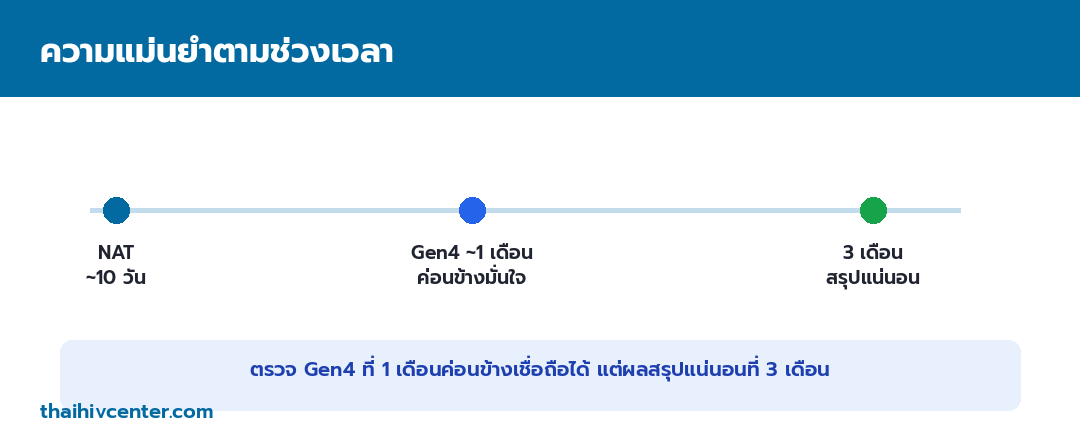
Early after infection, testing may not yet detect the virus, but as time passes, the ability to detect increases. NAT, which detects the virus's genetic material, detects earliest, around 10 days after a risk. The 4th-generation test usually detects in most people at about 1 month, making a result at this time fairly reliable. And by 3 months, a negative is conclusive for all test methods. Understanding this timeline shows that a 1-month result is already at a fairly reliable point, but confirming at 3 months gives maximum certainty. Read more in how many days after a risk to test.
Different tests detect at different speeds
The type of test greatly affects how quickly the virus can be detected. NAT detects the virus's genetic material directly, so it detects earliest in the early period, but it isn't used as general screening everywhere. The 4th-generation test detects both the virus's antigen and the body's antibody, so it detects earlier than antibody-only tests, usually detecting in most people at about a month. Antibody-only tests, such as some kits, may take longer to detect. Knowing which method you used matters for interpretation, because each has a different window period. If unsure which method you used, you can ask the staff who tested you. Compare testing methods in HIV testing methods.
What to do when a 1-month test is negative
When a 1-month test is negative, there are approaches to consider.
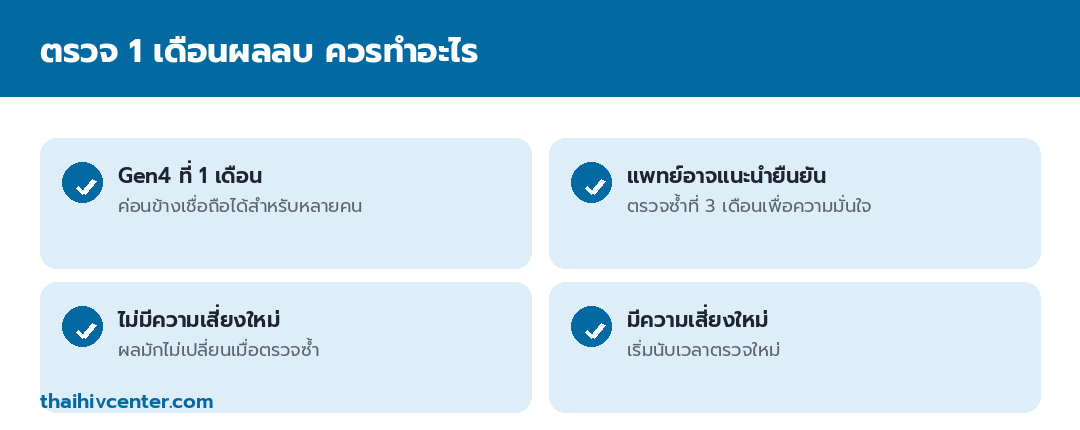
| Situation | Approach |
|---|---|
| 4th-gen at 1 month, negative | Fairly reliable, but not yet conclusive |
| Want maximum certainty | Confirm at 3 months |
| No new risk | Result usually doesn't change on retest |
| A new risk | Restart the timing from the latest risk |
Generally, if you test with a 4th-generation test at 1 month and it's negative, it's reliable enough to reassure many people, but if you want maximum certainty or a doctor recommends it, confirming at 3 months is appropriate. Consulting a doctor about your specific situation helps you get the most targeted advice.
Why standards still recommend 3 months
Although testing at 1 month is fairly reliable, medical standards still recommend confirming at 3 months for safety and certainty. Because each person's body responds to the virus at different times, although most detect within a month, a small proportion may take longer. Testing at 3 months covers all these cases, making a negative at 3 months conclusive. This recommendation is a safety margin to ensure there's no undetected infection. Following this standard ensures a truly confident result. However, specific guidance may vary by test type and a doctor's judgment, so consulting a professional is best for setting a testing plan that suits each person.
Factors affecting accuracy
HIV test accuracy depends on many factors. The first is the type of test, each with a different window period and detection sensitivity. The second is time since the risk, because the more time passes, the higher the accuracy. The third is each person's body response, which may produce antibodies slightly faster or slower. And the fourth is following the testing steps correctly, especially in self-testing. These factors together determine how reliable a result at a given time is. Understanding that accuracy doesn't depend on time alone but also on the method and other factors helps you interpret appropriately and know when to confirm.
How necessary is retesting at 3 months
The need to retest at 3 months depends on many factors. If you test with a 4th-generation test at 1 month and it's negative with no new risk, the chance of the result changing on retest is small. However, confirming at 3 months gives maximum certainty and follows standards. For those still worried or wanting certainty, retesting is an option for peace of mind. For those with high risk or specific factors, a doctor may clearly recommend retesting. Deciding whether to retest should be considered with a doctor, considering the test type, risk level, and your own comfort. Importantly, retesting is about confirming certainty, not a sign something is wrong.
If there's a new risk while waiting
If a new risk occurs while waiting to retest at 3 months, the situation changes, because a new risk means restarting the testing timing from the latest risk. A previous test doesn't cover the new risk, so plan to test at the appropriate time from the latest risk. Also, if the new risk was within 72 hours, consider consulting about PEP. Meanwhile, use protection to avoid additional risks. Understanding that a new risk resets the testing clock helps you plan correctly and prevents the misconception that a previous test covers everything. Consulting a doctor in these cases helps you get appropriate guidance.
Managing worry while waiting to retest
The time between the first test and confirmation may be full of worry, which is understandable. What helps is anchoring to the fact that a 1-month negative with a 4th-generation test is already fairly reliable, and retesting is just confirming certainty. Avoid repeatedly searching symptoms online, because early symptoms are non-specific and usually increase worry unnecessarily. Caring for your mental health — resting, doing activities you enjoy, and having someone you trust to talk to — helps you get through this. If worry disrupts daily life a lot, talking to a mental-health professional is a good option. Read more about managing worry in still worried after an HIV test.
I recently had a risk — when should I test
For those who recently had a risk, planning testing appropriately helps get a reliable result and reduce worry. If the risk was within 72 hours, the first thing to consider is PEP, an emergency medicine that must start within this window. After that, the first test can be done as advised, but understand that testing too early may not yet detect the virus. Testing at about 1 month with a 4th-generation test gives a fairly reliable result, and confirming at 3 months gives maximum certainty. Consulting a doctor helps set a testing schedule that suits your situation. You can find a clinic near you to test and consult.
Frequently asked questions
Can I trust a negative 4th-gen test at 1 month
Fairly reliable for many, because 4th-gen detects in most people at 1 month, but not yet conclusive; standards recommend confirming at 3 months.
Does everyone need to retest at 3 months
If no new risk, the result usually doesn't change, but testing at 3 months gives maximum certainty per standards; consult a doctor.
Why isn't 1 month 100% conclusive
Because each person responds slightly differently; some may detect later, and testing at 3 months covers these cases.
Does faster NAT mean conclusive sooner
NAT detects earlier in the early period, but the final conclusion of a negative still follows a doctor's advice and testing standards.
I'm very worried while waiting for 3 months — what do I do
Anchor to the fact that a 1-month result is fairly reliable, avoid repeatedly searching symptoms, and if very worried consult a mental-health professional.
A new risk while waiting — what do I do
Restart the testing timing from the latest risk, and if within 72 hours consider PEP.
Summary
Testing for HIV at 1 month with a 4th-generation test gives a fairly reliable result for many people but not yet 100 percent conclusive, because each person responds differently. Medical standards therefore still recommend confirming at 3 months, the time a negative is conclusive. If there's no new risk, the result usually doesn't change on retest, but confirming gives maximum certainty. A new risk requires restarting the timing, and managing worry while waiting matters too. Consulting a doctor helps set a testing plan that suits you. To test or consult, find a clinic near you.