Repeated Negative HIV Tests but Still Anxious — What Should You Do?
Many people who had a risk and tested negative for HIV find that the worry doesn't go away. Some test again and again, negative every time, yet their mind is still not at ease. If you feel this way, know that you are not alone — health anxiety is common and understandable. This article helps you understand when an HIV test result is conclusive, why continuous retesting may not relieve the worry, and how to care for anxiety, based on accurate information and understanding, so you can return to living more at ease.
Is it normal to test negative but still worry
It's understandable. Worry about HIV often comes from fear and uncertainty, which are natural human feelings, especially about a health issue that seems scary. Sometimes, even after a reliable negative result, worried thoughts keep returning, creating an urge to retest for reassurance. This feeling does not mean something is wrong with you — it's a common form of anxiety. What matters is having accurate information about the reliability of the result and learning to care for the worry appropriately, so it does not control daily life.
When is an HIV test result conclusive
Understanding test timing helps you feel more confident in the result.
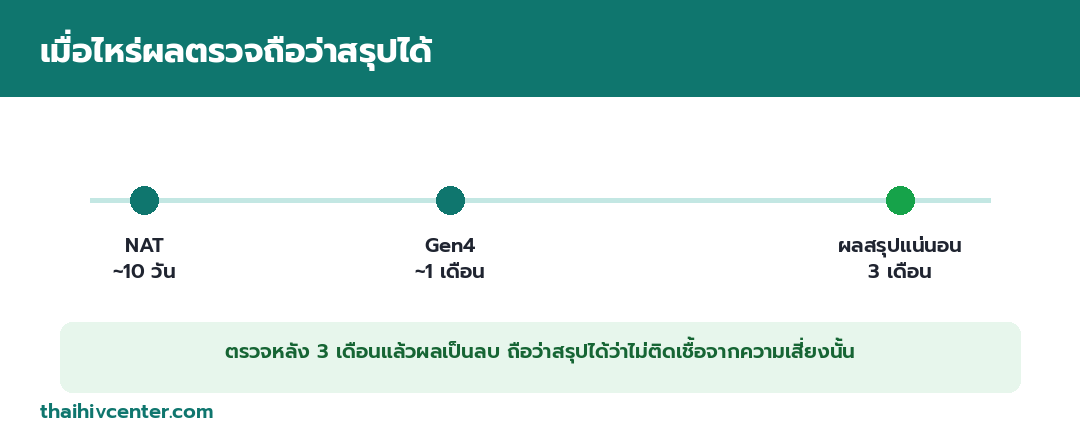
Each HIV test has a different time when it can start detecting the virus. NAT detects earliest, around 10 days after exposure; 4th-gen is usually accurate at about 1 month; and the result is considered conclusive when tested at 3 months after the risk. If you test after 3 months from your last risk and it is negative, that is conclusive that you were not infected from that risk, without needing to retest. Knowing this gives you a clear anchor. Read more in the HIV window period and how many days after a risk to test.
How often is enough
The table below summarizes the appropriate timing to help show when testing is sufficient.
| Time after risk | Meaning of a negative |
|---|---|
| ~10 days (NAT) | Can start detecting, but not conclusive |
| ~1 month (4th-gen) | Fairly confident, but a doctor may advise confirming |
| 3 months | A negative is conclusive — no need to retest |
| After 3 months (no new risk) | Retesting usually adds no information |
If no new risk occurs, retesting after the result is conclusive usually doesn't change the answer. What can change is a new risk, which starts a new timing period. So if you have tested at the full time and have no additional risk, you can trust the result.
Why continuous retesting may not help
When anxiety is the driver, retesting may give temporary relief, then the worry returns, creating an endless cycle of retesting. Relief from a negative usually doesn't last, because the root of the problem is not the test result but the unaddressed worry. Retesting too often may reinforce the worry rather than ease it. Once the result is conclusive, turning to care for the source of the worry usually helps more than more tests. This does not mean your worry is unreasonable — it means there is a more targeted way to care for it.
How to manage anxiety
There are several gentle ways to care for anxiety.
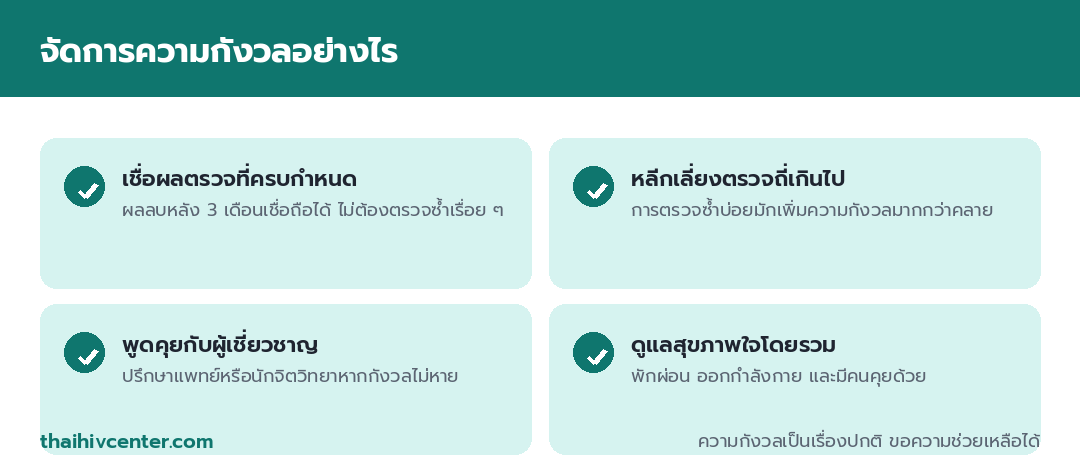
First, anchor to the conclusive, reliable result — once negative after 3 months, treat it as a clear answer. Second, try to avoid retesting too often, as it usually increases worry rather than easing it. Third, talk to a professional, whether a doctor or a psychologist, who can help you understand and manage the worry better. Fourth, care for overall mental health — rest enough, exercise, do activities you enjoy, and have someone you trust to talk to. These help your mind grow stronger and better able to cope with worry.
When to consult a professional
If worry about HIV disrupts daily life — causing insomnia, difficulty concentrating at work, retesting that affects your time and money, or ongoing distress despite negative results — consulting a mental-health professional is a good option and nothing to be ashamed of. Just like caring for physical health, caring for mental health matters. A professional can help you understand where the worry comes from and find ways to manage it that suit you. Asking for help is strength, not weakness. If you have questions about risk or testing, you can also consult a clinic near you.
Caring for mental and physical health together
Good sexual-health care isn't only physical testing but also caring for the mind. When you have accurate information, know when a result is reliable, and have ways to care for worry, you feel more secure. If a new risk arises in the future, testing at the appropriate time is something you can do normally, without fear taking over. Viewing health holistically — both body and mind — helps you care for yourself in a balanced and happier way.
Frequently asked questions
Negative at 3 months — do I still need to test
If there is no new risk, a negative at 3 months is conclusive; there is no need to retest.
Negative every time over many tests — what does that mean
It means the results are consistent and reliable. Once tested at the full time, retesting usually adds no new information.
The worry won't go away — what should I do
If it disrupts daily life, consulting a doctor or psychologist is a good option for caring for your mental health.
Does a lot of worry affect the body
Stress and worry can cause physical symptoms like insomnia or fatigue, so caring for mental health helps.
Summary
Testing negative for HIV but still worrying is common and understandable. Once you test at the full 3 months and it is negative, with no new risk, it is conclusive that you are not infected. Continuous retesting usually doesn't relieve the worry, because the root is unaddressed anxiety. Anchoring to a reliable result, avoiding over-testing, caring for your mental health, and consulting a professional when needed will help you feel at ease again. Asking for help is strength. If you want to consult about testing, find a clinic near you.
Note: If you are feeling very distressed or the worry is affecting your life, talking to a doctor or a mental-health professional can help. You don't have to face it alone.