HIV Test: Walk-In vs Appointment — What's the Difference, and Which Should You Choose?
When deciding to test for HIV, many may wonder whether to go in walk-in or book an appointment ahead, and how these two differ. The important answer is that HIV testing can be done both walk-in and by appointment, and both allow you to get tested. Walk-in testing means going to the testing place and getting tested right away without an appointment, while an appointment means booking a time ahead, which saves time and helps you plan. Choosing which depends on your convenience, the time you have, and your urgency. However, each place may have different policies — some accept walk-in, some require appointments — so ask the place you'll test first. This article explains in detail how walk-in and appointment HIV testing differ, the benefits of each, how to book ahead, and how to choose which suits you, so you can get tested conveniently and smoothly.
Walk-in vs appointment — what's the difference
The answer is that HIV testing can be done both walk-in and by appointment, and both allow you to get tested, differing in convenience and planning.
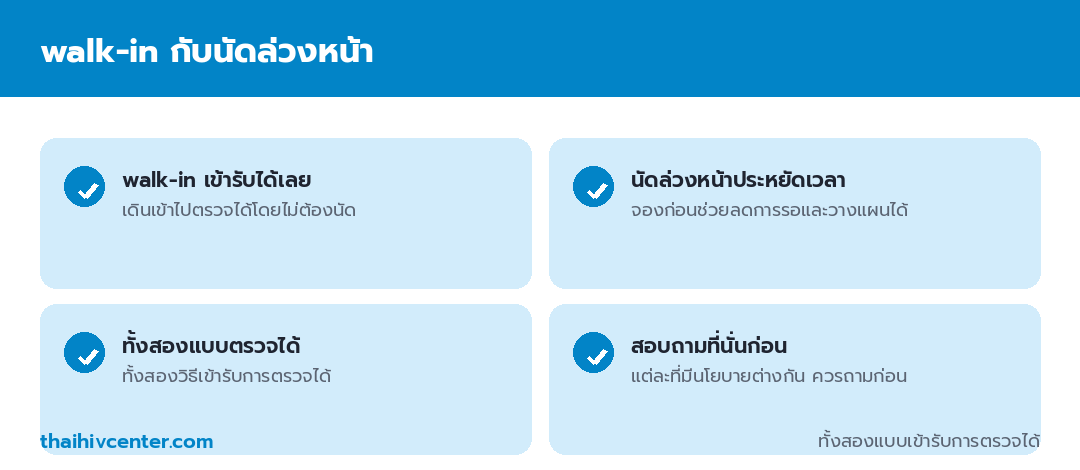
Walk-in and appointment HIV testing are two ways to get tested that both work. The main difference is the appointment. Walk-in testing means going to the testing place and getting tested right away without booking ahead, convenient when you want to test immediately or have unplanned free time, while an appointment means booking a time with the testing place ahead, giving you a set time and possibly reducing waiting. Both allow you to get tested for HIV the same way and give reliable results. Choosing which depends on your preference and situation. What's important to know is that each place may have different policies — some accept only walk-in, some require appointments, and some accept both — so ask the place you'll test first for clear policies. Understanding how the two differ helps you choose the method that suits you. Read more about test methods in HIV testing methods.
What is walk-in
Walk-in testing means going to the testing place and getting tested right away without booking ahead. This suits those who want to test immediately, have unplanned free time, or decide to test at a convenient time. The benefit of walk-in is flexibility and convenience, because you can go test when you want without waiting for an appointment day. However, since you didn't book ahead, you may have to wait if many people are using the service, depending on how busy the place is when you go. Walk-in testing still gives reliable results and usually has pre- and post-test counseling like appointments. What to know is that not every place accepts walk-in; some may require appointments only. So if you want walk-in, check with the place first whether they accept it and what hours they offer. Understanding what walk-in is helps you decide whether this method suits your needs and situation and plan your visit appropriately.
What is an appointment
An appointment means booking a time with the testing place before going to get tested. This gives you a set time for testing and usually reduces waiting when you arrive, because the place has prepared time for you. Appointments suit those who want to plan time, want certainty, or have a schedule to manage. The benefit of an appointment is convenience in scheduling and reducing waiting. Also, an appointment helps the place prepare to serve you. Appointments can be made several ways depending on the place, such as calling to book, booking through a website or app, or other online channels. Some places have convenient online booking systems, making it easy to book from home. What to know is that each place has different appointment methods, so check how the place you want to go handles appointments. Understanding what an appointment is and its benefits helps you decide whether this method suits your needs. Read about choosing a testing place in where to test and how fast results are.
Benefits of each
Both walk-in and appointment testing have different benefits, helping you choose which suits your needs.
| Aspect | Walk-in | Appointment |
|---|---|---|
| Appointment | No booking, go in right away | Book a time ahead |
| Flexibility | Go when convenient | Have a set time |
| Waiting | May wait if busy | Usually reduces waiting |
| Suits | Wanting to test immediately | Wanting to plan time |
The benefits of each:
- Benefits of walk-in — flexibility, going to test when convenient without waiting for an appointment day, suiting when you want to test immediately.
- Benefits of an appointment — helps plan time, gives a set time, and usually reduces waiting when you arrive.
- Both give reliable results — whichever you choose, you can get quality testing.
- Depends on the place — each has different policies; ask first to know which they accept.
Understanding the benefits of each helps you choose the method that suits your needs and situation. Both are good options for getting tested for HIV, and the choice depends on your convenience and preference.
Which should you choose
Choosing between walk-in and appointment testing depends on several factors related to your needs and situation.
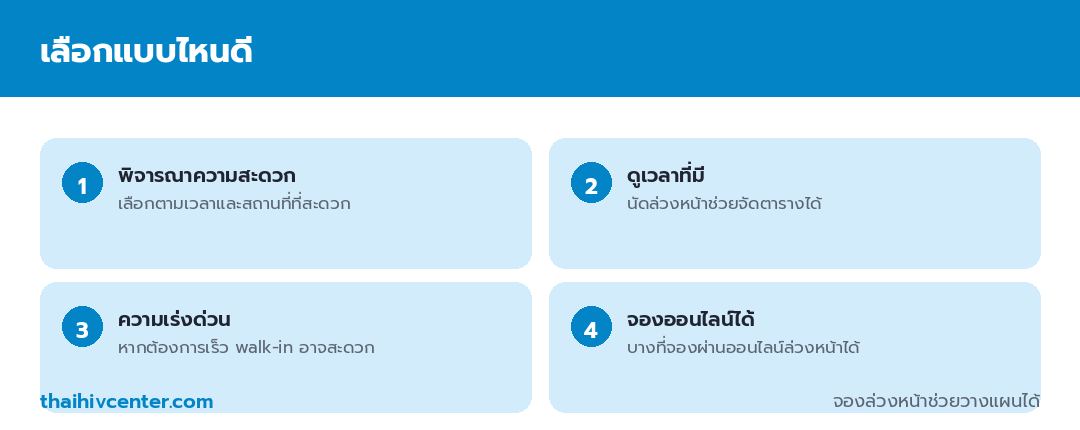
- Consider convenience — choose by the time and place convenient for you.
- Look at the time you have — if you want a set schedule, an appointment helps.
- Urgency — if you want to test immediately, walk-in may be more convenient.
- Online booking available — some places have online booking making appointments easy.
Considering these factors helps you choose the method that suits you. If you have unplanned free time and want to test immediately, walk-in may suit better, but if you want to plan time and reduce waiting, an appointment may be a good option. Whichever you choose, what matters is getting tested when you have a risk or want to know your status. Understanding which to choose helps you get tested conveniently and suiting your situation. Read about preparing in how to prepare for an HIV test.

How to book ahead
If you choose to make an appointment, booking can be done several ways depending on the testing place. Common booking methods include calling the place directly, booking through the place's website, booking through an app or online platform, or other channels the place offers. Some places have convenient online booking systems, letting you choose the day and time you want from home, without calling or asking in person. Online booking usually shows available times to choose and confirms the appointment immediately, making booking convenient and quick. For those wanting to find a testing place and book, there are platforms that help find clinics and book testing, making the process easier. What to know is that booking methods vary by place, so check how the place you want to go handles booking and what requirements there are. Understanding how to book ahead helps you make appointments conveniently and plan your visit as you want. Read more about finding and booking in find a clinic near you.
What to know before testing
Whether you choose walk-in or appointment testing, there are things to know before testing to make it go smoothly:
- Ask the place's policy — whether they accept walk-in or require appointments, and what hours they offer.
- Prepare information you may need — such as documents the place requires, if any.
- Time it after a risk — appropriately for result accuracy, because of the window period.
- Prepare questions to ask — to use the chance to talk with staff.
These preparations help testing go smoothly whichever you choose. Asking the place's policy ahead helps you know what to do and prepare. Understanding what to know before testing helps you be ready and confident getting tested. Read more about preparing in how to prepare for an HIV test.
Pre- and post-test counseling
Whether walk-in or appointment, quality HIV testing usually comes with pre- and post-test counseling. Pre-test counseling helps you understand testing, assess risk, and prepare. Staff may talk about your risk and explain how testing works. Post-test counseling helps you understand results and get appropriate advice. If negative, staff may advise on prevention and retesting if needed. If positive, staff give information about next steps and entering care. This counseling is valuable whichever testing method you choose, because it helps you not face information or results alone and get appropriate care. Both walk-in and appointment testing can offer this counseling, depending on the place. Understanding that there's pre- and post-test counseling helps you feel reassured that someone will help explain and advise throughout, whichever testing method you choose.
Privacy in testing
Privacy is something many consider when going to test for HIV, whether choosing walk-in or appointment. Testing places generally value the privacy of those getting tested. However, privacy policies and practices may vary by place. If privacy worries you, you can ask the place about its privacy policy and data handling. Also, some places offer anonymous testing that doesn't require your real name, an option for those wanting extra privacy. Choosing a place and testing method that make you feel comfortable about privacy helps testing be a good experience. Understanding that you can ask about privacy helps you choose a place and method that suit your needs. Read more about privacy in is an HIV test confidential.
Misconceptions about walk-in and appointment testing
There are several misconceptions about walk-in and appointment testing to correct:
- "Walk-in testing gives worse results than appointments" — false, both give reliable results the same.
- "Every place always requires appointments" — false, many accept walk-in, depending on each place's policy.
- "Walk-in testing has no counseling" — false, walk-in testing usually has pre- and post-test counseling too.
- "Appointments are complicated" — false, many places have convenient, quick online booking.
Knowing these facts reduces misconceptions about walk-in and appointment testing and helps you see both are good options for getting tested. Choosing which depends on your convenience and needs, not testing quality.
Frequently asked questions
Do walk-in and appointment HIV testing differ
They differ in the appointment; walk-in you go in right away, appointment you book ahead; both allow testing and give reliable results.
Does every place accept walk-in
No, each place has different policies; some accept walk-in, some require appointments; ask the place you'll go first.
Is an appointment better than walk-in
Not better for results, but an appointment helps plan time and reduce waiting, while walk-in is convenient when you want to test immediately.
How do I book ahead
Several ways, such as calling, booking through a website or app; some have convenient online booking; check the place's channels.
Does walk-in testing have counseling
Yes, walk-in testing usually has pre- and post-test counseling like appointments, depending on the place.
Which should I choose
It depends on convenience, the time you have, and urgency; for testing immediately choose walk-in, for planning choose an appointment.
Summary
HIV testing can be done both walk-in, where you go in and get tested right away, and by appointment, where you book ahead. Both allow you to get tested and give reliable results. Walk-in testing is flexible and convenient when you want to test immediately, while an appointment helps plan time and reduce waiting. Choosing which depends on your convenience, the time you have, and your urgency. Each place has different policies, so ask first, and many places have convenient online booking. Whichever you choose, what matters is getting tested when you have a risk or want to know your status. If you're ready to test or want to find a place, find a clinic near you.