NAT/PCR vs Antibody HIV Testing: How They Differ and How Early Each Can Detect HIV
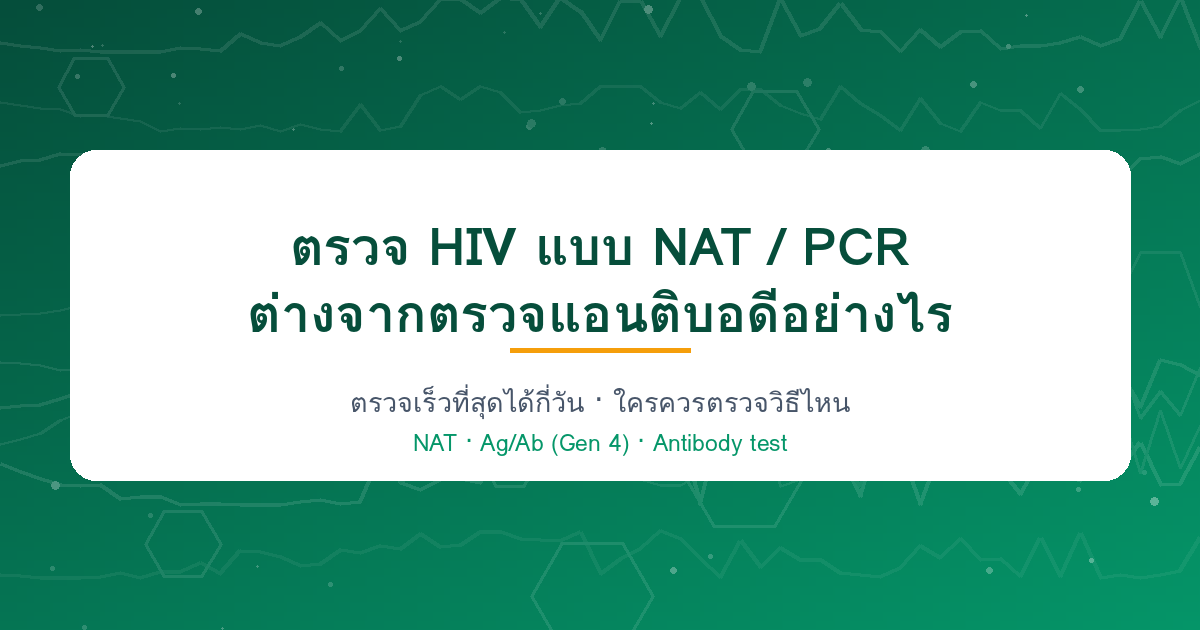
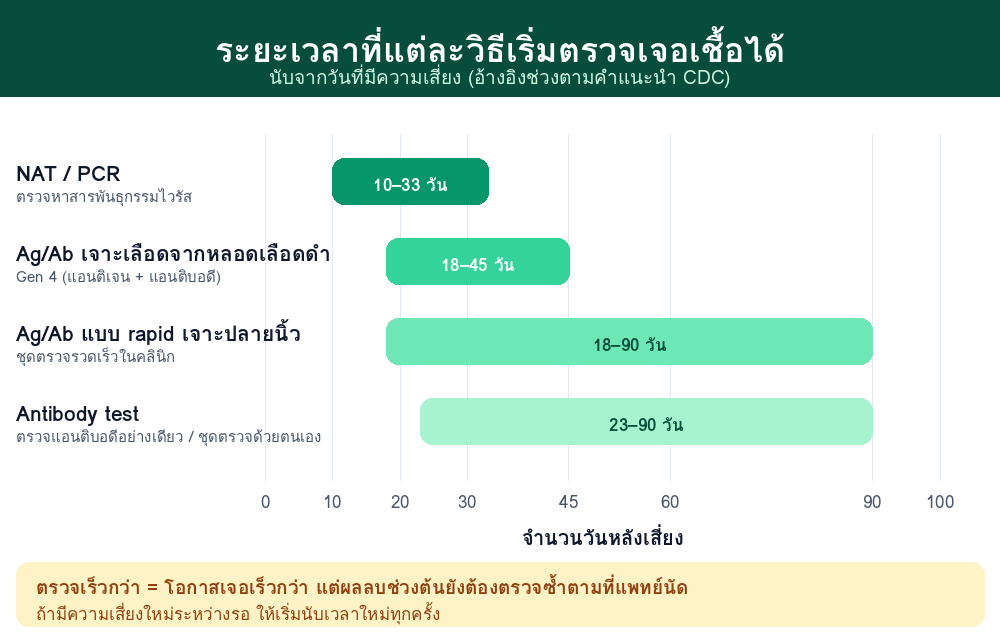
A NAT or PCR test looks for the genetic material of HIV directly in the blood, which makes it the earliest-detecting method in routine use - generally around 10 to 33 days after an exposure. A laboratory antigen/antibody test (often called a fourth-generation or Gen 4 test) usually detects infection from roughly 18 to 45 days, while an antibody-only test typically detects it from around 23 to 90 days. The difference comes down to what each test is looking for, not to one method being universally more accurate than another.
People who have just had a possible exposure almost always want answers as fast as possible, and searching online quickly produces a confusing mix of terms: NAT, NAAT, PCR, RNA test, Gen 4, Gen 3. This guide explains what each of those terms means, how the methods differ in practice, who each one suits, and - most importantly - how to interpret an early negative result without drawing the wrong conclusion.

What a NAT/PCR test actually looks for
NAT stands for Nucleic Acid Test. You may also see it written as NAAT, for Nucleic Acid Amplification Test. In practice these tests usually rely on a technique called PCR, which is why many people simply say "PCR test." The principle is to search for the virus's own genetic material (RNA) and then amplify it in the laboratory until there is enough for an instrument to detect.
A simple analogy helps here. An antibody test is like looking for footprints to work out whether someone walked past. A NAT is like seeing the person directly. Footprints take time to appear, so looking for the person is faster - but you still need enough of them present in the place you are looking. That is precisely why testing in the first days after an exposure cannot give a meaningful answer, no matter which method is used.
- What it detects: the genetic material of HIV itself
- Does it wait for an immune response: no
- Sample required: blood drawn from a vein
- When it typically starts detecting: around 10 to 33 days after exposure
- Where it is available: facilities with laboratory capacity - it is not a home self-test
How antibody testing works
When HIV enters the body, the immune system gradually produces antibodies in response. An antibody test therefore looks for evidence of the body's reaction rather than for the virus itself.
The advantages are practical ones. Antibody tests are simpler to run, cost less, and can use blood from a vein, blood from a finger prick, or oral fluid. They are the principle behind the self-test kits available in pharmacies. The limitation is that different people produce antibodies at different speeds. Testing too early may find nothing to detect even when infection is present.
Another source of confusion is the generation numbering. A third-generation test detects antibodies only, but does so more sensitively than older versions. A fourth-generation test adds antigen detection on top. The generation number does not tell you which test is "better" in every respect - it tells you what the test looks for, and that is what determines how early it can detect infection.
Whatever the generation, all of these are screening tests. A reactive result always moves on to a confirmatory process. No single screening result is a diagnosis on its own. If you are considering an oral fluid kit, see our detailed guide to oral fluid HIV testing and how it compares with blood testing.
Where the Ag/Ab or Gen 4 test sits between the two
An antigen/antibody test looks for two things at once: the antibodies the body produces, and p24 antigen, a viral protein that appears in blood earlier than antibodies do.
The p24 antigen has a distinctive pattern. It rises early in infection and then falls as antibodies appear and bind to it. A Gen 4 test is designed to cover both phases - the early window when antigen is high but antibodies have not yet developed, and the later period once antibodies are established. Combining the two targets gives broader coverage across time than either target alone.
In practice, this is what most clinics and hospitals use as their standard screening test. When a nurse draws blood from your arm at a walk-in HIV testing service, this is usually the test being run. It represents a sensible balance of speed, accuracy, and cost for general use, and it is more than adequate for most people who have passed the appropriate interval since their exposure.
The three methods side by side
| Feature | NAT / PCR | Ag/Ab (Gen 4) | Antibody test |
|---|---|---|---|
| What it detects | Viral genetic material | p24 antigen + antibodies | Antibodies only |
| Typical detection window | About 10-33 days | About 18-45 days (venous blood) | About 23-90 days |
| Sample type | Venous blood | Venous blood or finger prick | Blood, finger prick, or oral fluid |
| Available as a self-test | No | Some clinic-based formats | Yes, self-test kits exist |
| Used for routine screening | No | Yes - the most common standard | Yes, in some settings |
| Relative cost | Highest | Moderate | Lowest |
| Main role | Confirmation, acute infection, treatment monitoring | Screening, then confirmation | Accessible routine testing |
How soon after exposure can you test
The single most common question is some version of "how many days do I have to wait?" The honest answer is that there is no one universal day, because each method's detection period is a range rather than a fixed point.
The commonly cited figures are roughly 10 to 33 days for NAT, 18 to 45 days for a laboratory Ag/Ab test on venous blood, 18 to 90 days for a rapid finger-prick Ag/Ab test, and 23 to 90 days for antibody testing. The width of those ranges reflects genuine variation between individuals: differences in immune response, in the amount of virus involved, and in other factors nobody can control in advance.
A useful way to read those numbers is this. The lower figure - 10 days for NAT, for example - means the earliest that some people would begin to test positive, not the point at which everyone would. The upper figure represents the interval by which nearly everyone who acquired HIV would be detected. Planning should be anchored to the upper figure, with early testing treated as supplementary information rather than as a conclusion.
One point that gets overlooked constantly: if a new exposure happens while you are waiting, the clock restarts from that new date. It does not continue from the first one. For more on counting intervals correctly, see the HIV window period explained, and for how much confidence a one-month negative deserves, see is a negative HIV test at one month reliable.
Why NAT is not the first choice for everyone
If NAT detects infection earliest, why do clinics not simply use it for everyone from the start? There are several overlapping reasons.
- Cost is substantially higher - reagents, equipment, and specially trained laboratory staff all add up
- Laboratory infrastructure is required, so it cannot be offered as an on-the-spot result at every service point
- Turnaround is slower in many settings, since samples are often sent to a central laboratory
- False positives do occur, and become proportionally more troublesome when a test is applied broadly to people at low risk, creating anxiety without benefit
- Ag/Ab testing already serves most people well - once past the appropriate interval it is highly reliable and far more widely available
For these reasons, guidance around the world places NAT in a specific supporting role rather than as the default first test everyone receives.
Common misconceptions about NAT testing
Because it sounds advanced and carries a higher price, people often expect more from a NAT than it can actually deliver. These are the misconceptions that come up most often.
- "A NAT means I never need to test again." Not true. If it was done early after exposure, follow-up testing is still needed on the schedule your clinician sets.
- "NAT is more accurate than everything else in every situation." Not true. Past the appropriate interval, a standard Ag/Ab test is also highly reliable.
- "I can test the day after an exposure and get an answer." Not true. No method detects infection immediately, because enough virus has to be present first.
- "A positive NAT is the final word." Not true. It still goes through the same confirmatory pathway as any other result.
- "Paying more gets answers faster." Not reliably. What determines when you can know is time since exposure, not the price of the test.
These beliefs lead some people to spend money on repeat testing during a period when no test could answer their question, and then to skip testing at the point when it actually would have. Understanding the underlying principle saves both money and worry. For more, see common myths about HIV.
When clinicians do consider using NAT
NAT is generally used when there is a clear clinical reason, rather than simply on request. The situations that come up most often are these.
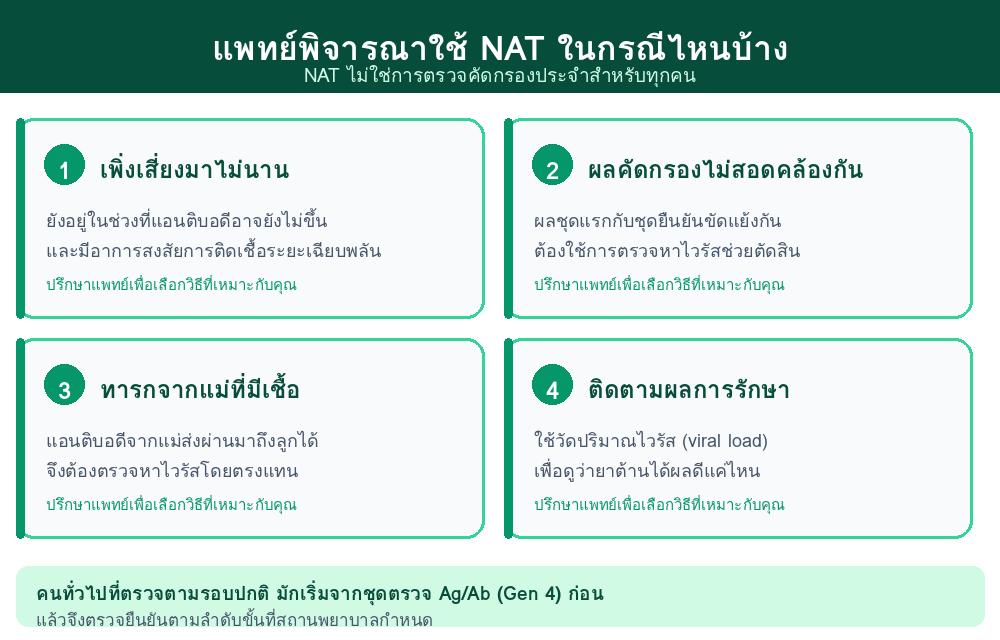
Suspected acute infection. Someone had a recent exposure and now has symptoms that raise suspicion - fever, swollen lymph nodes, rash, sore throat - during a period when antibodies may not yet have developed. That said, these symptoms occur in a great many other infections. Having them does not mean HIV, and not having them does not mean safety.
Discordant screening and confirmatory results. When a screening test is reactive but the next stage is unclear, looking for the virus directly can help resolve the picture.
Infants born to mothers living with HIV. Maternal antibodies cross to the baby and persist for months, so antibody testing in an infant cannot be interpreted. Direct viral detection is used instead.
Blood donation screening. Many blood services use NAT alongside other methods to reduce the risk from donors who might be very early in infection.
Treatment monitoring. People on antiretroviral therapy have their viral load measured periodically using the same underlying technology.
Does a negative NAT mean you are in the clear
This is where misunderstanding causes the most harm. A negative NAT taken very soon after an exposure is not a final answer. In the first days, the amount of virus in blood may still be below what any instrument can detect. A negative at that stage means only "nothing detected at this moment."
There is a period immediately after exposure during which no test of any kind can detect infection, because the virus is still replicating in tissue and has not reached the bloodstream in sufficient quantity. This is a biological constraint that no testing technology can bypass, however much it costs. Understanding this helps people decide when to test rather than rushing to test on a day when there is nothing yet to find.
This is why guidance still recommends repeat testing with standard methods at the intervals your clinician specifies before drawing conclusions. Repeat testing is not a signal that something is wrong - it is simply part of testing correctly.

The reverse also matters. If a screening result comes back reactive, that is a preliminary screening result requiring confirmation, not a diagnosis. Several confirmatory steps follow before anything is settled. Reaching conclusions alone at this stage usually creates far more distress than the situation warrants.
How NAT differs from a viral load test
Both rely on the same underlying principle of detecting viral genetic material. What differs is purpose.
- NAT for diagnosis answers "is the virus present?" and is usually reported as detected or not detected
- Viral load for monitoring answers "how much virus is present?" and is reported as copies per millilitre
- People on consistent treatment who reach an undetectable viral load do not pass HIV on through sex - this is the basis of U=U
- Undetectable does not mean cured - the virus remains in the body and treatment must continue as prescribed
- Testing frequency is set by the treating clinician rather than chosen independently
For more on interpreting these numbers, see understanding CD4 and viral load results, and for U=U see undetectable equals untransmittable.
Availability and cost in Thailand
In practice NAT is not offered everywhere. It is generally found in larger hospitals, specialist centres, and laboratories with the necessary capacity. Costs are clearly higher than routine screening and vary considerably between providers.
For that reason this article does not quote specific prices that could quickly become outdated or misleading. Ask the facility directly about current fees. Useful questions include whether NAT is available at all, what clinical indication is required, how many days results take, and whether free or subsidised screening is available under your existing entitlements.
One option many people overlook is community-based services. Many offer screening at no cost or low cost, with counsellors experienced in discussing this without judgement. For anyone concerned about privacy or uncomfortable attending a hospital, these are often a far easier door to walk through, and they have referral systems for confirmation and care if a result is reactive.
For most people, screening already available under existing entitlements is sufficient. See how much HIV testing costs and where to test for free, or find a service near you at our clinic finder.
If the exposure was within the last 72 hours
If a possible exposure happened within the past 72 hours, the priority is seeing a clinician about PEP, not finding the fastest possible test. During that window, no test can tell you anything about the most recent exposure - but the opportunity to prevent infection is closing by the hour.
PEP is antiretroviral medication taken after an exposure. It is highly effective when started promptly and taken as prescribed for the full course, and it must begin within 72 hours - the sooner the better. Blood testing done on the day you start PEP establishes your status beforehand; it does not assess the recent exposure.
The reason this ordering matters so much is that testing can be done a few weeks from now and will give the same answer. The chance to start PEP cannot. Many people lose that opportunity while researching which test to choose instead of getting to a clinician quickly.
When you arrive, describe what happened plainly and give the timing as precisely as you can recall, because timing is what the clinical decision turns on. Downplaying details can lead to a risk assessment that misses the mark. Staff working in this field have seen every situation and are there to help, not to judge.
Recent exposure? Do not wait. See how to complete a 28-day PEP course or go to our full PEP information page. If exposures happen repeatedly, talk to a clinician about moving from PEP to PrEP and what starting PrEP involves.
Looking after yourself while you wait
The stretch between a possible exposure and a clear result is often the hardest part emotionally. People lose sleep, search the same information repeatedly through the night, or monitor their body until every minor sensation seems alarming. That reaction is extremely common and is not a sign of weakness.
What genuinely helps is converting open-ended waiting into a concrete plan. Once you know which date you will test, by which method, and when any repeat is due, the uncertainty shrinks immediately. Putting the appointment in a calendar and closing the search tab each night helps more than people expect.
It is also worth knowing that the symptoms people fixate on during this period - low-grade fever, sore throat, rash, swollen glands - are non-specific and have many other causes. They cannot establish your status either way. Only testing at the appropriate time can answer the question. Equally, having no symptoms does not mean no exposure occurred.
If worry is clearly interfering with sleep, eating, or work, speaking to a counsellor at a clinic or a mental health helpline is a reasonable step rather than something to endure alone.
Preparing for your test
- Note the exposure date precisely - it is the single most important piece of information for choosing a method and scheduling follow-up
- No fasting is required for HIV testing, unless other tests are being done at the same time
- Bring your questions - which method is being used, how long results take, when to repeat
- Ask about other STI testing, since many infections are also symptomless
- Expect that a repeat test may be needed, so the first visit does not feel wasted
For more detail, see preparing for your first HIV test, and for an overview of all methods see our HIV testing hub.
In summary: choosing the right test for your situation
For most people testing routinely, or testing some weeks after a possible exposure, a standard Ag/Ab test is the appropriate starting point on every measure that matters - accuracy, convenience, and cost. NAT has a specific role in situations where a clinician judges it necessary.

What matters more than finding the "fastest" method is testing at the right time, returning for any repeat test as scheduled, and not letting fear push the whole thing further and further into the future. Knowing sooner only means something if it leads to acting sooner.
The practical version for most people: if the exposure was within 72 hours, PEP comes first, always. If that window has passed, test with whatever standard method your service uses and ask clearly when to return. And if exposures are a recurring feature of your life, discuss prevention in advance rather than chasing a test after each one.
Finally, testing is not shameful and says nothing about what kind of person you are. It is ordinary health care, like any other check. Whatever the result, options exist today that allow people to live full and normal lives - and knowing earlier only widens those options.
Frequently asked questions
Is a PCR test at 7 days after exposure reliable?
Seven days is earlier than the commonly cited range, so a negative at that point cannot be treated as conclusive - viral levels may still be too low to detect. Repeat testing on your clinician's schedule is still needed. In the meantime, use the waiting period for things you can act on: booking the follow-up test, discussing future prevention, and testing for other STIs that may be detectable sooner.
Are NAT and PCR the same thing?
In everyday use they usually refer to the same thing. NAT is the family name for tests that detect genetic material; PCR is the technique most commonly used within that family.
Can I request a NAT myself if I am willing to pay?
Some facilities may offer it, but not all do, and many require a clinical indication. Ask directly, and discuss with a clinician which approach genuinely fits your situation.
What does a negative NAT with a reactive Ag/Ab test mean?
This needs a clinician to interpret alongside your history and further testing. Several explanations are possible, and it should not be interpreted from a single result sheet.
Does taking PEP or PrEP affect test results?
Medication can affect interpretation in some circumstances, so always tell your clinician what you are taking so that the method and timing can be chosen appropriately.
How often should I test if exposures keep happening?
People with ongoing exposure are usually advised to test at intervals set by their clinician. More important than frequency, though, is a conversation about prevention - testing describes what has already happened, while prevention reduces future risk.
If a NAT finds nothing, do I still need a repeat test?
Generally yes, on the schedule your clinician sets - particularly if it was done early after exposure, or if a new exposure occurred in the meantime.
References and further reading
- CDC - HIV Testing
- HIVinfo (NIH) - HIV Testing
- i-Base - Guide to HIV testing
- NIAID - HIV/AIDS
- Thai Red Cross AIDS Research Centre
The content on this website is for educational purposes only. It cannot replace diagnosis, examination, treatment, or medical advice from a qualified healthcare professional. If you have had a high-risk exposure or have concerning symptoms, please see a doctor promptly.