How Many HIV Testing Methods Are There? Know Them All to Choose What Suits You
When thinking about getting an HIV test, many people wonder how many methods there are and which is best for them. The truth is there are now several methods, each detecting something different with different advantages. Understanding the differences helps you choose the right one for your situation — in terms of speed, convenience, and time since a risk. This article introduces every HIV testing method, with a clear comparison table.
What HIV testing methods are there
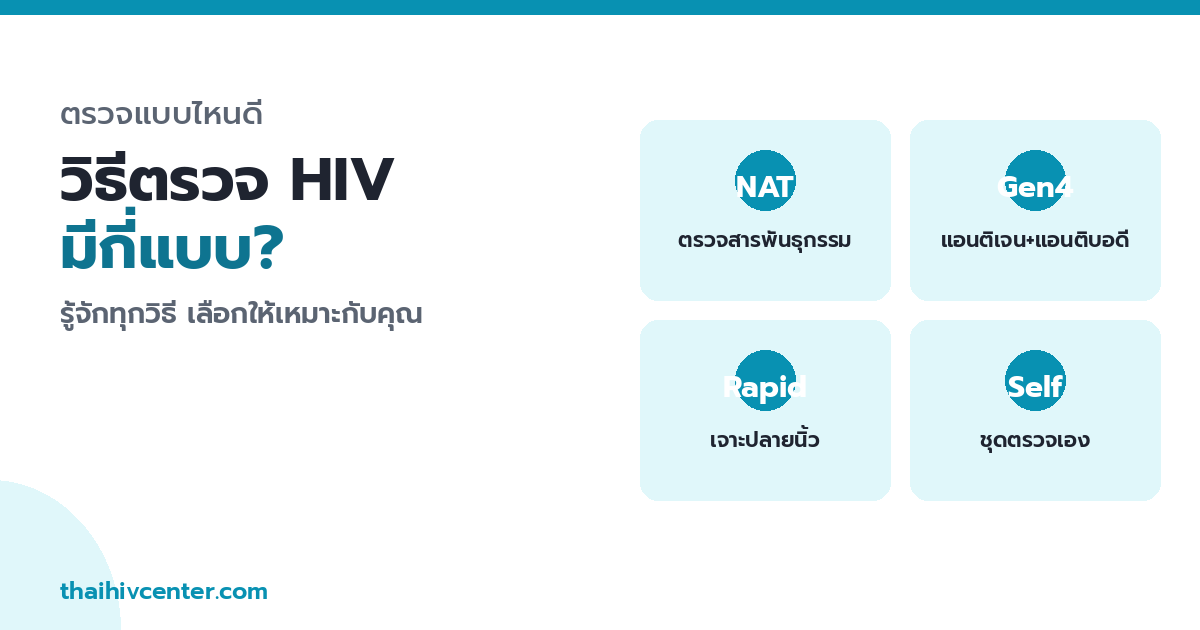
The HIV testing methods used today fall into four main types, based on what they detect and how the sample is collected.
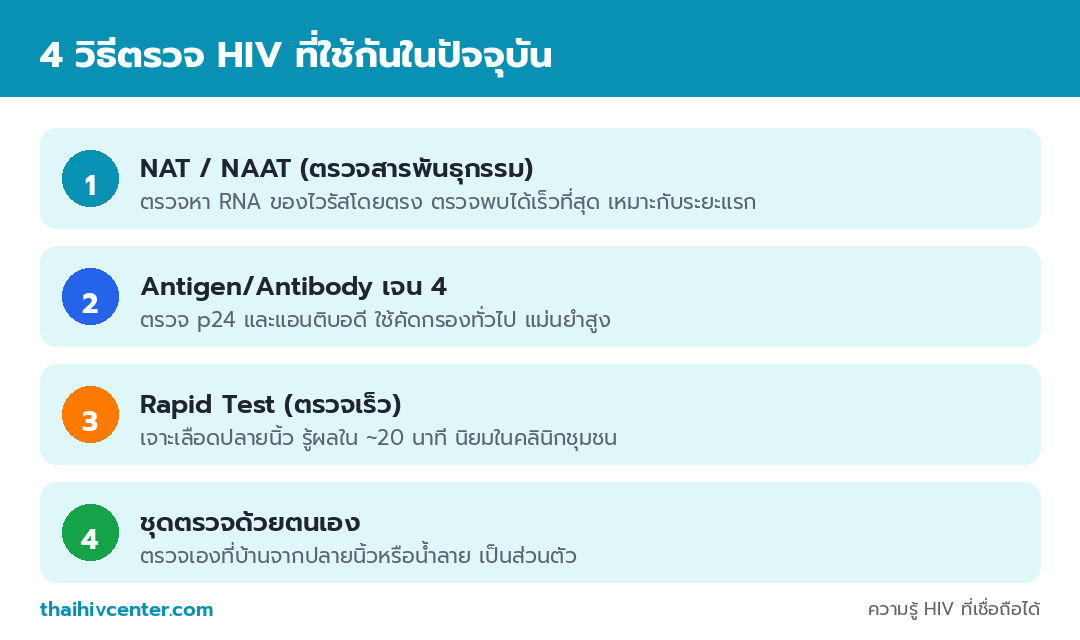
1. NAT / NAAT (detects genetic material)
This detects the virus's genetic material (RNA) directly, so it detects infection soonest. It suits cases where you have just had a risk and want to test early, or to confirm a result. It is usually done in a laboratory and costs more than other methods.
2. Antigen/Antibody 4th gen (detects antigen and antibodies)
This detects both the p24 antigen and antibodies to HIV. It is the general screening method in hospitals and clinics, with high accuracy and earlier detection than antibody-only testing.
3. Rapid Test (fast results)
This uses a finger-prick blood sample with results in about 20 minutes. It is convenient and popular in community clinics and mobile units. If the result is positive, it must be confirmed with a standard method.
4. HIV Self-Test
This is a kit you can use at home with a finger-prick or oral fluid sample, suited to those who want privacy. If the result is positive or uncertain, confirm it at a health facility.
HIV testing methods compared
To see the differences clearly, the table below summarizes each method by what it detects, the sample used, time to result, and detection window.
| Method | Detects | Sample | Result | Detection window* |
|---|---|---|---|---|
| NAT / NAAT | Genetic material (RNA) | Venous blood | 1–3 days | ~10–33 days |
| Ag/Ab 4th gen | p24 + antibodies | Blood | Hours–2 days | ~18–45 days |
| Rapid Test | Antibodies | Finger prick | ~20 minutes | ~23–90 days |
| Self-test | Antibodies | Finger prick / oral | ~20 minutes | ~23–90 days |
*The detection window is approximate and varies from person to person. Read more in the HIV window period.
The samples used, and when you get results
Another factor that makes the methods differ is the type of sample and the time to results.
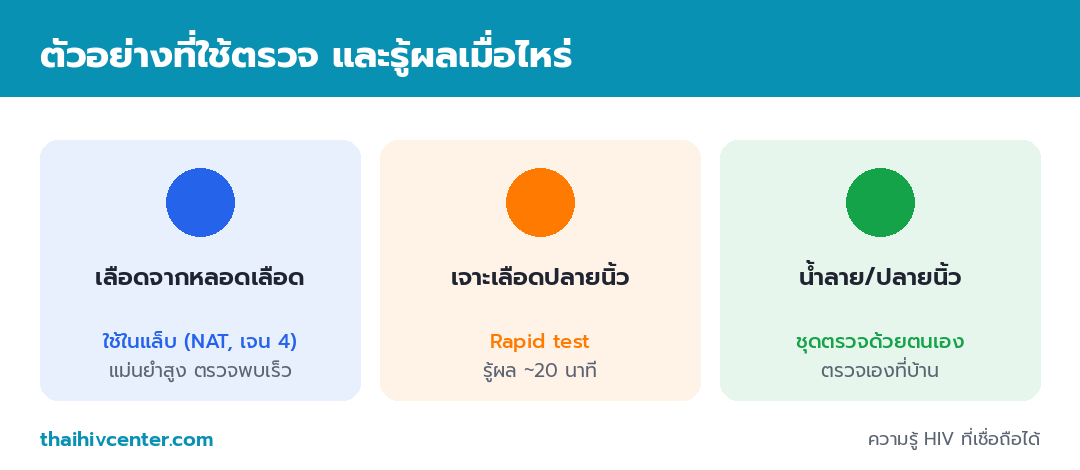
Which method should you choose
Choosing a method depends on your needs and situation. If you have just had a risk and want to test early, NAT or 4th-gen Ag/Ab is better because it detects sooner. If you want convenience and same-day results, a Rapid Test is a good option. Those who want high privacy might choose a self-test. Whichever you choose, a positive result should always be confirmed with a standard method. To learn when to test after a risk, read when to test for HIV after a risk.
Where can you test for HIV
Today, HIV testing is easy to access with several options. Thai nationals can test free twice a year under universal health coverage at public hospitals. There are also community clinics offering free, friendly, and confidential services, as well as self-test kits you can buy. To find a convenient site, you can search for an HIV testing clinic near you.
Things to watch for with each method
Although every method is reliable, there are things to understand. Antibody-based methods such as Rapid Test and self-test kits have a longer window period, so they may give a false negative if used too soon after a risk. A positive result from any method should be confirmed with a standard method before concluding. In addition, collecting the sample or using a kit incorrectly can skew results, so testing with trained staff — or following the instructions carefully for self-tests — is important.
How to prepare for an HIV test
The good news is that HIV testing is not complicated and requires no fasting beforehand. What to bring is an ID card or identity document (conditions may vary by site). Usually there is brief pre-test counseling to assess risk and explain the steps, then the sample is collected and you wait for the result. Most tests are quick and confidential. If you are concerned about privacy, many community clinics design their services to be friendly and discreet.
Frequently asked questions
Which HIV test is best
There is no single best method for everyone — it depends on the situation. For early testing, choose NAT/4th gen; for speed and convenience, choose a Rapid Test.
Is the Rapid Test accurate
Standard Rapid Tests are highly accurate but have a longer window period, and a positive result must be confirmed with a standard method.
Are self-test kits reliable
They are reliable if you use a standard kit and follow the instructions, but confirm a positive result at a health facility.
Do I need to fast before an HIV test
No. HIV testing does not require fasting from food or water beforehand.
Summary
There are several HIV testing methods — NAT, 4th-generation Antigen/Antibody, Rapid Test, and self-test kits — differing in what they detect, their speed, and their detection window. Choosing the right method for your situation and testing at the right time gives an accurate result. If you are ready to test or want advice, find an HIV testing clinic near you.