Where Does an HIV Rash Appear? What HIV Rash and Bumps Look Like vs Other Skin Conditions
Many people worried about HIV watch their body closely, and finding bumps or a rash on the skin can be alarming. In truth, a rash is one possible symptom of early HIV infection — but a rash alone cannot diagnose it, because many skin conditions cause similar rashes. This article helps you understand what an HIV rash looks like, where it appears, when it happens, and how to distinguish it from other rashes, plus what to do next if you're concerned.
What causes an HIV rash
An HIV rash usually occurs during Acute HIV Infection — the phase soon after exposure when the immune system responds strongly to the virus. This reaction causes flu-like symptoms, including a skin rash. So the rash is not the virus damaging the skin directly, but a result of the immune response. However, not everyone who is infected gets a rash — some have clear symptoms, some very mild, and many have none at all — so the presence or absence of a rash cannot determine infection.
When does an HIV rash appear
Generally, an acute HIV rash appears around 2 to 4 weeks after exposure and usually fades on its own within a few days to two weeks. The rash often appears with other acute-phase symptoms.

Because this timing coincides with the HIV window period, a rash during this time is worth attention — but it must always be confirmed by a blood test, not concluded from the rash alone.
Where do HIV bumps and rash appear
An acute HIV rash usually appears as flat red patches or slightly raised small red bumps spread over a wide area. The most common location is the trunk — chest, back, and abdomen — sometimes spreading to the face, neck, arms, or legs. A key feature is that it is usually not itchy or only mildly itchy, unlike allergic rashes which are often very itchy. Besides the skin rash, some people also have small ulcers in the mouth, genitals, or esophagus. However, the appearance and location can vary between individuals, so there is no fixed pattern.
How an HIV rash differs from other skin conditions
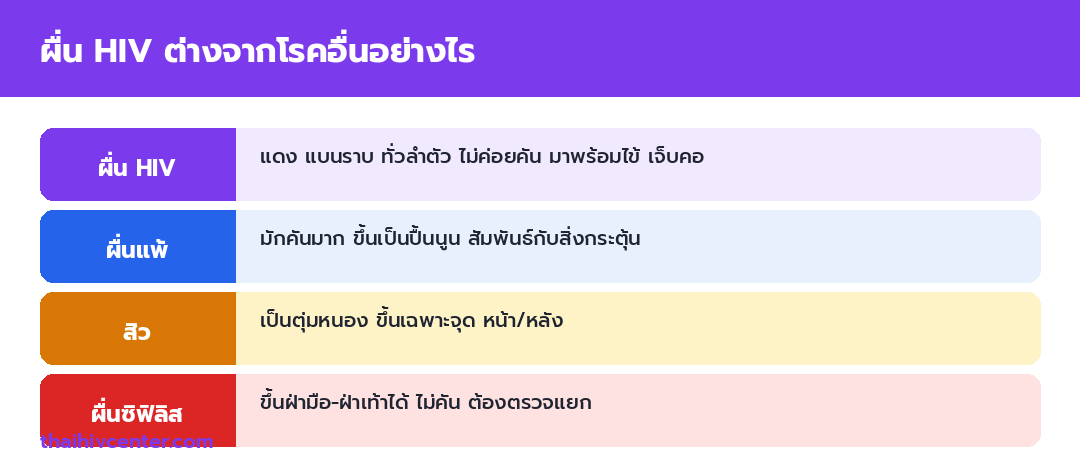
Because many rashes look alike, telling them apart requires looking at several factors together, not just the rash shape. The table and image below help compare.
| Rash type | Key features | Accompanying signs |
|---|---|---|
| HIV rash | Red, flat, over the trunk, usually not itchy | Fever, sore throat, swollen lymph nodes, fatigue |
| Allergic rash | Very itchy, raised patches | Linked to food, drugs, or contact |
| Acne | Pustules, in specific spots | Usually no fever, chronic |
| Syphilis rash | Can appear on palms and soles, not itchy | May have a prior painless sore |
An important note: an HIV rash usually doesn't come alone but with systemic symptoms like fever and sore throat, following a sexual risk 2-4 weeks earlier. If all these are present, get tested for certainty. But an itchy rash linked to food or drug allergy is usually not HIV.
Other symptoms that often come with an HIV rash
In the acute phase, the rash is usually just part of a flu-like syndrome. Common accompanying symptoms include fever, sore throat, muscle and joint aches, swollen lymph nodes (especially neck, armpits, groin), fatigue, headache, and sometimes gastrointestinal symptoms like nausea or diarrhea. These are not specific to HIV and closely resemble ordinary viral infections, so many mistake them for a cold. The point to consider is: if these occur after a sexual risk, an HIV test is the only clear answer. Read more about early HIV symptoms for the full picture.
What to do if you have this rash
If you have a rash and a history of sexual risk, here's what to do. First, don't panic and don't jump to conclusions from internet image searches, because rashes look very similar. Second, if the risk was within the last 72 hours, promptly consult about emergency PEP, because prevention is still possible. Third, if it has been longer, plan to test for HIV at the appropriate time. You can use our test date calculator to see when to test, and find a clinic near you to get tested.
When is an HIV test accurate
Because a rash appears at 2-4 weeks — a time when some tests may not yet be accurate — the choice of test and timing matters. NAT testing can detect the virus earliest, around 10 days after exposure; 4th-gen testing is fairly accurate at about 1 month; and results are conclusive at 3 months. So if you test early and it is negative, a clinician may recommend retesting to confirm. Read more in how many days after a risk to test and see testing methods in HIV testing methods.
Frequently asked questions
I have a rash but no fever — is it HIV
An HIV rash usually comes with fever and other symptoms. An itchy rash alone without systemic symptoms usually has another cause, but the only way to confirm is to test.
Does an HIV rash go away on its own
The acute-phase rash usually fades within a few days to two weeks, but the rash going away does not mean there is no virus — it remains in the body.
I never had a rash — does that mean I'm not infected
No. Many infected people never have a rash or any symptoms, so the absence of symptoms is not proof of safety.
Should I see a dermatologist or test for HIV
If there is a sexual risk involved, an HIV test gives the most direct answer, while a dermatologist can diagnose other rash causes. If unsure, starting with an HIV test is a good choice.
Summary
An HIV rash is a possible early symptom, usually appearing at 2-4 weeks on the trunk as flat red spots that are usually not itchy, often with fever, sore throat, and swollen lymph nodes. However, a rash alone cannot diagnose HIV, and many infected people have no rash at all. If you have a rash with a history of risk, don't guess — get tested for certainty. If the risk was within 72 hours, consult about PEP immediately, and in any case, testing at a clinic near you is the clearest answer.