How Long Is the HIV Window Period? When Tests Can First Detect It

One of the most common questions after a possible exposure is: “How long do I wait before an HIV test is accurate?” The answer hinges on the window period — the reason testing too early can give a result that doesn’t reflect reality. Many people rush to test right after a risk and feel reassured by a negative, when in fact it may still be too early for the test to be reliable.
This article explains what the HIV window period is, how soon each test can detect infection, why clinicians advise a 90-day confirmatory test, and clears up the popular “blood changes colour” myth. It draws on guidance from the WHO, the U.S. CDC, and Thailand’s Department of Disease Control.
What is the window period?
The window period is the time between acquiring HIV and when a test can reliably detect it. During this window, even though the virus is present, there may not yet be enough virus or immune response (such as antibodies) for the test to pick up — so the result can be negative despite infection, a false negative.
Importantly, the window period differs by test type: tests that look for the virus directly detect it earlier, while antibody tests must wait for the body to produce enough antibodies. See the overview at HIV testing.
Why testing too early gives a false negative
After exposure, it takes time for the virus to multiply and for the immune system to respond. Test in the very early days, when everything is still low, and the tools simply can’t detect it yet — so a negative then cannot confirm you’re in the clear.
How soon can each test detect HIV?
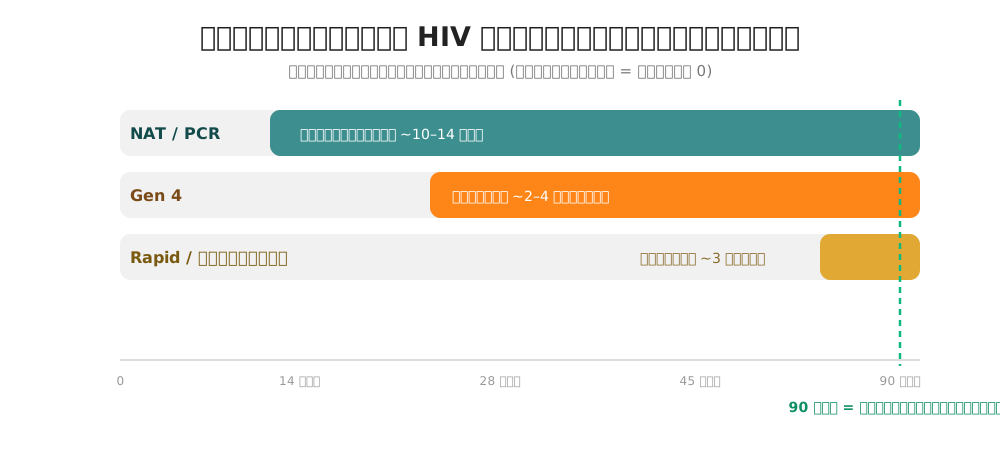
- NAT / PCR — detects viral genetic material directly; earliest, about 10–14 days.
- 4th-generation (antigen/antibody) — fairly reliable at about 2–4 weeks; widely used.
- Rapid / antibody test — convenient but slower; may take about 1–3 months.
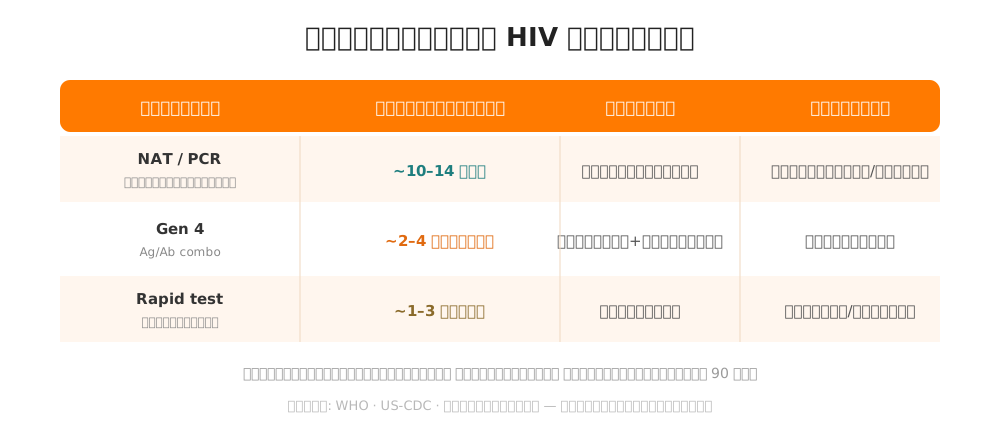
| Test | Earliest detection | Detects | Best for |
|---|---|---|---|
| NAT / PCR | ~10–14 days | Viral genetic material | Recent risk / need answer fast |
| 4th-gen | ~2–4 weeks | Antigen + antibody | General testing |
| Rapid test | ~1–3 months | Antibody | Screening / home use |
See each method in depth at types of HIV test.
“Does blood change colour?” — a myth cleared up
Does HIV make blood “change colour”? No. HIV does not change the colour of blood, and you cannot tell who is infected by looking. What actually changes are lab values — viral load rising early, antibodies developing, and CD4 possibly falling over time if untreated — none visible to the eye. See the stages of HIV.
Why retest at 90 days?
Even though modern tests detect HIV much sooner, standard guidance still advises a confirmatory test at around 90 days (3 months), because by then almost everyone has fully responded, making the result conclusive whatever the method.
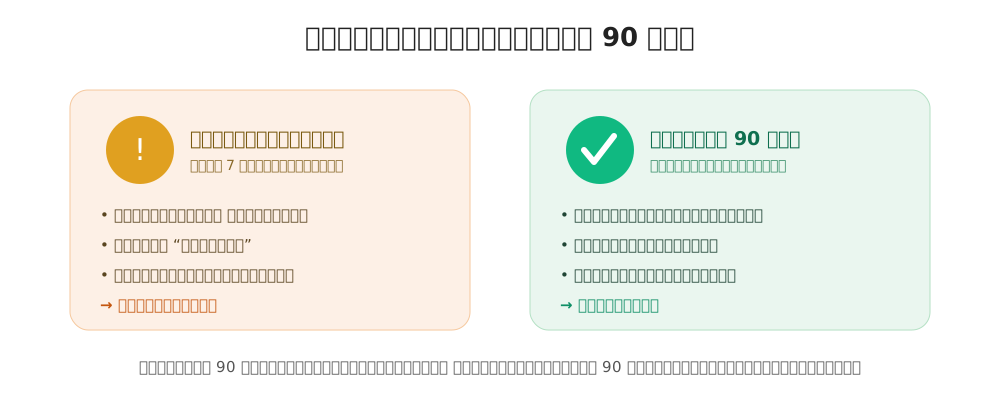
A negative before 90 days is reassuring — especially with NAT or 4th-gen — but a 90-day test is the most confident answer. A negative at 90 days with no further risk means no infection.
Window period is not the same as latency
People often confuse the window period with clinical latency. The window period is the early phase when a test can’t yet detect HIV — a matter of test sensitivity, lasting days to weeks. Clinical latency is the later, often symptom-free phase after HIV is already detectable — a matter of disease progression, lasting years. Past the window period means detectable; in latency means no symptoms yet, but detectable and transmissible. See the stages of HIV.
A sample testing plan
For someone whose risk was two weeks ago: start with NAT now (~14 days) if you want an early answer; repeat a 4th-gen test at ~1 month; and confirm at 90 days. If any new risk occurs while waiting, restart the clock from the most recent exposure.
When should you start testing?
- From 10–14 days, you can start with NAT.
- At 2–4 weeks, a 4th-gen test is fairly reliable.
- Confirm again at 90 days for maximum certainty.
Use our HIV test date calculator — enter your risk date and it tells you when and how to test. If you were exposed within 72 hours, seek PEP right away.

Where to test, and is it free?
The good news: Thai nationals can test for HIV free twice a year across all healthcare schemes under NHSO policy, using an ID card. Options include public hospitals and health centres (free, with counselling), anonymous clinics such as the Thai Red Cross Anonymous Clinic, specialist and community clinics, and self-test kits (private and convenient; a positive result must be confirmed at a facility). Whatever you choose, match the method to the days since exposure and confirm on schedule. See HIV testing for details.
Conclusion
The HIV window period is when infection is present but not yet detectable, so testing too early can give a false negative. NAT detects earliest (~10–14 days), 4th-gen is reliable at ~2–4 weeks, and antibody tests may need ~3 months — and whatever the method, a 90-day confirmatory test is the most confident answer. The “blood changes colour” idea is a myth; what changes are lab values. If you’ve had a risk, plan your test timing — try the calculator and see options at HIV testing.