How to Tell a Partner You Have HIV / Disclosing Your Status: Prepare, Talk, and Care for the Relationship
Disclosing to a partner that you have HIV is one of the most emotionally challenging things for a person with HIV. Fear of rejection, worry that the relationship will change, and uncertainty about how to say it are all understandable feelings. If you are facing this, know that you are not alone, and there are approaches that can make the process smoother. The important thing is to understand there is no single "right" way — each person and relationship is different. This article offers approaches for preparing, choosing the time and how to talk, the role of U=U in reducing fear, handling various reactions, and most importantly caring for yourself through the process, with understanding and empathy.
Why telling a partner matters
Telling a partner you have HIV matters in several dimensions. In terms of the relationship, honesty and openness build trust and understanding. In terms of health, a partner knowing your status helps both plan prevention and care together — such as considering PrEP for the negative partner or understanding U=U, which changes the risk greatly. However, disclosure is a personal, sensitive matter, and should be done at a time when you feel ready and safe. Understanding why telling has value doesn't mean pressuring yourself to rush, but helps you see that disclosure is part of caring for both the relationship and health.
There's no single right way
The first thing to understand is that there is no formula or single right way to tell a partner. Each relationship has a different context — how long you've been together, the depth of the relationship, each person's personality, and the specific situation. Some may choose to tell directly in a serious conversation; some may gradually open the topic of sexual health first. What suits one person may not suit another. So instead of seeking the "most correct" way, seek the way that best suits you and your relationship. Respecting yourself and your feelings in choosing the method and timing is important — you don't need to compare with others' experiences or feel you must follow any template.
Preparing before telling
Good preparation helps you feel more confident and ready to handle the situation.
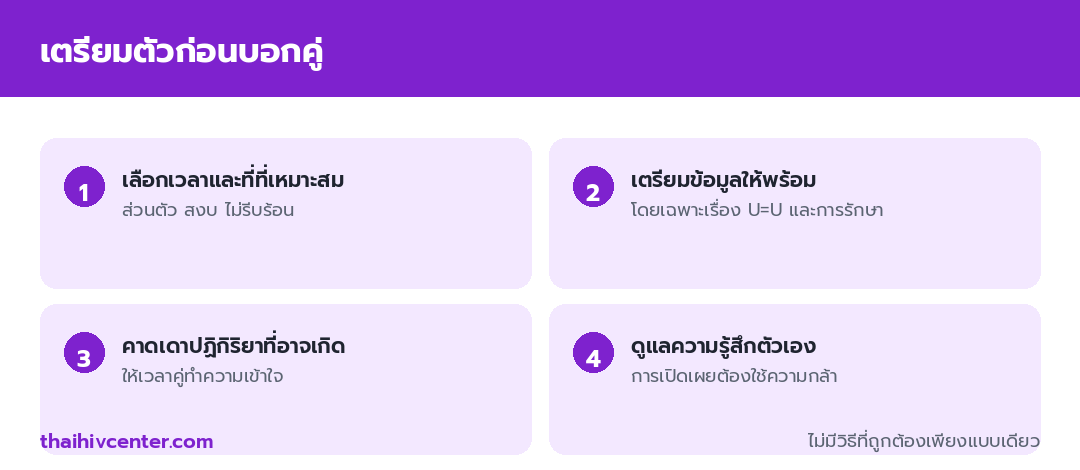
First, choose an appropriate time and place — private, calm, with enough time to talk without rushing. Second, prepare information, especially understanding U=U and current treatment, because accurate information answers questions and eases a partner's worry. Third, try to anticipate possible reactions, to prepare emotionally and with answers, even if you can't predict everything. And fourth, care for your own feelings, because disclosure takes courage and may affect your emotions. Preparing both information and mindset helps you enter the conversation more steadily.
Choosing the time and place
The time and place greatly affect the atmosphere of the conversation. Choose a time when both you and your partner are not rushed and not stressed by other things. Avoid telling during an argument or a tense situation. The place should be private where both feel safe and can talk openly. Some may choose the familiar home; some may choose a quiet place outside. The key is a place where your partner can express feelings naturally and privately. Giving enough time without needing to rush off to something else helps the conversation not be cut short and gives both space to understand each other.
What helps the conversation go smoothly
Several things help disclosure go more smoothly and constructively.
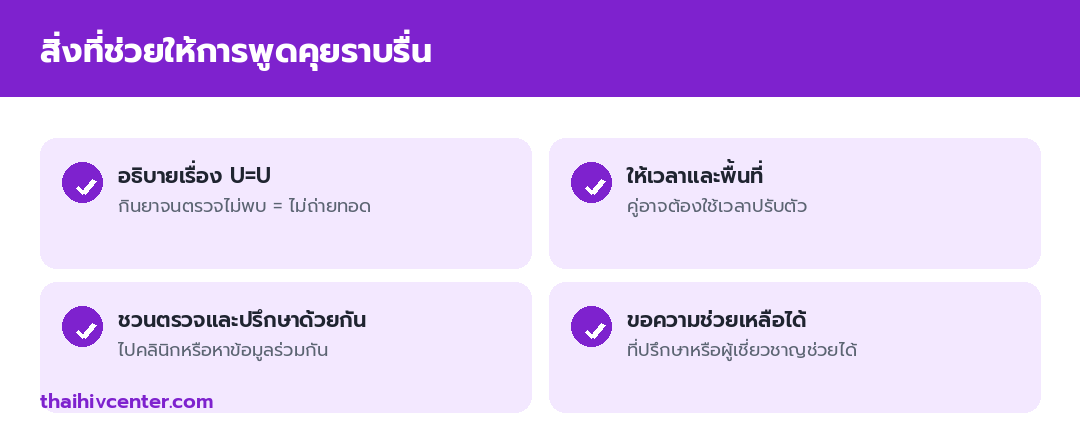
First, explaining U=U, which helps a partner understand that current treatment means a person taking ARVs to undetectable doesn't transmit HIV sexually — this greatly reduces fear. Second, giving time and space, because a partner may need time to take in the information and adjust; don't expect a perfect reaction immediately. Third, inviting your partner to test and consult together, which helps them feel they aren't facing this alone and get information from professionals. And fourth, knowing you can seek help from a counselor or professional. Having these approaches keeps the conversation grounded in information and understanding rather than fear.
The role of U=U in telling a partner
The U=U concept (Undetectable = Untransmittable) plays a crucial role in disclosing to a partner, because it is information that turns fear into understanding. When a person with HIV takes ARVs consistently until the viral level is undetectable, they don't transmit HIV sexually. This helps a partner understand that a relationship with a well-treated person with HIV is safe regarding HIV, and that they can plan a future together, including having children who are HIV-free. Explaining U=U with accurate information and credible references keeps the conversation grounded in scientific fact. Read more in what U=U is and life expectancy with HIV to prepare your information.
Handling a partner's reactions
Each partner may react differently on learning. The table below shows examples of possible reactions and how to respond.
| Possible reaction | How to respond |
|---|---|
| Shock or silence | Give time and space; don't rush a response |
| Many questions | Answer with accurate information, especially U=U |
| Worry about risk | Explain prevention and invite consulting a doctor together |
| Needs time to think | Respect the decision and allow time to adjust |
Whatever the reaction, staying calm and responding with understanding helps a lot. The first reaction may not be the final feeling — many need time to process the information before understanding and accepting. Giving time and accurate information is the best thing you can do.
If a partner responds negatively
Although we hope a partner responds with understanding, in reality, sometimes a partner may respond negatively — perhaps from fear, lack of understanding, or misconceptions about HIV. If this happens, understand that a partner's reaction is about them and doesn't reflect your worth as a person. Rejection is an understandable pain, and you deserve emotional care in that time. Having friends, family, or an understanding support group helps you get through this. Sometimes time and information may change a partner's understanding later, but whatever the outcome, caring for your own mental health is most important, and seeking help from a professional is always a good option.
Telling a new partner vs a current partner
The disclosure situation may differ between a new partner and a current one. For a current partner in an existing relationship, disclosure may come with worry that the existing relationship will change, but there is a foundation of built trust as an asset. For a new partner starting a relationship, considering when and how to tell is a personal decision — some choose to tell early before the relationship deepens, for clarity. In both cases, the key principles are the same: choosing an appropriate time, preparing information, and respecting both yourself and your partner. There's no fixed answer on how early or late to tell — it depends on your comfort and each person's context.
Caring for yourself through the process
While we emphasize the conversation with a partner, what shouldn't be overlooked is caring for yourself. Disclosure is an emotionally demanding process, and it's normal to feel worried, afraid, or vulnerable. Accepting these feelings without blaming yourself is important. Before and after the conversation, find time to care for yourself, do things that help you feel better, and have someone you trust to talk to. Successful disclosure isn't measured only by a partner's reaction but also by your having done what you saw as appropriate with courage. Respecting and being kind to yourself through this process helps you protect your mental health whatever the outcome.
Seeking help from professionals
You don't have to face this process alone. There are professionals and services that can help. Health counselors or staff at HIV clinics often have experience helping people with HIV disclose their status and can give advice suited to your situation. Some places offer pre- and post-disclosure counseling or help facilitate a conversation with your partner. Psychologists or mental-health counselors can also help care for your emotions and worries. Seeking help isn't weakness but smart self-care. If you want counseling or information, you can find a clinic near you to talk with people who understand.
Frequently asked questions
Do I have to tell a partner every time
Disclosure is a personal, sensitive matter. Telling a partner helps with trust and planning health together. If unsure, consulting a professional helps.
When in the relationship should I tell
There's no fixed answer — some tell early, some wait until they feel trust. Choose a time when you feel ready and safe.
How do I explain U=U so my partner understands
Explain that taking ARVs to undetectable means not transmitting HIV sexually, and invite them to review credible sources or consult a doctor together.
If my partner can't accept it, what should I do
A partner's reaction is about them and doesn't reflect your worth. Care for yourself and find support from understanding people or professionals.
I'm very worried after telling — what should I do
Talking to a counselor or mental-health professional helps care for your emotions. You don't have to face this alone.
Who can help with telling a partner
HIV clinic staff, counselors, and psychologists can give advice and help prepare the conversation.
Summary
Telling a partner you have HIV takes courage and preparation, and there's no single right way. Choosing an appropriate time and place, preparing information especially about U=U, and giving a partner time help keep the conversation grounded in understanding rather than fear. A partner's reactions may differ, and staying calm with accurate information helps a lot. Most importantly, care for yourself through this process, and know you can always seek help from professionals. If you want counseling or information, find a clinic near you to talk with people who understand.
Note: Disclosure is an emotionally demanding process. If you feel distressed or very worried, talking to a mental-health professional or counselor can help. You don't have to face it alone.