HIV and STI Check-Up: What Should You Get Tested For?
When it comes to sexual-health testing, many people think only of HIV testing. In truth, a complete STI check-up should cover more, because there are several other sexually transmitted infections, some of which don't show clear symptoms. Testing only for HIV may miss other conditions that should be treated. This article explains what a complete sexual-health check-up should include, how often to test, who should test, and how it works, so you can care for your sexual health with confidence and completeness.
What should an HIV and STI check-up include
A good sexual-health check-up should look at the big picture rather than a single condition, because sex that carries HIV risk often carries risk for other STIs at the same time. Comprehensive testing helps detect and treat conditions early, reduces long-term complications, and reduces spread to partners. The good news is that many conditions can be tested together in a single visit, making it convenient and time-saving. The key is choosing tests appropriate to your risk and behavior, by consulting a doctor or clinic staff.
STIs worth testing for
Besides HIV, there are several other STIs worth considering.
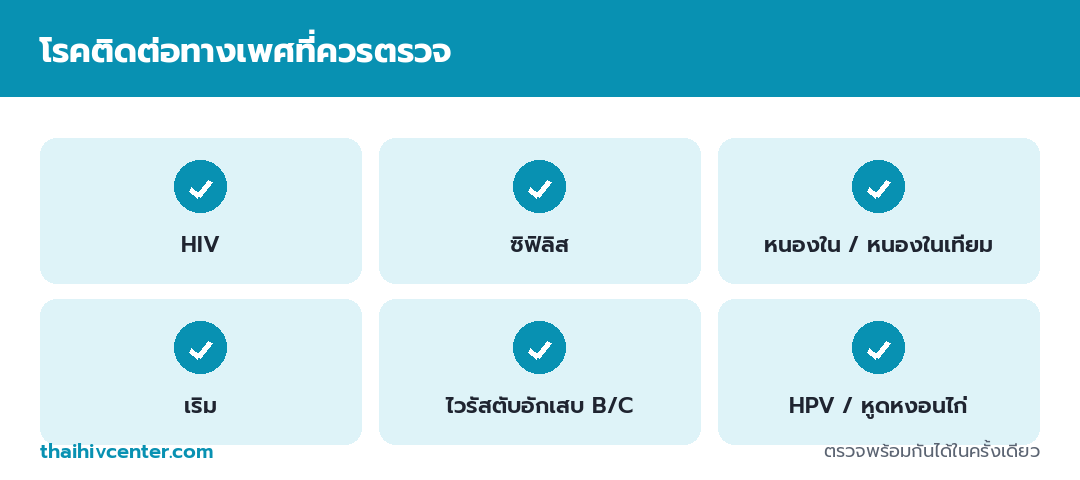
Conditions worth considering include HIV as a baseline, syphilis which sometimes shows no symptoms but has long-term effects, gonorrhea and chlamydia which are common and can cause complications if untreated, herpes which causes sores on the genitals or mouth, hepatitis B and C which can transmit through sex and blood, and HPV or genital warts which is linked to some cancers. You don't always need to test for every condition, but choose based on risk and a doctor's advice, which helps make testing appropriate for each person.
How often and who should test
Testing frequency depends on each person's behavior and risk.
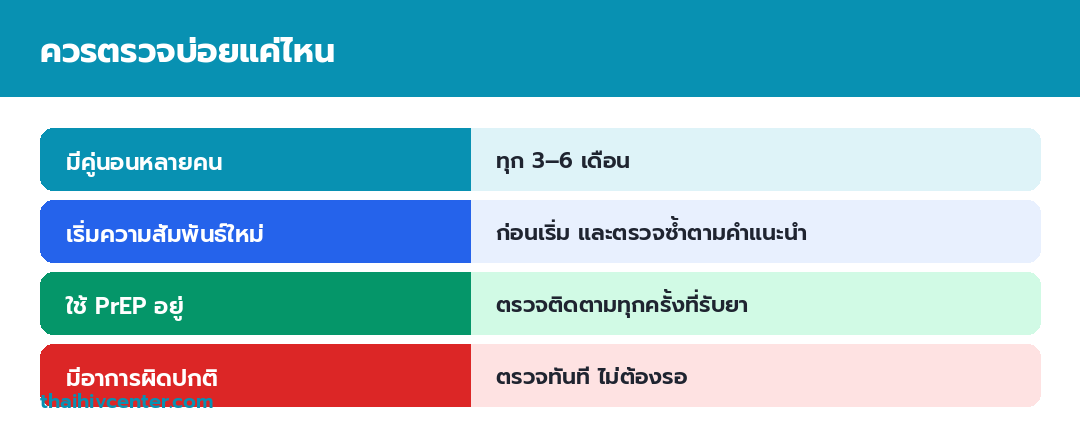
People with multiple partners or who change partners often should test regularly, such as every 3-6 months. Those starting a new relationship should test before having sex and retest as advised. People on PrEP have regular monitoring at each visit. And those with unusual symptoms — such as abnormal discharge, painful urination, or sores or bumps on the genitals — should test immediately without waiting. Regular testing when you have a risk is a healthy habit and eases the mind.
How STI testing differs from HIV testing
HIV testing is part of STI testing, but a complete STI check-up covers other conditions too, using different methods by condition. Some are tested from blood, others from urine or a swab. HIV testing involves the window period to consider, while other conditions have their own appropriate testing times. So consulting a doctor to plan appropriate testing is important. Read more in HIV testing methods and the HIV window period to understand timing.
How STI testing works
STI testing is usually straightforward and quick. It generally starts with talking to a doctor or staff about your risk history and symptoms to choose which conditions to test. Then samples are collected — which may be a blood draw, urine collection, or a swab of the relevant area, depending on the condition. Many can be tested together in one visit. Some results are known quickly, while others may take time. Staff will give results and advice, and if a condition is found, treatment can begin — most STIs are treatable.
Is it free or is there a cost
In Thailand, free HIV testing is available at many places under coverage, and some also offer testing for other STIs. Costs may vary by location and test type. Testing at specialized clinics or some community services may offer accessible options. To learn where you can test for free, read more about free HIV testing, and if you're interested in preliminary self-testing, an HIV self-test kit is an option — but confirm and test for other conditions at a clinic for completeness.
What to do after getting results
If all results are negative, that's good news — keep preventive behavior and test at the appropriate time going forward. If an STI is found, don't panic, because most are treatable. Start treatment as advised, complete the medication, and inform partners so they can be tested and treated too, to prevent reinfection. If HIV is detected, there are antiretrovirals that are free under coverage and keep you healthy. Testing is an important first step in caring for yourself. You can find a clinic near you to get tested.
Frequently asked questions
Is testing only for HIV enough
It depends on your risk, but comprehensive STI testing helps detect other conditions that may have no symptoms. Consulting a doctor helps choose appropriate testing.
No symptoms — should I test for STIs
Yes, because many conditions including HIV and syphilis may have no early symptoms. Testing based on risk is important.
Can I test for all STIs in one visit
Many can be tested together in one visit, using blood, urine, or swab samples depending on the condition.
Does STI testing hurt
Generally not much — a blood draw or sample collection is quick, and staff make it as comfortable as possible.
Summary
Good sexual-health care shouldn't test only for HIV but should cover other STIs like syphilis, gonorrhea, herpes, hepatitis, and HPV, based on risk and a doctor's advice. Testing frequency depends on behavior, and people with multiple partners or on PrEP should test regularly. Many conditions can be tested together and most are treatable, so regular testing is worthwhile care for yourself and your partners. When ready, find a clinic near you to start comprehensive sexual-health care.