HIV Symptoms in Women — Do They Differ from Men? Most Symptoms Are Similar, and Testing Is the Only Way to Know
A question many women wonder about is whether HIV symptoms in women differ from those in men, and whether there are specific symptoms that indicate it. The important answer is that HIV symptoms in women are mostly similar to those in men. The main symptoms — flu-like symptoms early or no symptoms at all in the latent stage — don't differ by sex. Although there are some points that may differ slightly in women, what's most important to understand is that all HIV-related symptoms are non-specific and can't be used to diagnose whether you're infected, whether in women or men. Using symptoms to judge status isn't reliable. The only way to know your status for certain is testing. This article explains in detail what HIV symptoms in women are like, what points may differ from men, why symptoms can't be used to diagnose, and why testing matters, so women understand this correctly and care for their health appropriately.
Do HIV symptoms in women differ from men
The answer is that HIV symptoms in women are mostly similar to those in men. The main HIV-related symptoms don't differ significantly by sex. Both women and men may have flu-like symptoms early after infection, or no symptoms at all for a long time in the latent stage. Although there are some points that may differ slightly in women, such as certain gynecological symptoms that may be more frequent when immunity declines, these points are also non-specific and can't be used to distinguish whether you're infected. What's most important is that HIV-related symptoms in both women and men are non-specific, making trying to diagnose from symptoms inaccurate. Understanding that most symptoms are similar and non-specific helps you see you shouldn't rely on symptoms to judge status, whatever the sex, and should use testing, an accurate method. Read more about early symptoms in early HIV symptoms.
Most symptoms are similar
HIV symptoms in women and men are similar in many ways, helping you understand that symptoms don't differ significantly by sex.
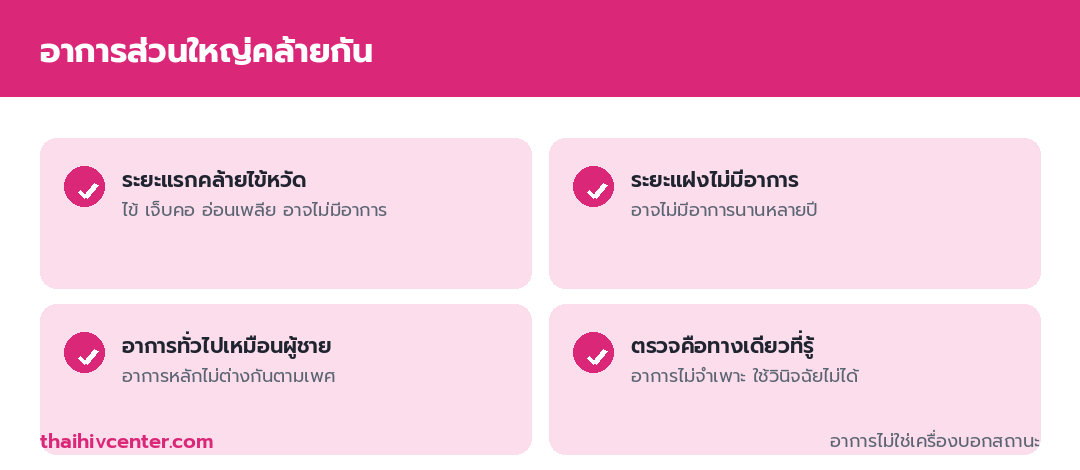
- Early flu-like — both women and men may have fever, sore throat, fatigue, or body aches, or no symptoms.
- Latent stage no symptoms — both sexes may have no symptoms for years, even though the virus damages immunity.
- General symptoms the same — the main HIV-related symptoms don't differ by sex.
- Testing is the only way to know — symptoms are non-specific and can't be used to diagnose, in both women and men.
These similarities show that HIV symptoms don't differ much by sex, and importantly, these symptoms are non-specific and can't be used to diagnose. Understanding that most symptoms are similar helps you not misunderstand that there are specific symptoms indicating HIV in women. Read more about having no symptoms in can you have HIV with no symptoms.
What are early symptoms like
Symptoms early after infection, called the acute stage, usually occur in the first few weeks after infection and are similar in both women and men. Symptoms that may occur in this stage include:
- Fever
- Sore throat
- Fatigue
- Body aches
- Swollen lymph nodes
- Rash
However, these symptoms aren't specific to HIV, because they're found in many general illnesses, such as colds or flu, and importantly, not everyone has symptoms in this stage. Some may have only mild symptoms unnoticed, or none. Symptoms in the early stage usually go away on their own within a few days to weeks, so many mistakenly think they've recovered. Understanding that early symptoms in women are similar to men's and non-specific helps you see you can't use symptoms to diagnose. Read more about rash in what an HIV rash is like.
The latent stage may have no symptoms
After the early stage, HIV enters the latent stage, when many people with HIV have no symptoms, in both women and men. This stage can last years, in some cases over a decade if untreated. During this latent stage, a person may feel well and live normally, but HIV is still active in the body and slowly damaging the immune system. What's important to understand is that having no symptoms in the latent stage doesn't mean not infected, true in both women and men. Because HIV has a long, symptom-free latent stage, many women may be infected without knowing and have no symptoms to signal it. Feeling well and being healthy isn't a guarantee against infection. For this reason, testing when you have a risk without waiting for symptoms matters. Understanding that the latent stage may have no symptoms helps explain why testing is the only way to know your status for certain and helps women realize the importance of testing whether or not they have symptoms.
Points that may differ in women
Although the main symptoms are similar, there are some points that may differ slightly in women, which should be understood correctly.
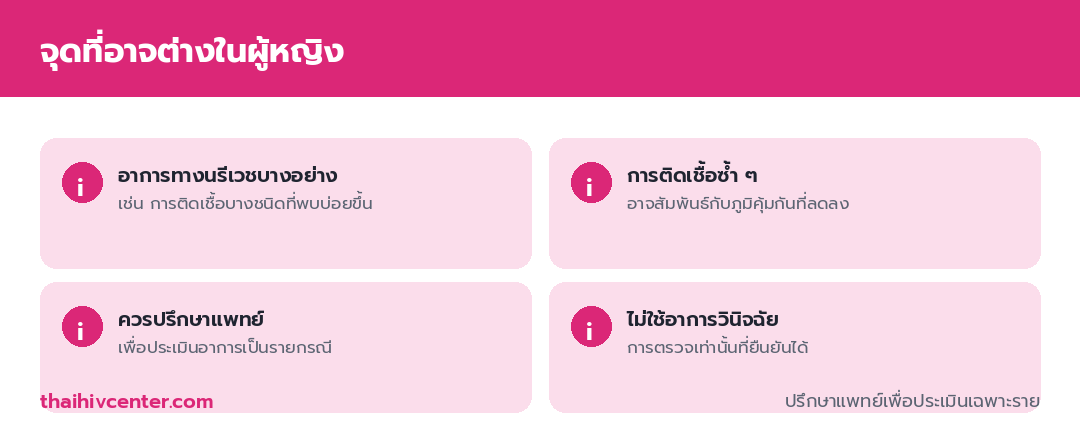
| Point that may differ | Explanation |
|---|---|
| Certain gynecological symptoms | Such as certain infections that may be more frequent when immunity declines |
| Recurrent infections | May relate to declining immunity, but aren't specific to HIV |
| Still non-specific | These points can't be used to diagnose HIV; testing is needed |
Things to understand about points that may differ in women:
- Certain gynecological symptoms or recurrent infections may occur, but have many possible causes and aren't specific to HIV
- These points can't be used to distinguish whether you have HIV
- If you have worrying symptoms, consult a doctor to assess case by case
Understanding that points that may differ in women are still non-specific helps you not misunderstand that there are specific symptoms indicating HIV and see the importance of testing and consulting a doctor.
Gynecological symptoms that may occur
In women with declining immunity, certain gynecological symptoms may be more frequent, such as certain infections in the genital area that may recur. However, what's important to understand is that these gynecological symptoms aren't specific to HIV and have many possible causes unrelated to HIV. Many women with gynecological symptoms don't have HIV, and those symptoms are from other common causes. So having gynecological symptoms doesn't mean HIV, and you shouldn't use these symptoms to self-diagnose. If you have worrying or recurrent gynecological symptoms, what to do is consult a doctor to find the cause and get appropriate care, not conclude yourself that it relates to HIV. A doctor can assess symptoms, find causes, and give appropriate care. Understanding that gynecological symptoms aren't specific to HIV reduces unnecessary worry and helps women care for their health appropriately, by consulting a doctor for worrying symptoms and testing for HIV when they have a risk.
Symptoms are non-specific, can't tell for sure
An important point to emphasize is that HIV-related symptoms in both women and men are non-specific. Symptoms like fever, fatigue, swollen lymph nodes, or even gynecological symptoms in women are all found in many other conditions unrelated to HIV. Having these symptoms doesn't mean HIV, and conversely, having no symptoms doesn't mean not infected. The non-specificity of symptoms makes trying to self-diagnose from symptoms inaccurate and possibly causing worry or misunderstanding. Some may worry too much when they have general symptoms and think they're infected, while some may be careless because they have no symptoms. The best solution is not relying on symptoms to judge but using testing, an accurate method. Understanding that symptoms are non-specific helps women not panic over general symptoms and not be careless when they have none, and see that testing is a reliable way to know status.
Why not use symptoms to diagnose
Trying to diagnose HIV from symptoms is an unreliable approach for several reasons. First, HIV-related symptoms are non-specific and found in many other conditions, so you can't distinguish whether they're from HIV or another cause. Second, many people with HIV have no symptoms for a long time, so waiting for symptoms may mean missing detection. Third, each person's response to the virus differs — some have symptoms, some don't — so you can't use symptoms as a definite criterion. For these reasons, using symptoms to diagnose is inaccurate and may lead to misunderstanding — both excessive worry with general symptoms and carelessness with no symptoms. The accurate, reliable way to know your status is testing, which can detect infection directly, regardless of symptoms. Understanding why you shouldn't use symptoms to diagnose helps women decide to test when they have a risk, instead of trying to assess from symptoms which is inaccurate, and helps get a clear answer about their status.
Testing is the only way to know your status
When symptoms can't reliably tell infection status, the only way to know for certain is HIV testing. Testing is an accurate way to detect infection and gives a clear result, whether or not you have symptoms. Testing has several methods and channels, from testing at a facility to self-testing. For women with a risk, testing is an important part of sexual health care. Knowing your status helps you plan health care appropriately. If negative, it reassures you and helps plan prevention; if positive, you can start effective treatment early, and treatment today helps people be healthy and live normally. Understanding that testing is the only way to know your status for certain helps women see the importance of testing, whether or not they have symptoms, and when they have a risk, test without waiting for symptoms. Read more about the window period in the HIV window period.
Sexual health care for women
Sexual health care matters for every woman, including testing for HIV when you have a risk and other health care. Good sexual health care includes:
- Test for HIV when you have a risk — without waiting for symptoms, and at the appropriate time.
- Use protection — such as condoms, to prevent HIV and other STIs.
- Have periodic sexual health checks — to care for overall health and detect problems early.
- Consult a doctor for worrying symptoms — to assess and get appropriate care.
Thorough sexual health care helps women be healthy and care for themselves appropriately. Testing for HIV when you have a risk is part of this care and isn't something to be embarrassed about but caring for your health responsibly. Read more about transmission in how HIV is transmitted.
Misconceptions about symptoms in women
There are several misconceptions about HIV symptoms in women to correct:
- "Women have specific HIV symptoms that can tell" — false, most symptoms are similar to men's and non-specific, can't be used to diagnose.
- "Having gynecological symptoms means HIV" — false, those symptoms have many causes and aren't specific to HIV.
- "No symptoms means not infected" — false, women may have no symptoms for years in the latent stage.
- "You can tell who's infected by looking" — false, infection can't be told from appearance.
Knowing these facts reduces misconceptions that may lead to excessive worry or carelessness and helps women understand that testing is the only reliable way to know status, not looking at symptoms or appearance.
Managing worry about symptoms
It's normal for many women to worry when they have some symptoms and wonder if they relate to HIV, especially after a risk. What helps is understanding that general symptoms and gynecological symptoms aren't specific to HIV and having or not having symptoms can't tell status, so trying to self-diagnose from symptoms usually increases worry without a certain answer. The best solution to ease worry is testing at the appropriate time, which gives a clear answer, and consulting a doctor for worrying gynecological symptoms to find the actual cause. Avoid repeatedly searching symptoms online or comparing your symptoms to symptom lists, because it usually causes excessive worry. If worry disrupts daily life a lot, talking to a health professional or counselor is a good option. Having accurate information and testing for a certain answer helps manage worry appropriately. Read more about managing worry in still worried after an HIV test.
Frequently asked questions
Do HIV symptoms in women differ from men
Mostly similar; the main symptoms don't differ by sex, and although some points may differ slightly, all are non-specific and can't be used to diagnose.
Does having gynecological symptoms mean HIV
No, gynecological symptoms have many causes and aren't specific to HIV; if worried, consult a doctor to find the cause.
Can a woman have HIV with no symptoms
Yes, a woman may have no symptoms for years in the latent stage; no symptoms doesn't mean not infected; the only way to know is testing.
What are early symptoms like in women
Similar to men, such as fever, sore throat, fatigue, swollen lymph nodes, or rash, but non-specific and there may be no symptoms.
When should I test for HIV
Test when you have a risk without waiting for symptoms, and at the appropriate time, with a conclusive result at 3 months.
Can I tell from symptoms if I'm infected
No, symptoms are non-specific and can't be used to diagnose, in both women and men; testing is the only way to know for certain.
Summary
HIV symptoms in women are mostly similar to those in men, including flu-like symptoms early or no symptoms at all in the latent stage. Although there are some points that may differ slightly in women, such as certain gynecological symptoms that may occur when immunity declines, these points are also non-specific and have many causes. All HIV-related symptoms are non-specific and can't be used to diagnose, whatever the sex. The only way to know your status for certain is testing, which should be done when you have a risk without waiting for symptoms. For worrying gynecological symptoms, consult a doctor to find the cause. Understanding this helps women care for their health appropriately and not be careless. If you have a risk or want to test, find a clinic near you.
Note: This article provides informational content. If you have worrying symptoms or want specific advice, consulting a doctor and testing helps you get answers and appropriate care.