Where to Test for HIV, How Much It Costs, and Where to Test for Free
Once you decide to test for HIV, the next questions are "where should I go," "can I test for free," and "if I pay, how much is it." This uncertainty often makes people hesitate, even though HIV testing in Thailand is now easy to access with many options, much of it free and confidential. This article gathers all the testing options, from places and costs to free-testing entitlements and self-test kits, so you can confidently choose what suits you. Whether you are worried about cost, privacy, or simply do not know where to start, this article gives you the overview to make the decision easier.
Where you can test for HIV
Thailand offers many types of HIV testing services, each with different strengths. You can choose based on convenience and comfort.
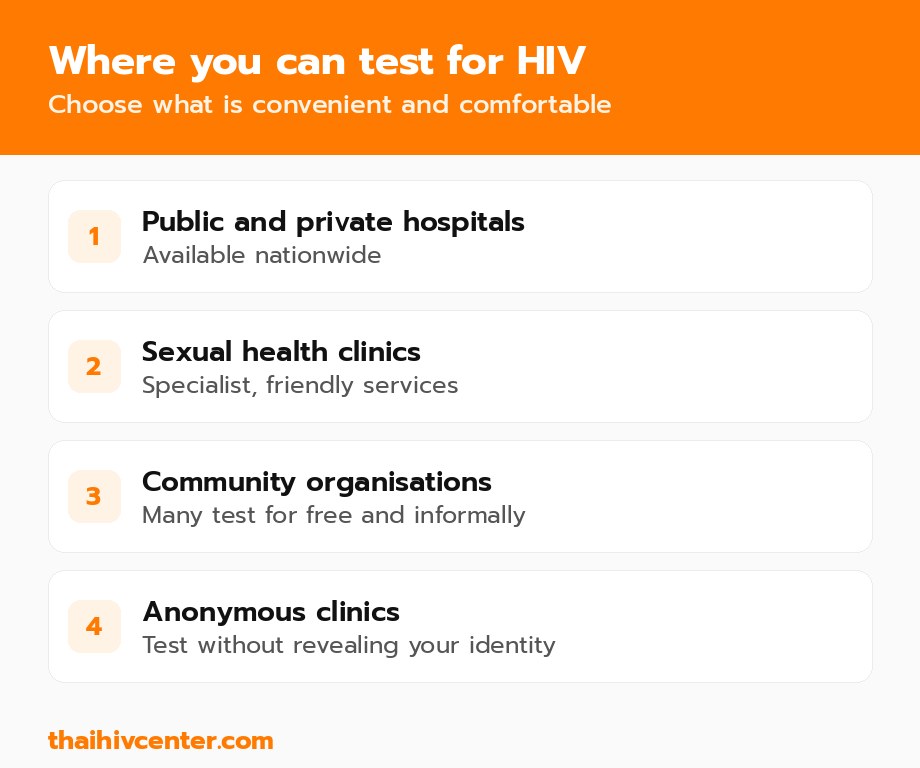
Public and private hospitals
Hospitals nationwide offer HIV testing, both under entitlements and for a fee. Public hospitals are often low-cost or free with entitlements, while private hospitals are fast and convenient but charge a fee.
Sexual health clinics
Specialist sexual health clinics test for HIV and other STIs, with knowledgeable, understanding staff and an atmosphere that is usually friendly and non-judgemental.
Community organisations
Many community organisations offer free HIV testing with staff who understand different communities. Many people feel comfortable with these services because the atmosphere is informal.
Anonymous clinics
For those wanting high privacy, anonymous clinics test without requiring you to reveal your identity, which greatly eases privacy concerns.
Where to test for HIV for free
The good news is that HIV testing in Thailand always has a free option.
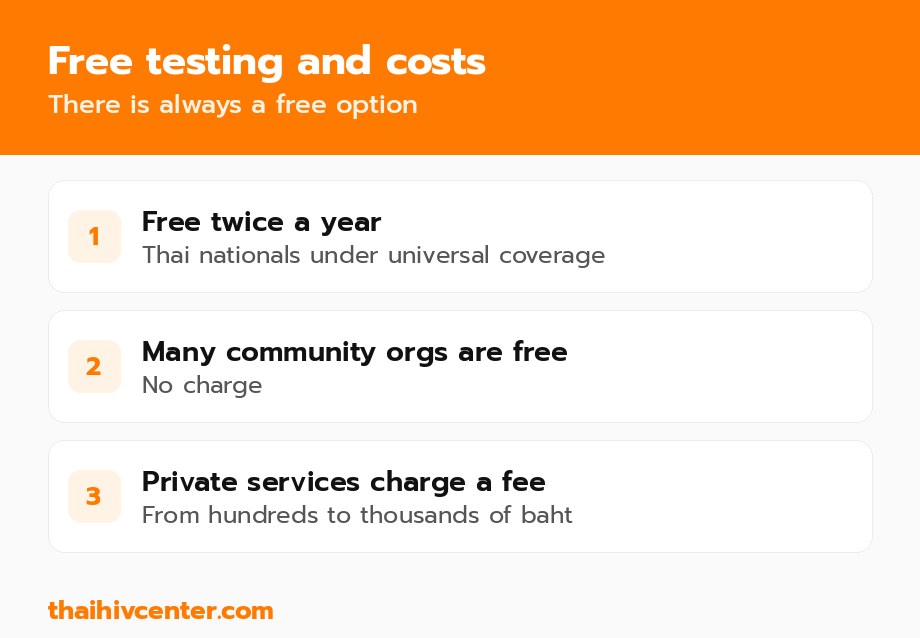
Thai nationals can test for HIV free twice a year at hospitals under universal coverage, just bring your ID card. In addition, many community organisations test for free with little paperwork. These free services reflect a public health policy aimed at making testing accessible to everyone, to reduce new infections and bring people into treatment sooner. Because cost is one of the most common reasons people delay testing, removing that barrier helps far more people learn their status early.
How much does an HIV test cost?
If you choose to pay, such as at a private hospital or some clinics, the cost varies by test type and location.
| Option | Approximate cost |
|---|---|
| Free twice a year (public hospital) | No charge |
| Many community organisations | Free |
| Private hospital / clinic | From hundreds to thousands of baht |
| Self-test kit | A few hundred baht |
Prices can change by location and time, so check directly with the facility you plan to use for certainty.
HIV self-test kits
Another convenient, private option is a self-test kit.
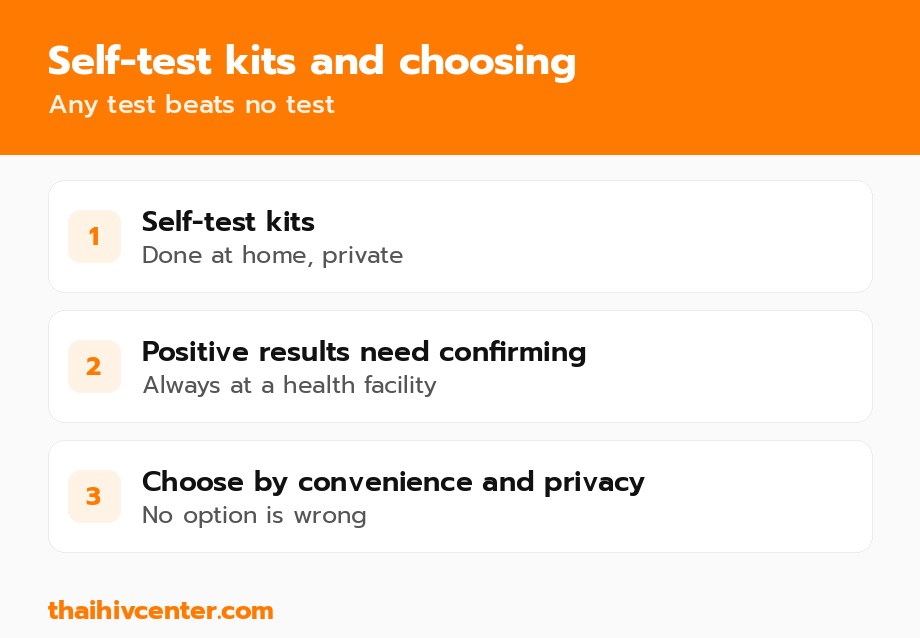
Self-test kits let you test at home privately, ideal for those not yet comfortable going to a facility. However, if the result is positive, always confirm at a health facility, because a screening result must be confirmed before it is final. Follow the instructions carefully for accuracy.
Testing for HIV alongside other STIs
When you test for HIV, many places also offer screening for other STIs at the same time, such as syphilis, gonorrhoea and hepatitis B. Testing for several at once is a good opportunity to look after your sexual health comprehensively, especially if you have had a risk, because some STIs may not show clear symptoms. Finding and treating them early prevents complications and reduces onward spread. If you're unsure what to test for, ask staff for advice suited to your risk.
How accessible testing has become
In recent years, access to HIV testing in Thailand has become much easier, with a range of services, flexible hours at some places, and online booking that reduces waiting time. Some organisations also offer outreach testing in communities or at events, so people can access testing more easily without travelling far. These conveniences reduce barriers to testing and make caring for your sexual health an easy part of everyday life.
Types of HIV test
Beyond location, there are several types of HIV test, each with a different detection window and level of convenience. Understanding the differences helps you choose what fits your situation.
Rapid test
A fingertip blood prick with a preliminary result in about 20 minutes. Ideal for those wanting a quick result, it is often used in clinics and community organisations, convenient and simple.
Blood-draw test (4th generation)
A blood draw sent to a laboratory. It is highly accurate and detects infection earlier than older tests, and is common in hospitals. Because of its accuracy, it is often the standard choice when a definitive result is needed.
Nucleic acid test (NAT)
The test that can detect the virus earliest. It is used in specific cases, such as when recent infection is suspected or to confirm a result. It is not usually the first test for routine screening, but plays an important role in specific situations.
After testing, how to read your result
Understanding what your result means reduces anxiety and clarifies what to do next.
Negative (no virus found)
This means no virus was found. If you had no risk in the past three months, it is reliable. If your risk was recent, retest after the window period for certainty.
Positive (virus found)
A reactive screening result must always be confirmed first, and it is not the end but the start of treatment that lets you live normally. A clinician begins treatment and gives self-care guidance.
How often should you test for HIV?
How often to test depends on personal risk. People with ongoing risk, such as multiple partners or not using condoms regularly, should test every 3-6 months, while others should test at least once a year. Regular testing keeps you aware of your status, and if anything changes you find out quickly, so you can enter care promptly. Scheduling tests in advance and tying them to a routine, such as an annual check-up, makes it easier to keep the habit.
How to choose what suits you
Choosing where to test depends on your needs. To save money, use free testing at a hospital or community organisation. For high privacy, an anonymous clinic or self-test kit is a good choice. For speed and convenience, a private hospital may fit. Whichever you choose, what matters is getting tested, because knowing your status is the first step in caring for your health. There is no single "best" place that fits everyone, only the one that fits you right now.
Testing for HIV: a small step that matters to society
Deciding to test for HIV is not only self-care, it is part of building a healthier society. As more people feel able to test and talk about it openly, fear and stigma decline. Accessible, free testing is an important tool that helps a country move closer to ending the HIV epidemic. Every time you test, you not only look after your own health but also become part of a change that makes HIV testing a normal thing anyone can do without shame. This is the power of a small step that everyone can take.
Preparing before you go
An HIV test needs little preparation, no fasting required, just bring your ID if using an entitlement, and prepare emotionally. There is no special diet or restriction beforehand, which makes it easy to fit into a busy day. For full details on the steps and preparation, read Preparing for your first HIV test, or find testing locations and book through our clinic directory.
Why knowing your HIV status matters
HIV testing isn't only for people who feel "at risk", it is part of basic health care everyone should do. Knowing your status has many benefits. If the result is negative, you have peace of mind and can plan prevention to keep it that way. If positive, early detection lets treatment begin in time, so people with HIV stay healthy with a life expectancy close to average. And once treated to undetectable, HIV isn't passed to a partner, the principle of U=U. Testing therefore protects both you and those you love. Beyond that, when many people in society know their status and enter care, the spread of HIV declines overall.
Worries before testing, and confidentiality
Feeling hesitant or anxious before testing is natural. Many people fear a positive result, or fear others finding out. What's important to understand is that your HIV result is protected health information, and facilities and organisations are obliged to keep it confidential. If you're especially concerned about privacy, you can choose anonymous testing. As for a positive result, remember that HIV today is a treatable condition, and knowing early is an advantage, not a punishment. Bringing a friend or someone you trust can help you feel more at ease.
Frequently asked questions
Are there conditions for free HIV testing?
Thai nationals can test free twice a year at hospitals under universal coverage, and many community organisations test free too.
Do I need an ID card to test?
For free testing under an entitlement, bring your ID, but many anonymous clinics test without revealing your identity.
Is my result confidential?
Your health information is protected, and facilities keep your result confidential.
Self-test or hospital, which is better?
Both have advantages. Self-tests are convenient and private, while facility testing offers counselling and confirmation. Choose by convenience.
Does an HIV test take long?
No. Taking a sample takes a few minutes, and a rapid test gives a preliminary result in about 20 minutes.
Can young people test on their own?
Young people can access testing, and many places offer youth-friendly, confidential services.
Does an HIV test hurt?
Only slightly, like an ordinary blood test. Some kinds only prick a fingertip.
Do I need to fast before testing?
No. An HIV test does not require fasting; you can eat normally.
Conclusion
HIV testing in Thailand is easy to access with many options: hospitals, sexual health clinics, community organisations, anonymous clinics, and self-test kits. Importantly, Thai nationals can test free twice a year, and many community organisations offer free testing too. Whether you're worried about cost or privacy, there is always an option to suit you. Don't let uncertainty stand in the way of this important step, because knowing your status is the start of good health care. Whatever the result, you always have options to care for yourself, and a single test can change your life for the better.
References
- CDC — HIV Testing
- World Health Organization (WHO) — HIV Testing Services
- British HIV Association (BHIVA)
- aidsmap — HIV testing
- HIV Testing — Thai HIV Center
This article is for educational purposes and is not a medical diagnosis. Prices and services may change; check directly with the facility.