How Is HIV NOT Transmitted? Facts You Should Know

Misunderstanding about how HIV spreads is a major cause of excessive fear and stigma toward people living with the virus. Many still believe that HIV is not transmitted only in certain cases, when in fact this virus is far harder to transmit than people think and does not spread through everyday contact at all. This article walks you through what HIV is not transmitted by, so we can live together in society with understanding, safety, and dignity.
Why understanding how HIV is not transmitted matters
When people do not understand how the virus spreads, baseless fears arise — fear of sharing meals, fear of working with someone who has the virus — which leads to discrimination and pushing people with HIV out of society. Knowing the fact that HIV does not spread through ordinary contact is therefore not just academic; it lets people living with the virus live, work, and have relationships normally.
Before understanding what does "not" transmit, it helps to know that HIV spreads only through blood and certain body fluids in a high enough amount. Read the actual routes in how HIV is transmitted, and the basics in what HIV is.
Everyday activities that do not transmit HIV
You can live safely with a person who has HIV in nearly every situation. These activities do not cause infection:
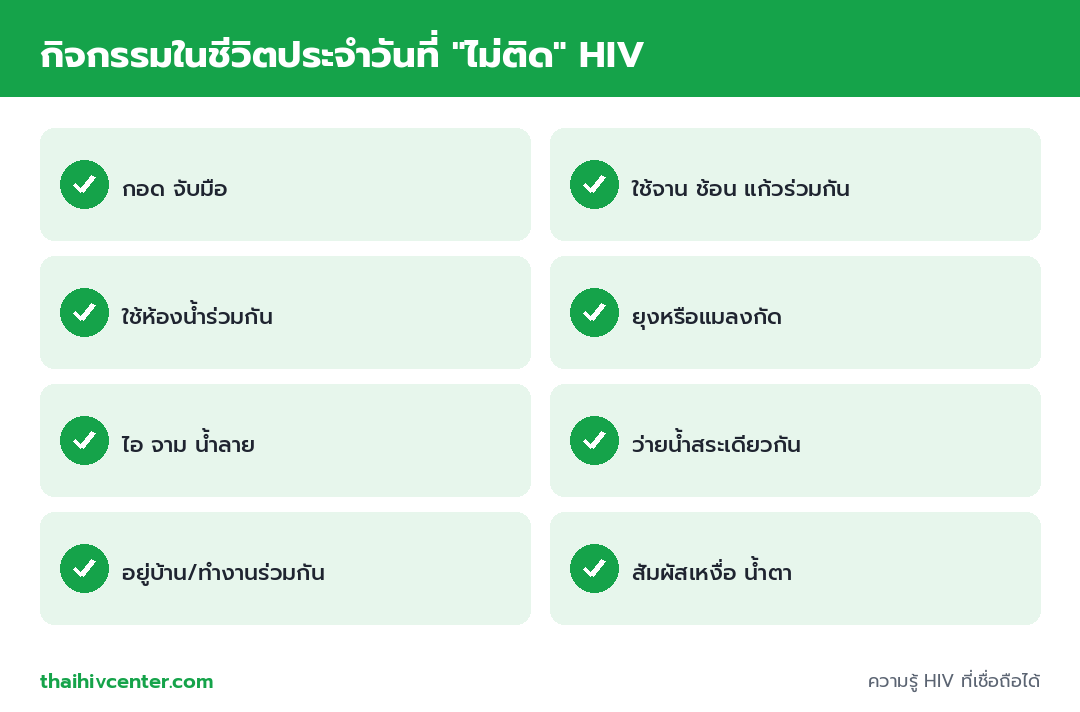
- Hugging, shaking hands, or ordinary touch, because the virus does not pass through intact skin.
- Sharing plates, spoons, cups, or eating together, because saliva does not contain enough virus.
- Sharing toilets, showers, or swimming pools.
- Mosquito or insect bites, because the virus cannot survive and multiply in insects.
- Coughing, sneezing, or contact with sweat and tears.
- Living in the same home or working together.
Common myths versus facts
Most fear comes from myths passed around. Compare them with the facts:
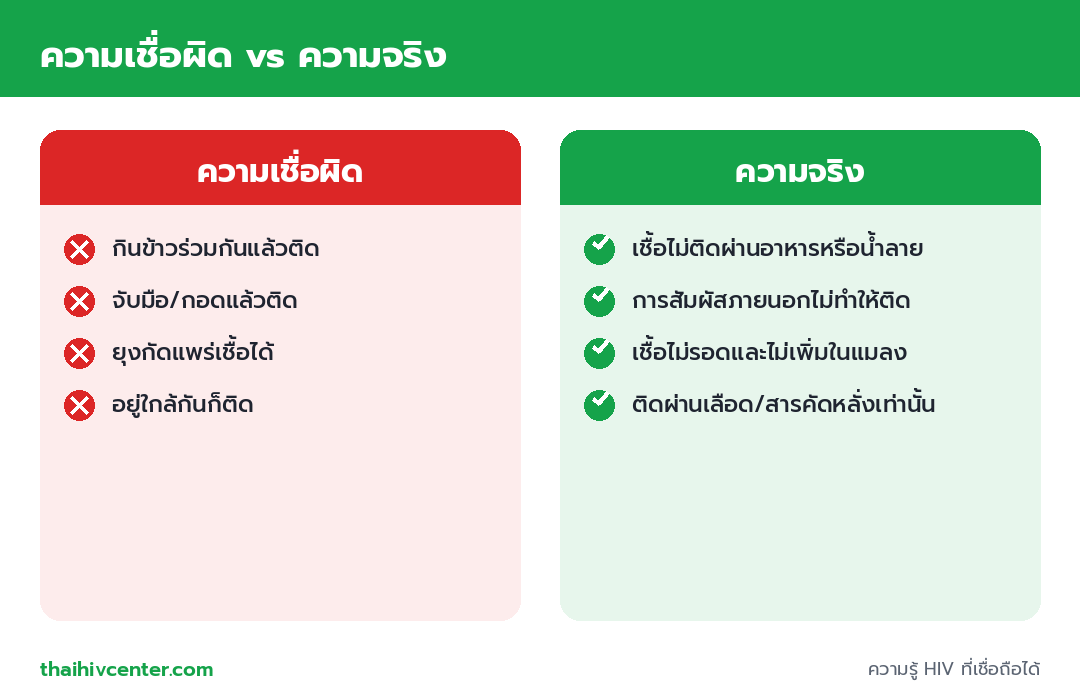
- Myth: Sharing meals transmits it — Fact: the virus does not spread through food or saliva.
- Myth: Shaking hands or hugging transmits it — Fact: external contact does not cause infection.
- Myth: Mosquito bites can spread it — Fact: the virus does not survive or multiply in insects.
- Myth: Being near someone transmits it — Fact: it spreads only through blood or body fluids.
How does U=U fit in
Another fact that reduces fear is the concept of U=U (Undetectable = Untransmittable), which means a person with HIV who takes antiretroviral medicine and suppresses the virus to undetectable levels consistently does not pass the virus on through sex to their partner. This means people with the virus who stay in treatment can have relationships and children safely. Read more in what U=U is.
HIV transmission needs all three conditions
The reason everyday contact does not cause infection is that HIV transmission requires three things together — if any one is missing, no infection occurs.
- Enough virus must be present — HIV is found in high enough amounts to transmit only in blood, semen, vaginal fluid, and breast milk, not in saliva, sweat, or tears.
- There must be a way into the body — such as soft mucous membranes (vagina, anus, mouth), an open wound, or directly into the bloodstream, while intact skin is a natural barrier.
- The virus must still be alive — once outside the body and exposed to air, HIV weakens and dies quickly, so it does not spread through objects or surfaces.
Understanding these three conditions makes it clear why hugging, sharing meals, or sharing a toilet carries no risk of infection at all.
Is it safe at work, school, and in public
It is definitely safe. Studying or working with a person living with HIV carries no risk of infection — whether sharing desks, equipment, meeting rooms, canteens, or toilets. For this reason, people with the virus can work in any job and live in society normally. Excluding or discriminating against people with the virus at work or school has no medical basis and also violates their rights and human dignity.
How stigma causes harm
Stigma and baseless fear not only hurt people with the virus emotionally but also make many afraid to get tested or treated for fear of being judged, which harms both the individual and epidemic control overall. Spreading accurate knowledge that HIV does not spread through everyday life is therefore an essential part of building an understanding and equal society.
Living with a person who has HIV, with understanding
We can be friends, colleagues, partners, or family of a person living with the virus normally. What people with HIV need is not distance but understanding and equal treatment. If you or someone close to you wants to test or seek advice on sexual health, you can find a friendly clinic across the country.
Frequently asked questions
Can you get HIV from living with someone who has it
No. Living together, sharing meals, toilets, or belongings does not cause infection.
If a mosquito bites a person with HIV then bites me, will I get it
No. HIV cannot survive or multiply in mosquitoes or insects.
Can kissing a person with HIV transmit it
Ordinary kissing does not transmit it, because saliva does not contain enough virus.
Is caring for or dressing wounds of a person with HIV risky
The risk is very low if you follow basic hygiene, such as wearing gloves when in contact with blood and washing your hands.
Summary
HIV does not spread through everyday life — not through hugging, shaking hands, sharing meals, sharing toilets, or mosquito bites. The virus spreads only through blood and certain body fluids. Understanding this reduces fear and stigma and lets us live together as equals. Whenever you want peace of mind about your own health, you can always find an HIV testing clinic near you.