
HIV vs AIDS
HIV and AIDS are not the same thing — HIV is the virus, AIDS is the advanced stage of untreated infection, and having HIV does not mean you have AIDS.
HIV and AIDS are not the same

Many people use HIV and AIDS as if they mean the same thing, but they are different. Understanding this difference matters, because it reduces fear and stigma and shows why treatment changes everything.
The short version
- HIV is a virus that damages the immune system
- AIDS is the most advanced stage of untreated HIV infection — not a separate virus
Put simply, a person has HIV but does not necessarily have AIDS, especially when they are on treatment. Read the basics at what is HIV.
What HIV is
HIV stands for Human Immunodeficiency Virus.
What the virus does to the body
HIV attacks CD4 cells, the white blood cells that play a key role in the immune system. As the virus destroys more of these cells, the body finds it harder to fight off other infections.
How HIV is acquired
HIV is passed through blood, sexual fluids, and breast milk. The most common routes are condomless sex and sharing needles. See the detail at how HIV is transmitted.
Living with HIV
The important thing is that a person with HIV can live a long and healthy life. With treatment the virus is controlled and the immune system is protected.
HIV is no longer a death sentence
HIV was once seen as equal to death, but with today's antiretrovirals it has become a manageable long-term condition, like other chronic illnesses. Many people with HIV work, study, raise families, and live full lives.
What AIDS is
AIDS stands for Acquired Immunodeficiency Syndrome.
AIDS is a stage, not a virus
AIDS is not a new virus. It is the most severe stage of HIV infection left untreated, when the immune system has been badly damaged.
When it is called AIDS
Someone is considered to have reached AIDS when:
- their CD4 count falls below 200 cells per cubic millimetre, or
- they develop an AIDS-defining opportunistic infection or cancer
Why it is dangerous
At this stage the body is vulnerable to infections that do not usually cause illness in healthy people, but it is still treatable. Read about all the stages at the stages of HIV.
The key differences
Placed side by side, the differences become clear. Looking at them one aspect at a time shows that the two terms mean different things.
Where they differ
- Type — HIV is a virus, while AIDS is a stage of the disease
- Having it — everyone with AIDS has HIV, but not everyone with HIV has AIDS
- Timing — HIV is acquired when a person is infected, while AIDS develops later, after the virus has damaged the immune system if untreated
- Transmission — what is passed on is the HIV virus; there is no separate way to catch AIDS
- Treatment — both involve antiretroviral medicine, which stops HIV from progressing to AIDS
An easy way to remember
HIV is the cause, and AIDS is what may happen without treatment. Treatment breaks that chain.
Why the two terms get confused
Part of the reason is that in the past, before effective medicine, HIV often did progress to AIDS, and that image stuck. Today the picture is very different, and using the right words reflects the current reality better.
Having HIV does not mean AIDS
The most common misunderstanding is that having HIV means having AIDS — this is not true. In reality there is a gap between getting HIV and developing AIDS, and treatment fits into that gap.
Most people never reach the AIDS stage
Today, most people who are diagnosed and start treatment early never develop AIDS at all. The virus is controlled and the immune system is protected.
Knowing your status is the starting point
Knowing early that you have HIV opens the door to treatment that stops the disease from progressing. This is why testing matters. See testing at HIV testing.
How HIV progresses to AIDS without treatment
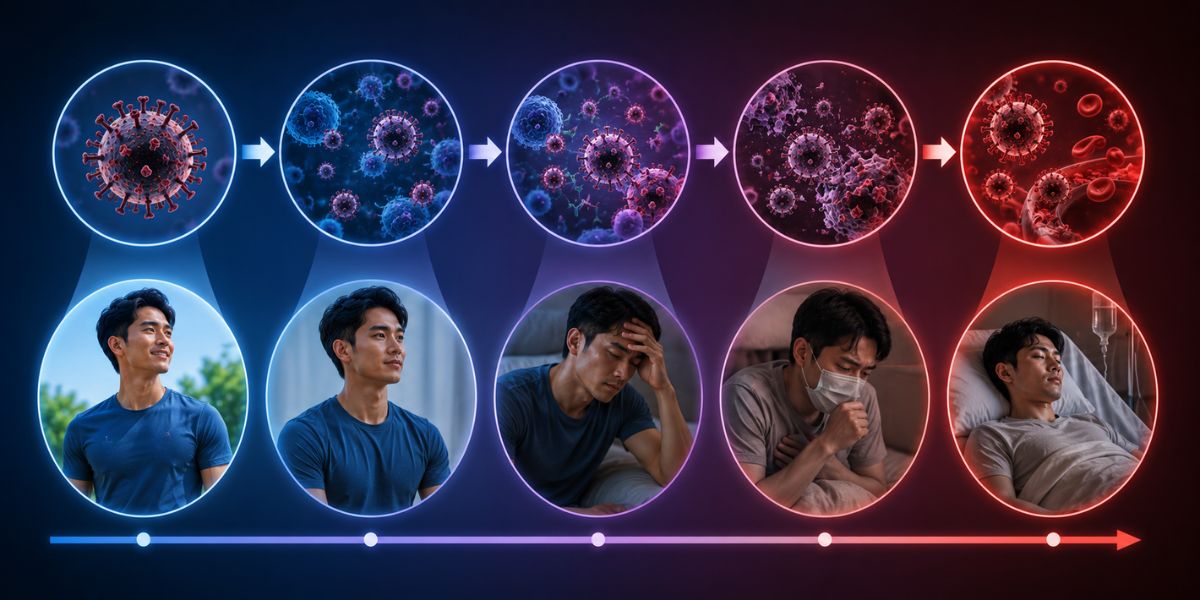
Without treatment, HIV infection slowly progresses through stages until it reaches AIDS.
The three stages in brief
- Acute infection — the early period when the virus multiplies rapidly
- The asymptomatic stage — which can last many years without symptoms
- The AIDS stage — when the immune system is severely damaged
The timeline
On average it takes around 10 years from infection to AIDS, but this varies a great deal. This timeline describes only what happens without treatment. Read the detail on each stage at the stages of HIV.
Treatment stops this journey
The key point is that the path from HIV to AIDS is not inevitable. Antiretroviral medicine stops the disease from progressing, so most people never reach the AIDS stage at all.
How treatment changes the outcome
Antiretroviral therapy (ART) completely changes what having HIV means. What was once a disease that progressed to death is now a condition people live with for a long time.
What treatment does
- stops the virus from multiplying
- brings the viral load down to undetectable
- lets the CD4 count recover and the immune system grow stronger
The result
Most people who start treatment early never reach AIDS, have a life expectancy close to everyone else, and once undetectable they do not pass HIV on sexually under U=U. Read more at antiretroviral therapy and U=U.
The earlier the better
Starting treatment soon after diagnosis protects the immune system the most and lowers the chance of reaching AIDS, but starting at any stage is always worthwhile. See the treatment overview at HIV treatment.
CD4 and how AIDS is defined
What separates the AIDS stage from the others is how much the immune system has been damaged, measured by the CD4 count.
What the CD4 count is
CD4 cells are the white blood cells HIV attacks. In a healthy person the count is usually between about 500 and 1,600. When it falls sharply, the immune system has been heavily damaged.
The definition of AIDS
- a CD4 count below 200, or
- an AIDS-defining opportunistic infection, at any CD4 level
Tracking the CD4 count and viral load is a key part of care. See more about testing at HIV testing.
These numbers can change
The CD4 count and viral load are not fixed forever. Effective treatment brings the viral load down and lets the CD4 count rise, so regular monitoring shows that treatment is still working well.
Can AIDS still be treated

Even when HIV is diagnosed at the AIDS stage, it can still be treated.
Treatment still works
Starting antiretroviral treatment brings the virus under control and lets the immune system recover over time. Many people who begin treatment at this stage return to good health and normal life.
What to know
An AIDS diagnosis describes the stage at that moment, but it is not the end of the road. With continued treatment the CD4 count can rise again. Read about living with HIV at living with HIV.
The AIDS stage is not permanent
As the immune system recovers with treatment, someone who was once at the AIDS stage may see their CD4 count rise above the old threshold. The diagnosis history remains, but health and risk can change a great deal for the better.
Why the difference matters
Telling HIV and AIDS apart is not just about words — it affects people's real lives. The words we use shape how society sees and treats people living with HIV.
Reducing fear and stigma
The myth that having HIV means having AIDS and being close to death creates unnecessary fear and stigma, even though people on treatment are healthy and live normal lives.
Accurate information helps
Using the right words and understanding the facts helps people feel able to test, to talk openly, and to reach care. See the common myths at myths about HIV.
In summary
In short, HIV is a virus that damages the immune system, while AIDS is the most advanced stage of untreated infection. Everyone with AIDS has HIV, but most people with HIV today never develop AIDS, because they are on treatment. The difference between the two terms is therefore not just about language — it is the hope that treatment brings.
Antiretroviral treatment stops the disease from progressing, gives people a life expectancy close to everyone else, and means no sexual transmission once the viral load is undetectable.
If you have had a risk or are unsure of your status, testing is the most important first step. Find and book a clinic at Love2Test.
References
Based on guidance from international and national health authorities.