What Is AIDS, What Causes It, and How It Differs From HIV
The words "AIDS" and "HIV" are often used interchangeably, so many people think they are the same thing. In fact they are different. Understanding what AIDS is, what causes it, and how it relates to HIV helps reduce fear and the misconceptions still rooted in society. This article explains AIDS simply, from its meaning and causes to how it differs from HIV, its symptoms, and the good news that AIDS today is preventable and treatable. Having accurate knowledge is an important tool, for caring for yourself, for prevention, and for living alongside others in society with understanding.
What is AIDS?
AIDS stands for Acquired Immunodeficiency Syndrome. It is the late stage of HIV infection, when the immune system is so severely damaged that the body can no longer fight off infections normally. Put simply, AIDS is not a germ, it is a "condition" or "stage" of disease caused by untreated HIV.
What causes AIDS?
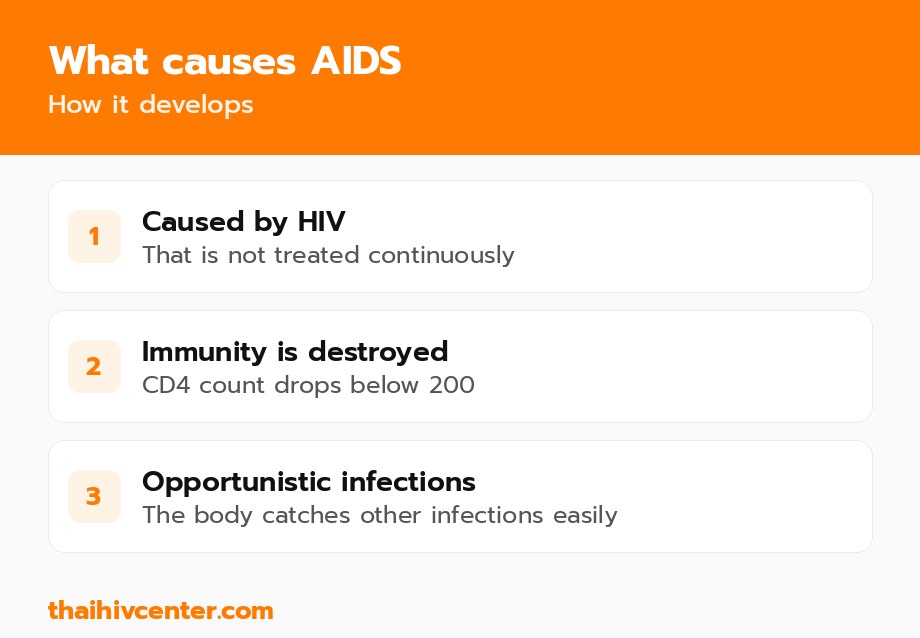
AIDS is caused by HIV, which enters the body and gradually destroys immune cells. Without continuous treatment, the virus keeps weakening immunity until it reaches the AIDS stage.
HIV destroys the immune system
HIV attacks a type of white blood cell called CD4, which is key to fighting infections. As the virus destroys these cells, the immune system weakens.
When CD4 falls below 200
Generally, doctors consider a person to have reached AIDS when their CD4 count falls below 200 cells per cubic millimetre, or when certain opportunistic infections occur. At this level the body becomes vulnerable to infections that people with normal immunity usually don't get.
The path from HIV infection to AIDS
Understanding how AIDS develops means first understanding how HIV progresses. After infection, the body goes through an acute stage that may have flu-like symptoms, then enters a latent stage that usually has no symptoms and can last many years. Without treatment, the virus gradually destroys immune cells until immunity becomes very low and the AIDS stage begins. The important point to stress is that this process takes time and can be stopped with treatment. If detected and antiretrovirals are started in the early stages, most people with HIV will never reach the AIDS stage at all. This is why early detection matters so much.
How HIV differs from AIDS
The difference between HIV and AIDS is worth understanding clearly, because using the wrong term can lead to misunderstanding and stigma.
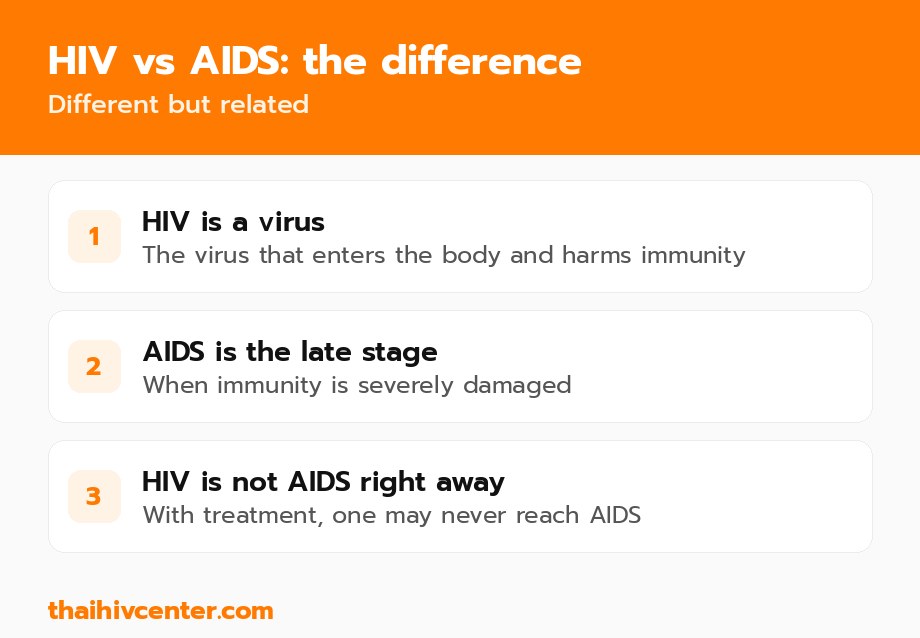
| Aspect | HIV | AIDS |
|---|---|---|
| What it is | A virus | The late stage of HIV infection |
| Immediate on infection? | It is the infection | No, it takes time if untreated |
| Treatable? | Controlled with antiretrovirals | Prevented by treating HIV |
In short, having HIV does not mean having AIDS. Many people with HIV who receive treatment never reach the AIDS stage in their lifetime.
Symptoms of AIDS
At the AIDS stage, weakened immunity makes the body vulnerable to opportunistic infections and various symptoms, such as significant weight loss, persistent fever, night sweats, chronic diarrhoea, prolonged swollen lymph nodes, and serious infections like tuberculosis or certain pneumonias. These result from the damaged immune system, not directly from the virus itself. Recognising that the illness at this stage comes from a weakened defence, rather than the virus attacking organs directly, helps explain why restoring immunity through treatment can turn the situation around.
Good news: AIDS is preventable and treatable
The most important thing to know is that AIDS today is no longer a death sentence.
Treating HIV early prevents AIDS
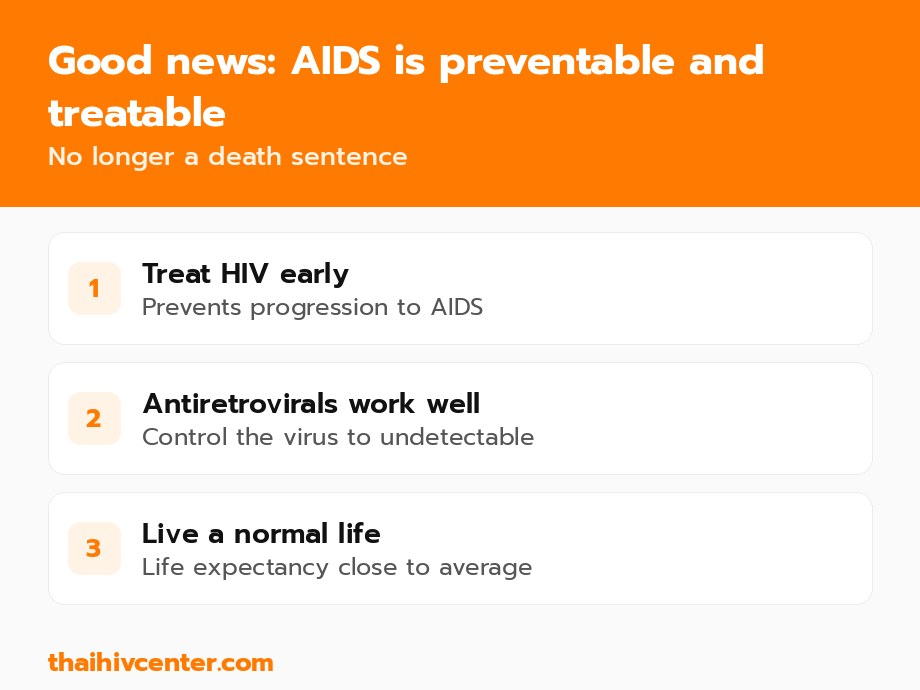
If HIV is detected and antiretroviral treatment begins early, immunity is protected, and most people with HIV never reach the AIDS stage. Treatment is the key to preventing AIDS. In other words, AIDS is not an inevitable outcome of HIV, but largely a consequence of infection going undetected or untreated, which is why testing and timely care matter so much.
Antiretrovirals work very well
Today's antiretrovirals can control the virus to undetectable levels, so people with HIV stay healthy with a life expectancy close to average. And when the virus is undetectable, it isn't passed on through sex, the principle of U=U.
AIDS symptoms in women and men
AIDS-stage symptoms are broadly similar across genders, because they arise from the same weakened immunity, such as weight loss, chronic fever and opportunistic infections. However, women may have some specific symptoms, such as recurrent, hard-to-treat vaginal infections or menstrual irregularities, while men may notice general signs of weakened immunity. These symptoms are not a definite indicator, though. A blood test and CD4 assessment by a doctor remain the only accurate way to confirm the stage of disease.
How AIDS can be prevented
The key to preventing AIDS is preventing HIV infection in the first place, and treating HIV continuously if already infected. Preventing infection can be done in several ways, such as using condoms consistently, taking pre-exposure medication (PrEP) for those at high risk, and not sharing injection needles. For people already living with HIV, starting antiretrovirals early and taking them consistently keeps immunity from dropping to the AIDS stage. This is why regular HIV testing matters, because the sooner you know, the better AIDS can be prevented. To learn where to test, read Where to test for HIV.
Opportunistic infections at the AIDS stage
When immunity weakens to the AIDS stage, the body becomes vulnerable to "opportunistic infections", infections that people with normal immunity usually don't get, because the body can no longer control them. Common examples include tuberculosis, certain pneumonias, fungal infections of the mouth and oesophagus, and nervous system infections. These opportunistic infections are the main cause of illness at the AIDS stage, not the HIV virus itself. Treating with antiretrovirals to restore immunity is therefore central to preventing and managing these conditions.
Care and treatment at the AIDS stage
Even at the AIDS stage there is still treatment, it is not the end. A clinician starts antiretrovirals to control HIV while treating any opportunistic infections at the same time. In many cases, with continuous treatment, the CD4 count gradually recovers, immunity strengthens, and the person can return to good health. Care at this stage requires both medical treatment and emotional support from those around, so the person has the encouragement to continue treatment. Consistent follow-up appointments and a supportive environment make a real difference to recovery at this stage.
How understanding of AIDS has changed over time
In the past, HIV and AIDS were seen as terrifying and untreatable, causing intense fear and stigma. Today, much has changed.
From a deadly disease to a manageable condition
With advances in antiretrovirals, HIV is now a manageable chronic condition, like other chronic diseases. People with HIV who receive treatment can be healthy, work, have families, and live fully. This understanding has helped shift society's view for the better.
U=U: Undetectable = Untransmittable
One of the most important advances is the principle of U=U, which confirms that a person treated to an undetectable viral load does not pass HIV on through sex. This knowledge not only changes the lives of people with HIV but greatly reduces fear and stigma in society.
AIDS and reducing stigma in society
Misconceptions about AIDS remain a source of stigma and discrimination against people with HIV. Many still believe AIDS spreads easily through everyday contact, which is not true. Sharing accurate information, that HIV spreads only through specific routes and that people on treatment can live safely with others, is key to reducing stigma. Treating people with HIV with understanding and respect is not only a matter of human rights but also encourages more people to come forward for testing and treatment.
Common myths about AIDS worth knowing
Many myths about AIDS persist in society, such as the belief that AIDS spreads through touch, sharing meals, or mosquito bites, none of which is true. HIV spreads only through specific routes. Another myth is seeing AIDS as a disease of one particular group, when in reality HIV can affect anyone at risk, regardless of gender, age or occupation. Understanding these facts helps reduce both needless fear and stigma toward people with HIV. Correcting these misconceptions is not only about accuracy, it directly affects whether people feel safe enough to test, seek treatment, and speak openly about their health.
Living with HIV today
With today's effective treatment, people with HIV can live like anyone else in almost every way. They can work, study, exercise, have relationships and start families. Women with HIV who receive appropriate treatment can become pregnant and have HIV-negative children. The key is taking antiretrovirals consistently and attending appointments, to keep the virus at an undetectable level. Support from family and an understanding society plays a major role in helping people with HIV maintain their care and enjoy a good quality of life. Seeing people with HIV as ordinary people caring for their health, rather than as "frightening patients," is an important shift in the thinking of modern society.
Frequently asked questions
Does everyone with HIV get AIDS?
No. With continuous treatment, most people with HIV never reach the AIDS stage.
Can AIDS be transmitted?
What is transmitted is HIV, not "AIDS." Transmission happens through routes like unprotected sex and sharing needles, not everyday contact.
Can AIDS be cured?
There is no cure yet, but antiretrovirals control the virus very well, so people with HIV stay healthy and live normally.
Can someone with a low CD4 recover?
In many cases yes. Once treatment begins, the CD4 count usually gradually recovers and immunity strengthens.
Can I catch it by living with someone who has AIDS?
No. HIV is not spread through everyday contact such as sharing meals, sharing a bathroom, or hugging.
Can "AIDS" and "HIV" be used interchangeably?
They shouldn't be. HIV is the virus, while AIDS is the late stage. Using the terms correctly reduces misunderstanding.
What can cause AIDS besides HIV?
AIDS is caused only by HIV. It is the late stage of untreated HIV infection and does not arise from other causes.
If I take antiretrovirals consistently, can I reverse the AIDS stage?
In many cases yes. As immunity recovers and the CD4 count rises, many people return to good health and out of the critical phase.
Can people with HIV have children?
Yes. With appropriate treatment and care, women with HIV can become pregnant and have HIV-negative children.
Conclusion
AIDS is the late stage of HIV infection where immunity is severely damaged, not a germ in itself, and having HIV does not always mean having AIDS. With today's antiretroviral treatment, most people with HIV can prevent progression to AIDS and stay as healthy as anyone else. Understanding these facts not only reduces fear but also helps reduce stigma toward people living with HIV. The more people understand that AIDS is preventable, treatable, and that people on treatment can live safely alongside others, the more society becomes friendly and safe for everyone.
References
- World Health Organization (WHO) — HIV/AIDS
- HIV.gov — What Are HIV and AIDS?
- ClinicalInfo HIV (NIH)
- UNAIDS — Fact sheet
- U=U — Thai HIV Center
This article is for educational purposes and is not a medical diagnosis. If you have concerns, consult a doctor.