What Is HIV Antiretroviral Medicine, How to Take It, and How Well It Treats HIV
HIV antiretroviral medicine (ARV) is medication used to control HIV in the body by stopping the virus from multiplying, lowering the amount of virus until it is undetectable, and protecting the immune system. Although antiretrovirals don't cure HIV, they keep people with HIV healthy with a life expectancy close to average. This article explains what HIV antiretroviral medicine is, how it works, how to take it effectively, whether it has side effects, and what current HIV treatment looks like, so people just starting treatment or wanting to understand it have accurate information and can ease their worries.
What is HIV antiretroviral medicine?
HIV antiretroviral medicine is a group of drugs designed specifically to control HIV. They work by blocking the virus's life cycle at various stages, so the virus cannot multiply.
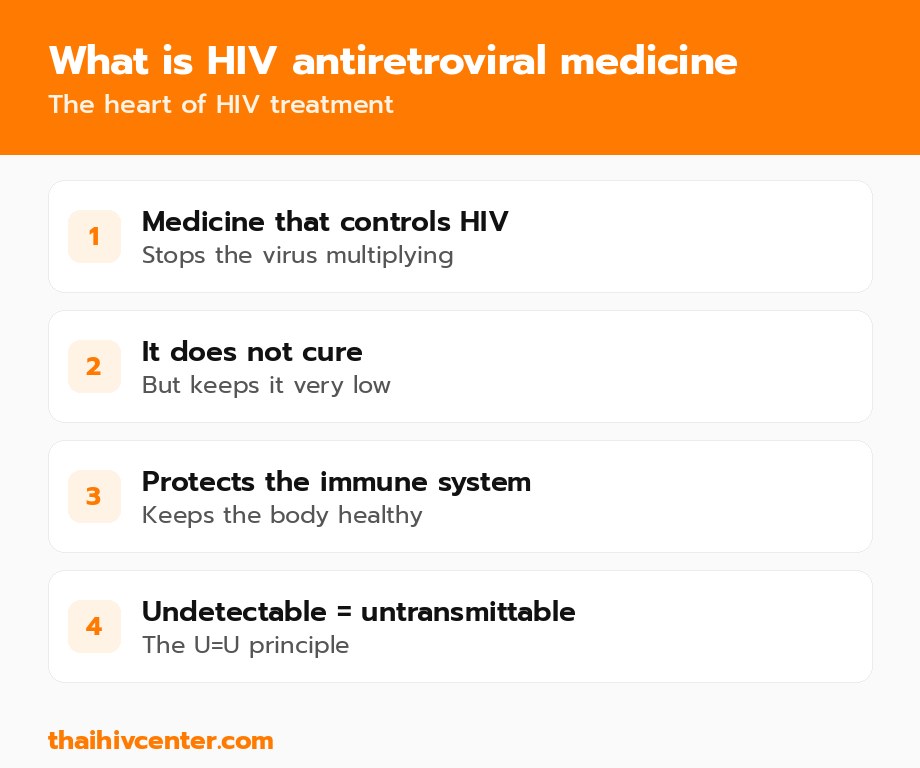
It controls the virus but doesn't cure it
Antiretrovirals don't eliminate HIV from the body entirely, but keep the amount of virus so low it becomes undetectable, so it no longer damages immunity. This is why people with HIV on effective treatment can have the same immune strength and health as anyone else.
It protects the immune system
Once the virus is controlled, the immune system is protected and gradually recovers, keeping the body healthy and preventing progression to AIDS.
Undetectable = Untransmittable (U=U)
When antiretrovirals are taken consistently until the virus is undetectable in the blood, the person doesn't pass HIV on through sex, the principle of U=U (Undetectable = Untransmittable), a major advance that has changed the lives of people with HIV and reshaped how society understands the virus. It means treatment protects not only the individual but also their partners.
How to take HIV antiretrovirals effectively
The effectiveness of antiretrovirals depends on taking them correctly and consistently. Consistency is the single most important thing.
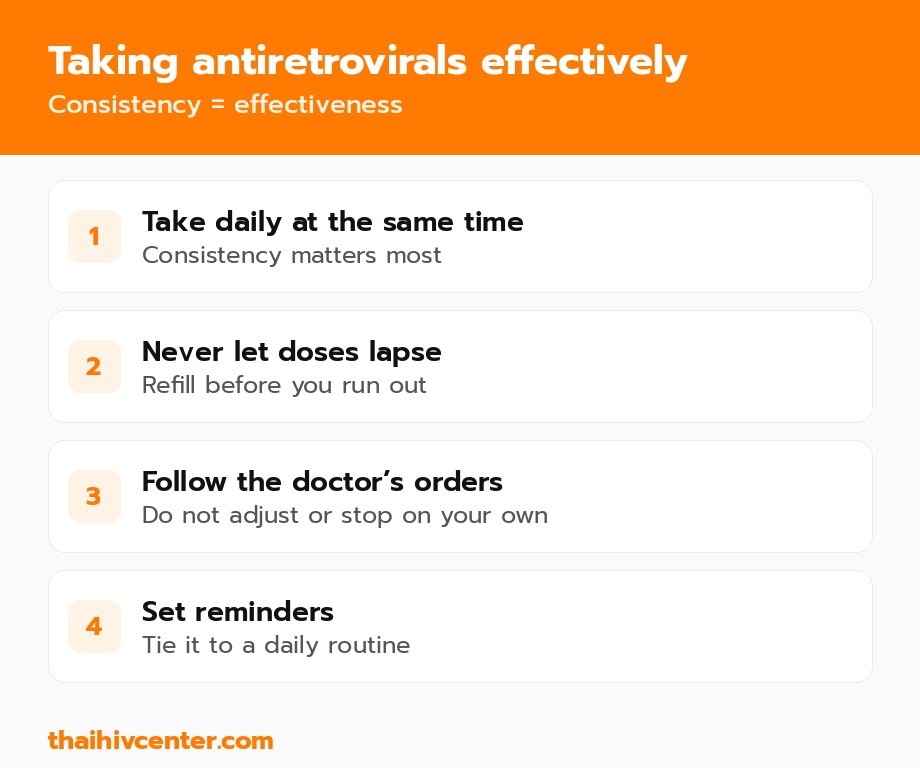
Take daily at the same time
Most antiretrovirals must be taken daily at the same time to keep drug levels steady in the body. Today, single-tablet regimens are available in many cases, making them easier to take and helping people stay consistent over the long term.
Never let doses lapse
Frequently missing doses or letting your supply run out can cause drug resistance and reduce effectiveness. Always refill before you run out, and set reminders, such as tying your dose to a daily routine.
Follow your doctor's orders, don't adjust or stop on your own
Take the medicine exactly as prescribed, without changing the dose or stopping on your own even when you feel well, because stopping lets the virus multiply again and can undo months of progress.
Side effects of antiretrovirals and monitoring
Many people worry about side effects, but today's antiretrovirals are very safe and most side effects are mild.
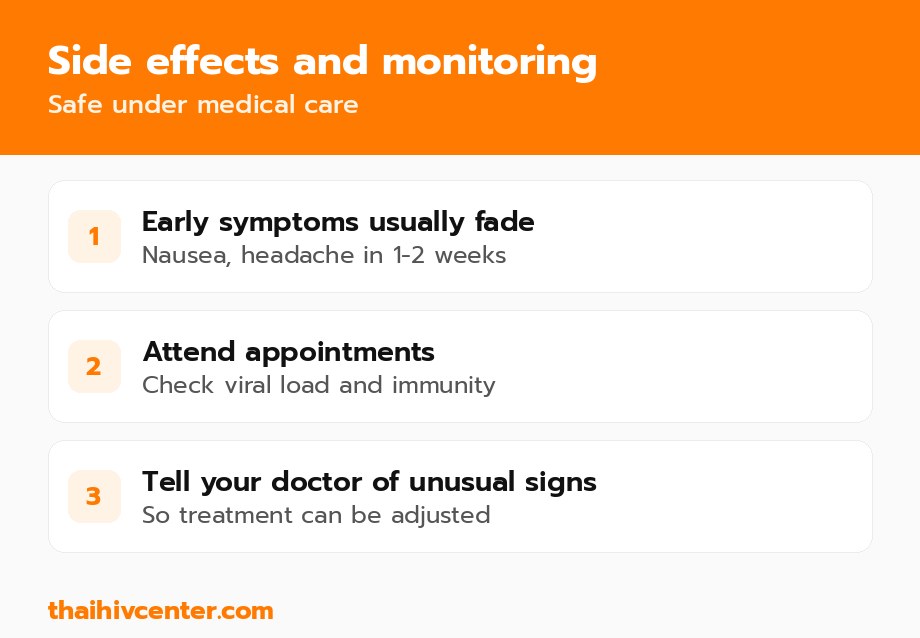
Early symptoms usually fade
In the first 1-2 weeks, some people have mild symptoms such as nausea, headache or stomach upset, which usually settle as the body adjusts.
Attend appointments for monitoring
HIV treatment requires periodic monitoring, such as checking the viral load and immune count (CD4), to assess how well treatment is working and adjust it appropriately. Tell your doctor about any unusual symptoms so they can respond early. These routine check-ups are a normal, reassuring part of long-term care rather than a cause for worry.
Summary table of HIV antiretrovirals
| Aspect | Detail |
|---|---|
| Role of the medicine | Controls the virus, stops it multiplying, protects immunity |
| How to take it | Daily at the same time, consistently, as prescribed |
| Side effects | Mostly mild and self-resolving |
| Outcome | Undetectable virus, good health, no transmission (U=U) |
How antiretrovirals differ from PrEP and PEP
Many people confuse antiretrovirals for treatment with prevention medicines like PrEP and PEP. In fact all are antiretroviral drugs, but used in different contexts. Antiretrovirals for treatment are used by people who already have HIV to control the virus. PrEP is taken before a risk to prevent infection in people who don't have HIV, and PEP is taken after a risk within 72 hours to reduce the chance of infection. Understanding this difference helps use the medicines for the right purpose. Read more about prevention in the Prevention section.
Drug resistance and how to prevent it
Drug resistance happens when HIV changes so that a once-effective medicine no longer works. The most common cause is inconsistent dosing, which leaves drug levels unsteady and gives the virus a chance to adapt. The best way to prevent resistance is taking medicine on time and consistently as prescribed, not stopping on your own, and attending appointments for monitoring. If resistance does develop, a doctor can switch to another regimen that still works, so communicating regularly with your doctor is very important.
How many types of HIV antiretrovirals are there?
HIV antiretrovirals come in several classes, each blocking the virus at a different step of its life cycle. Treatment usually combines several drugs to control the virus effectively and reduce the chance of resistance. In the past, people with HIV might take many pills several times a day, but today single-tablet regimens combine several drugs into one pill taken once daily, making treatment far more convenient. A doctor chooses the regimen that suits each person based on overall health, other medicines being taken, and lifestyle.
When to start antiretrovirals
Current guidelines recommend starting antiretrovirals as soon as possible after diagnosis, without waiting for the immune count to fall as in the past, because starting early best protects the immune system, reduces the risk of complications, and lowers the virus to undetectable sooner, which also means not passing it on sooner. Starting early therefore benefits both the person and prevention of transmission overall.
What to do if you miss a dose
Occasionally missing a dose can happen. The key is to take it as soon as you remember if it isn't too close to the next dose, but if it is nearly time for the next dose, skip the missed one and continue as usual, without doubling up. If you forget often, find reminders such as an alarm, a medication app, or tying your dose to a daily routine, and ask a doctor or pharmacist if unsure, because taking medicine consistently is the heart of effective treatment.
Living life while taking antiretrovirals
People taking antiretrovirals can live normally in almost every way, working, studying, exercising and having relationships. Most antiretrovirals can be taken without major dietary restrictions, but follow the specific instructions for your regimen. Overall healthy habits, such as adequate rest, good nutrition, and avoiding things harmful to the liver, help treatment work well. Importantly, people treated to an undetectable level can have relationships and children safely under a doctor's guidance.
Myths about antiretrovirals
Several myths about antiretrovirals are worth correcting. Some believe antiretrovirals always have severe side effects, when today's medicines have improved greatly and most side effects are mild. Some believe they can stop once they feel well, which is dangerous, because stopping lets the virus multiply again and may cause resistance. Another myth is thinking antiretrovirals cure HIV, when in fact they control the virus very well but don't eliminate it. Understanding these facts helps people with HIV take treatment correctly and continuously.
Current HIV treatment guidelines
Current HIV treatment guidelines recommend starting antiretrovirals as soon as possible after diagnosis, without waiting for immunity to drop, because starting early best protects health and reduces transmission. Today's treatment is highly effective and convenient, with a range of regimens to suit each person. People with HIV who receive continuous treatment can work, study, have families and live fully, with the same opportunities as anyone else. If you wonder whether HIV can be cured, read more in the HIV treatment section.
Why consistency matters most
If there is one thing to remember about antiretrovirals, it is consistency. Taking every dose on time each day keeps drug levels steady in the body, which is necessary to keep the virus undetectable. When drug levels are steady, the virus has no chance to multiply or adapt into resistance. Conversely, inconsistent dosing, even occasionally, can let the viral load rise again and risk resistance. Research clearly shows that people who take their medicine consistently have far better treatment outcomes. Building dosing habits, such as taking it at the same time each day, using a pill organiser, or setting reminders, is therefore one of the most worthwhile investments you can make in your long-term health. Over months and years, these small daily habits add up to a healthy life and an undetectable status.
Frequently asked questions
Do I take HIV antiretrovirals for life?
HIV treatment is currently long-term and continuous. People with HIV must take medicine consistently to control the virus, and stopping on your own can let it multiply again.
Do antiretrovirals cure HIV?
Antiretrovirals control the virus very well until it is undetectable, but this is not a cure, the virus remains at a low level, so treatment must continue.
Do antiretrovirals have long-term side effects?
Today's medicines are very safe under medical care with periodic monitoring, and serious side effects are uncommon.
Where can I get HIV antiretrovirals?
From hospitals and facilities that provide HIV care, where a doctor prescribes and monitors the treatment.
Can I drink alcohol while taking antiretrovirals?
Small amounts are generally not strictly forbidden, but consult a doctor, because alcohol can affect the liver and consistent dosing.
Do antiretrovirals cause weight gain or loss?
Different regimens affect the body differently, and some people notice weight changes. If concerned, consult a doctor to assess and adjust treatment.
When will I see results after starting?
The viral load usually falls within weeks to months, and many people become undetectable within about 3-6 months of consistent dosing.
Can I take antiretrovirals with other medicines?
Some medicines can interact with antiretrovirals, so always tell your doctor and pharmacist about all medicines and supplements you take.
Conclusion
HIV antiretroviral medicine is the heart of treatment that controls the virus, protects immunity, and keeps people with HIV as healthy as anyone else. Although it doesn't cure HIV, when taken consistently until undetectable, it isn't passed on through sex, the principle of U=U. The keys to treatment are taking medicine consistently, attending appointments, and not stopping on your own. With today's treatment, HIV has become a manageable chronic condition, not the frightening disease it once was. For most people, it means taking one simple daily step and living a full, healthy life.
References
- ClinicalInfo HIV (NIH) — HIV Treatment
- European AIDS Clinical Society (EACS) Guidelines
- National HIV Curriculum (University of Washington)
- Prevention Access Campaign — U=U
- U=U — Thai HIV Center
This article is for educational purposes and is not a diagnosis or medication advice. Always consult a doctor about treatment.