Masturbation and Sexual Health: The Facts You Should Know
Masturbation, or self-stimulation for sexual pleasure, is a natural activity that many people do, yet it is rarely discussed openly and is surrounded by myths. Many people grow up with warnings that have no scientific basis, leading to needless worry or guilt. This article offers straightforward, non-judgemental health facts, from whether it is normal, to its health benefits, its safety regarding HIV and other sexually transmitted infections, common myths, and the signs worth paying attention to, so you can understand your body and sexual health accurately.
What is masturbation, and is it normal?
Masturbation is stimulating one's own body for sexual pleasure and relaxation. It is a common human sexual behaviour and, in fact, a natural part of development and learning about one's sexuality.
People of all genders and ages do it
Masturbation is found across all genders and age groups, among people with and without partners. Sexual health research worldwide consistently confirms that it is common in most of the population, not abnormal or something to be ashamed of.
Doing it or not doing it are both normal
An important point to understand is that there is no "correct frequency" for masturbation. Some people do it often, some rarely, and some not at all, all of which are normal. Individual differences depend on desire, personal beliefs and life stage. No pattern is more "right" or "wrong" than another.
Masturbation and safety from HIV and STIs
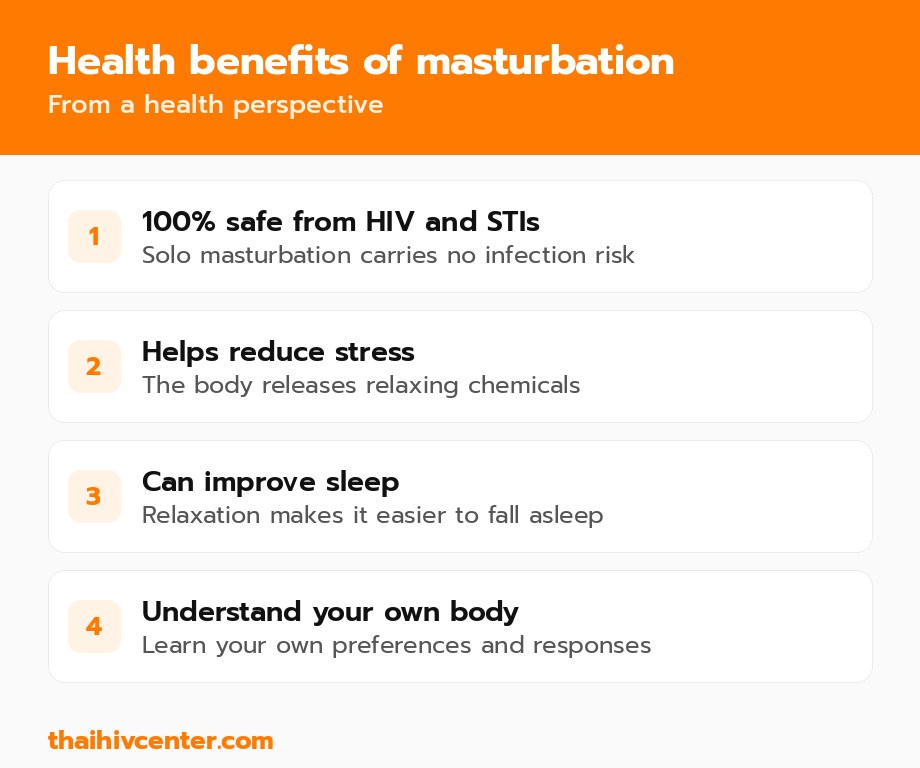
From the perspective of preventing HIV and sexually transmitted infections, masturbation is the safest sexual activity, because it involves no exchange of body fluids with another person.
Solo masturbation: no HIV risk at all
Masturbating alone carries no risk of HIV or any sexually transmitted infection, because these infections require the exchange of certain body fluids between people, such as blood, semen, or vaginal and rectal fluids. When done alone, there is no route of transmission. This is why sexual health organisations classify masturbation as part of "safer sex".
Mutual masturbation: low risk, but worth understanding
Mutual masturbation with a partner (without penetration) carries very low HIV risk. However, if fluids come into contact with open cuts on the skin, or a hand carrying fluids touches a partner's genitals, there can be some risk of certain infections. Washing hands and avoiding contact with cuts further reduces the risk.
Sex toys: cleaning and not sharing
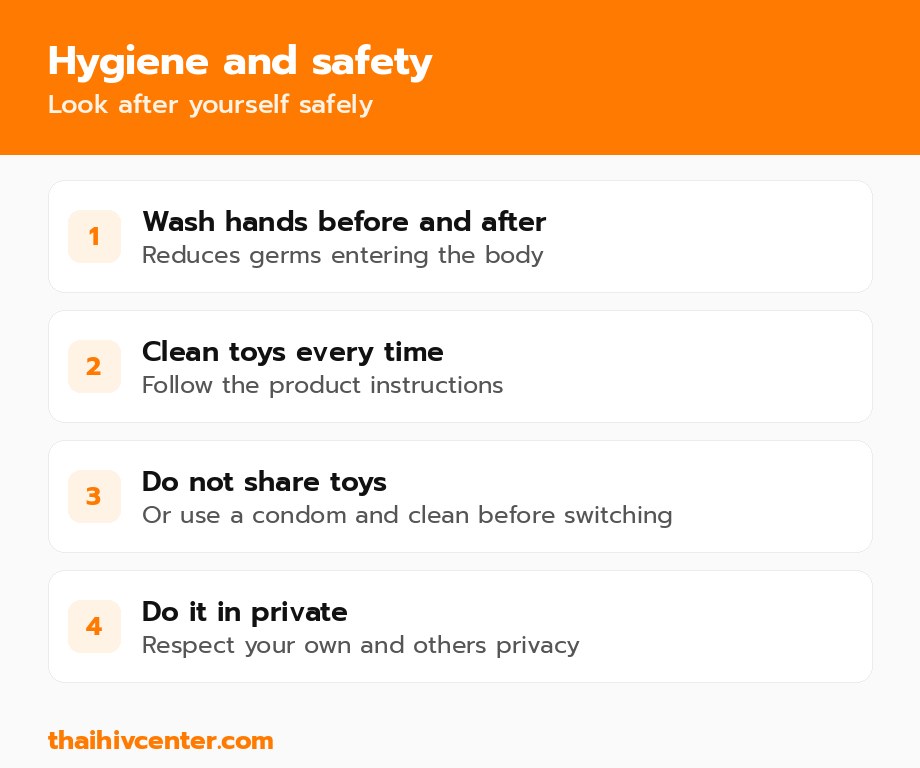
If you use sex toys, clean them every time according to the product instructions, and do not share them with others without cleaning or changing the condom covering them. Sharing toys carelessly can be a route for STIs. Good hygiene is an important part of safe masturbation.
Health benefits of masturbation
Beyond safety, masturbation has several health benefits, as sexual health research shows.
Reduces stress and aids relaxation
At orgasm, the body releases certain neurotransmitters and hormones that promote relaxation and wellbeing, such as endorphins and oxytocin, which ease tension and lift mood. Many people use it as a natural way to relieve stress.
Can improve sleep
The relaxed feeling after orgasm helps some people fall asleep more easily and deeply, which is why many feel drowsy and relaxed afterwards.
Helps you understand your own body
Masturbation helps you learn how your own body responds and what you do or don't enjoy. This understanding benefits overall sexual health and helps you communicate your needs to a partner in the future.
Other sexual health benefits
For some people, masturbation may relieve certain symptoms, such as tension or menstrual cramps in some cases, and helps maintain natural genital function. Results vary from person to person.
Supports mood and mental health
The release of endorphins and oxytocin at orgasm not only aids relaxation but can briefly lift mood. For some people, masturbation is a safe way to manage stress or tension without relying on anything external. That said, if it becomes the only way someone escapes negative emotions all the time, it's worth building a broader range of coping strategies too.
Builds confidence in your own body
Learning and accepting your own body through masturbation can strengthen confidence and a positive relationship with your body, an important part of sexual health and overall self-esteem.
What research and science tell us
In the past, masturbation was often viewed as abnormal or harmful. Most of those beliefs came from social and moral contexts of earlier eras, not scientific evidence. As medical science advanced, many studies confirmed that masturbation is a normal behaviour that is not harmful to the body.
Today, health and sexual health organisations worldwide view masturbation as part of normal sexual health and include it in comprehensive sex education. Evidence-based understanding helps people let go of needless guilt and care for their sexual health with confidence. This shift from belief to fact is a good example of how knowledge reduces sexual stigma.
Comprehensive sex education that includes accurate information about masturbation helps young people grow up with a healthier, shame-free understanding of their bodies. When people have facts rather than fear, they are better equipped to make informed decisions, communicate openly with partners, and seek help when something genuinely troubles them. In this sense, honest information about a normal behaviour is itself a form of health promotion.
Common myths about masturbation
Myths about masturbation are widespread and often passed along without evidence. Let's look at what's true and what isn't.
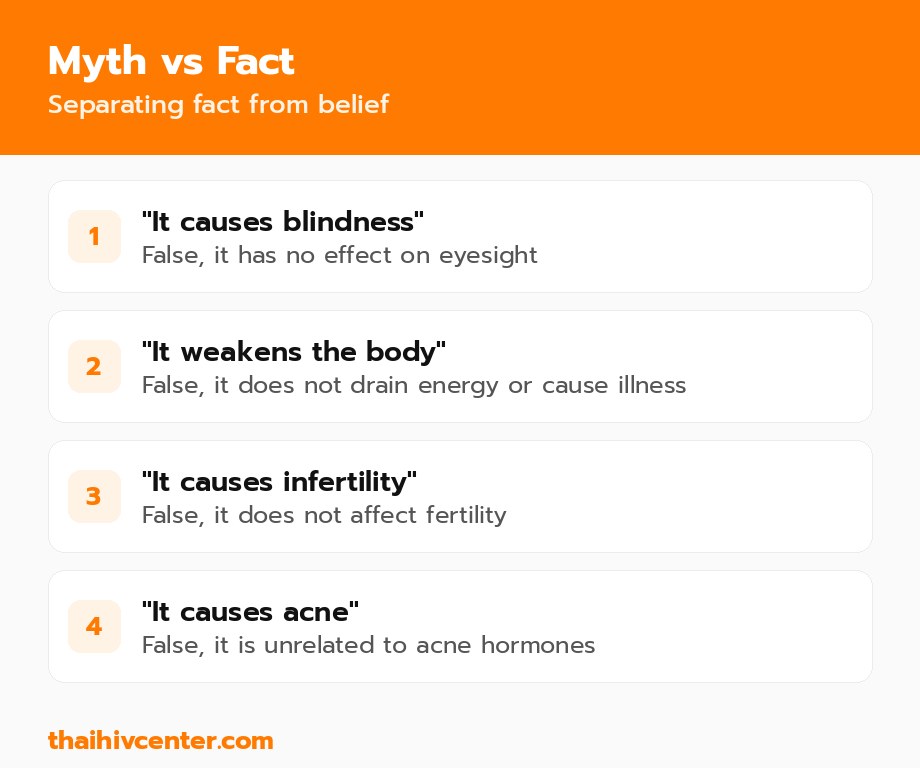
| Commonly heard belief | The medical reality |
|---|---|
| It causes blindness or worsens eyesight | False, it has no effect on vision |
| It weakens the body and drains energy | False, it does not cause illness or chronic fatigue |
| It causes future infertility | False, it does not affect fertility |
| It causes acne or hairy palms | False, these are baseless tales |
| It harms the brain or memory | False, there is no evidence for this |
On blindness and bodily weakness
The belief that masturbation causes blindness or weakens the body is an old misconception with no scientific basis. The body continually produces new semen and fluids, so masturbation at a normal level does not "drain energy" or cause illness.
On infertility
Masturbation does not affect fertility or the ability to have children in the future. This belief has no medical basis.
On sin and abnormality
Some people are taught that masturbation is wrong or shameful, often stemming from cultural or belief contexts. From a health perspective, masturbation is a normal, harmless behaviour. This article provides health information; personal decisions naturally depend on each person's beliefs and values.
Masturbation and specific health aspects
Beyond general benefits, masturbation relates to a few specific health areas, which differ from body to body.
Pelvic floor muscles
Orgasm involves contractions of the pelvic floor muscles, which play a role in continence and sexual health. Being aware of and understanding how these muscles work may benefit overall health.
Prostate health
For people who have a prostate, some observational research suggests a possible association between ejaculation frequency and prostate health. However, the findings are not conclusive and should not be taken as medical advice. If you have concerns about the prostate, consult a doctor.
Relieving menstrual cramps
For some people, orgasm may help relieve menstrual cramps, due to muscle contractions and the release of pain-reducing substances, though results vary from person to person.
Cultural and belief contexts
Attitudes toward masturbation vary by culture, religion and family. Some cultures view it as taboo, while others see it as natural. This diversity affects how individuals feel, and some may feel guilty because of instilled beliefs, even though there is no health harm.
This article presents information from a health perspective, which confirms that masturbation is a normal behaviour that is not harmful to the body. Whether to do it is a personal choice that depends on each person's values, beliefs and context. What matters is not letting baseless misconception or shame undermine your mental health and the relationship with your own body. If guilt from beliefs affects your wellbeing, talking with a counsellor who understands your context may help.
How often is "too much"?
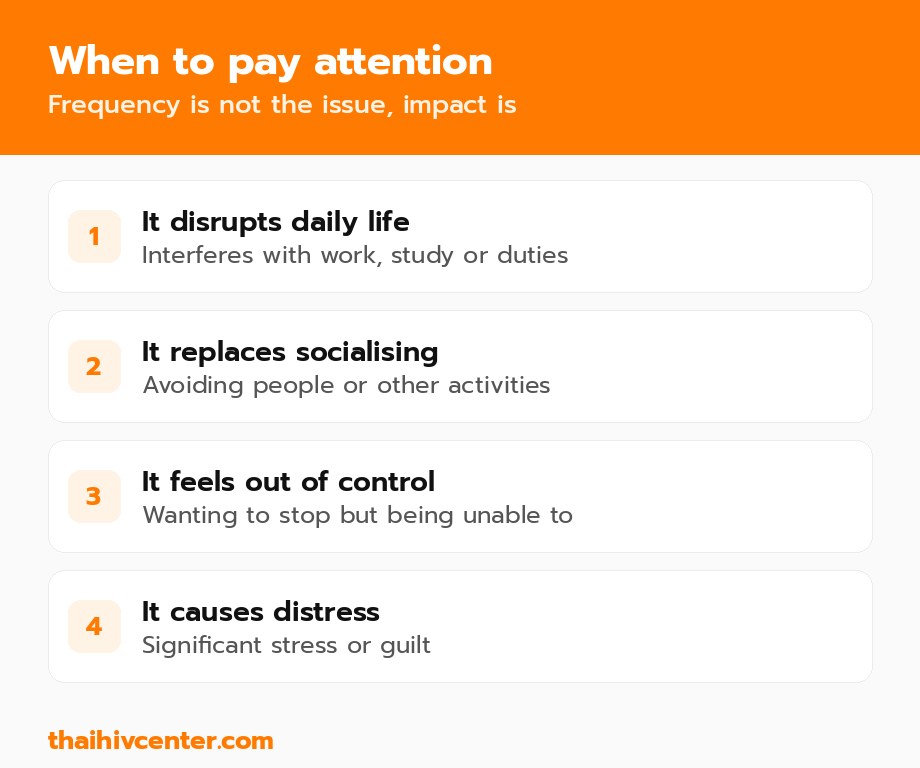
A question many people have is "how often is too much?" The key answer is that frequency is not the measure of a problem, the "impact on your life" is what matters.
Signs worth paying attention to
Masturbation may become something to pay attention to when it begins to disrupt daily life, such as affecting work or study, causing you to avoid socialising or other activities, feeling out of control even when you want to stop, or causing significant distress, stress and guilt. These signs suggest it may be time to seek help, not because the behaviour is wrong, but because it is starting to affect wellbeing.
When to consult a professional
If you feel masturbation is becoming uncontrollable or significantly affecting your life and relationships, talking to a mental health professional or a sexual health counsellor is a good option. A professional can help understand the real underlying causes, which can sometimes relate to stress, anxiety, or using it as a way to cope with emotions. Seeking help is not shameful, it is a mature way of caring for yourself.
Hygiene and safety
Masturbating with good hygiene reduces the risk of infection and irritation.
Wash your hands before and after
Washing your hands before and after reduces the chance of introducing germs into the body, especially delicate areas like the genitals, a simple basic hygiene step.
Care for sex toys
If you use sex toys, clean them every time per the product instructions, store them clean and dry, and don't share them without cleaning or a condom cover. This care prevents infection and extends their life.
Masturbation across the life stages
Understanding of masturbation may differ across life stages, but overall it is normal at every age. Understanding the context of each stage helps reduce worry and misunderstanding.
Adolescence
During adolescence, hormonal changes and curiosity about sex are natural. Masturbation is often how teenagers safely learn about their own bodies, without risk of infection or pregnancy. What matters at this age is understanding privacy, doing it in an appropriate space, and receiving accurate information rather than fear-based warnings.
Adulthood
In adulthood, masturbation remains normal, whether one has a partner or not. Many use it to relax, relieve stress, or care for their own sexual needs when single or when a partner is unavailable. Masturbation at this stage does not indicate any problem and is part of good sexual health.
Older age
Sexual desire does not disappear with age. Many older adults remain sexually active, including through masturbation, which is normal and healthy. It may help maintain genital function and be a safe source of pleasure at this stage of life.
Masturbation within a relationship: not a wrong
A common misconception is that people in a relationship shouldn't masturbate, or that masturbation is a sign of relationship problems. The reality is not always so.
Not a sign of relationship problems
People in relationships masturbating is normal and common, and does not mean they are dissatisfied or don't love their partner. Everyone's sexual needs vary over time, and masturbation is a way of caring for oneself independently of a partner. Many couples see it as an acceptable private matter.
Open communication with a partner
If this becomes an issue in a relationship, open, non-judgemental conversation helps both partners better understand each other's needs. Good communication about sex is the foundation of a healthy relationship and reduces misunderstanding or insecurity.
Talking about this with teenagers, with understanding
For parents or caregivers, knowing how to respond when they learn a teenager masturbates can be daunting. But responding with understanding matters for the young person's sexual health and self-confidence.
Give accurate information rather than scolding or shaming
Scolding or making a child feel guilty can create lasting shame and misconceptions about sex. Providing accurate information that it is a normal part of development, along with teaching about privacy, helps a child grow up with a healthy attitude toward their body and sexual health.
Emphasise privacy and consent
What should be taught is not that masturbation is "wrong", but about time and place, privacy, and respecting one's own and others' boundaries. Laying a foundation of consent and privacy from adolescence is an important basis for good sexual health in the future.
Masturbation, mental health and relationships
Masturbation does not conflict with a healthy relationship. Many couples see it as a normal part of each person's life, and sometimes part of a healthy relationship. What matters is understanding and open communication between partners. If worry or guilt affects your mental health, talking with someone you trust or a professional can help you see it from a healthier perspective.
For more on sexual health and prevention, see the Prevention section, or learn about sexual health testing in the Testing section.
Building a healthy relationship with your own sexuality
Beyond safety and health benefits, having a healthy attitude toward your own sexuality is an important foundation of wellbeing. Masturbation is just one part of this bigger picture.
Letting go of needless guilt
Many people carry guilt about masturbation from childhood, guilt that does not come from any health harm but from beliefs and teachings they received. Recognising that it is a natural, normal behaviour helps release that guilt and view your own body with more understanding. Good sexual health begins with accepting yourself without judgement.
Keeping balance with the rest of life
As with any activity, balance matters. Masturbation that is a balanced part of life, not disrupting duties, relationships or other meaningful activities, is healthy. Paying attention to whether it sits in a reasonable proportion to your life as a whole matters more than counting frequency.
Frequently asked questions
Is frequent masturbation harmful?
Generally not, as long as it doesn't disrupt daily life or cause distress. A suitable frequency differs from person to person.
Can masturbation give you HIV?
Solo masturbation carries no HIV risk at all, because there is no exchange of body fluids with another person.
Does masturbation reduce sexual performance?
No. Masturbation at a normal level does not reduce sexual performance, and some people use it to learn about their own body.
I feel guilty afterwards, what should I do?
Guilt usually comes from instilled beliefs, not health harm. If this feeling troubles you greatly, talking with a mental health professional may help.
Is it abnormal for children or teenagers to masturbate?
It is part of natural development. What matters is doing it in private and understanding privacy and consent.
Does masturbation affect hormones or the body long term?
There is no long-term harm to hormones or the body. The body balances itself naturally, so masturbation at a normal level causes no health problems.
Should I stop masturbating once I have a partner?
Not necessarily. Masturbating while in a relationship is normal and depends on each couple's needs and agreement. What matters is communication and mutual understanding.
Does masturbation really help with sleep?
For many people, the relaxation after orgasm makes it easier to fall asleep, but results vary and it is not a sleep solution for everyone.
How does masturbation differ from sex in terms of risk?
In terms of infection, solo masturbation has no risk, while sex with another person carries HIV and STI risk, which can be reduced with condoms, PrEP and regular testing.
If I have never masturbated, is that abnormal?
Not at all. Not masturbating is also normal. People differ in their desires and comfort, and there is no fixed standard.
Can masturbation affect my sex life with a partner?
For most people it does not harm partnered sex, and understanding your own body can even improve communication about what you enjoy. If you feel it is affecting intimacy, an open conversation with your partner usually helps.
Is there a "right age" to start?
There is no single right age; it is a natural part of development that begins at different times for different people. What matters most is understanding privacy, consent and respect for oneself and others.
Conclusion
Masturbation is a normal, safe and common sexual behaviour among people of all genders and ages. From the perspective of preventing HIV and STIs, solo masturbation is the safest activity because it involves no exchange of body fluids. It also has health benefits, such as aiding relaxation, sleep, and understanding your own body. Myths that it causes blindness, weakness or infertility have no scientific basis. What matters is not frequency but the impact on your life, and if it begins to disrupt daily life or cause distress, consulting a professional is a good option. Above all, understanding your body and sexual health accurately and without shame is the foundation of good sexual health. Having accurate, unbiased information lets us make confident decisions about our own bodies, and pass a healthier understanding on to those around us and to the next generation.
References
- NHS — Sexual health
- Planned Parenthood — Masturbation
- World Health Organization (WHO) — HIV/AIDS
- CDC — HIV Risk and Prevention
- HIV Prevention — Thai HIV Center
This article is for health education purposes and is not a medical diagnosis. If you have health or emotional concerns, consult a doctor or professional.