Can You Get HIV From Kissing? Separating Fact From Fear
"Can you get HIV from kissing?" is something many people wonder but hesitate to ask, especially at the start of a new relationship. The medically confirmed truth is that kissing does not transmit HIV, whether an ordinary kiss or a deep one. This article explains why, reviews the truth about saliva and HIV, and points out the rare cases worth extra care, so you can be close and confident in your relationships.
Kissing and HIV: the facts you should know
The myth that kissing transmits HIV comes from a fear of exchanging saliva, but science is clear that saliva is not a route of transmission.
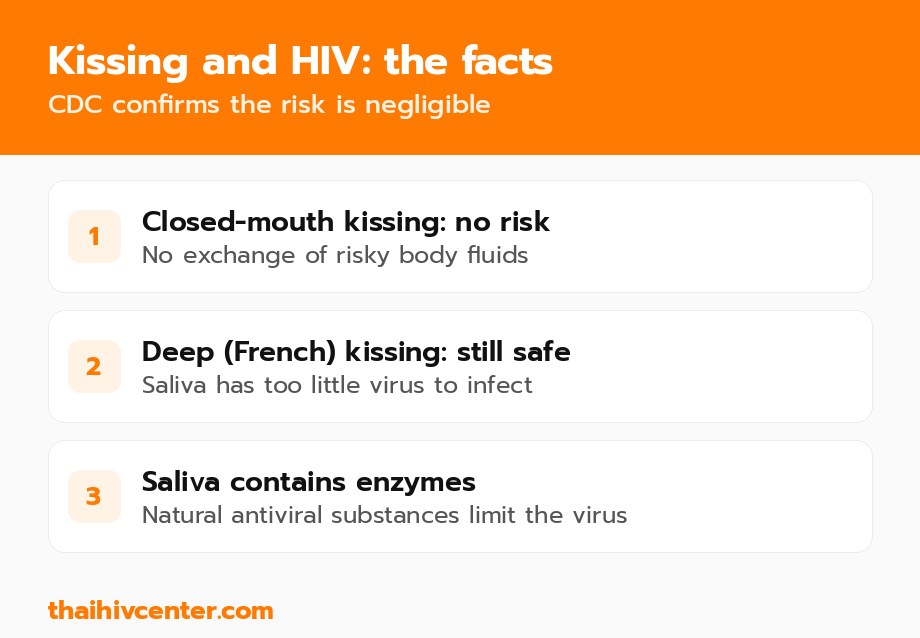
Closed-mouth kissing carries no risk
Closed-mouth kissing (a peck, a kiss on the cheek) involves no exchange of risky body fluids, so it cannot transmit HIV at all. It is a 100% safe way to show affection.
Deep (French) kissing is still safe
Even deep kissing that exchanges saliva is considered safe, because saliva contains far too little HIV to cause infection. Major global health bodies agree that the risk from kissing is negligible.
Saliva contains natural antiviral substances
Interestingly, human saliva contains certain enzymes and proteins that naturally inhibit HIV. This is another reason transmission through saliva is virtually impossible.
When to take extra care
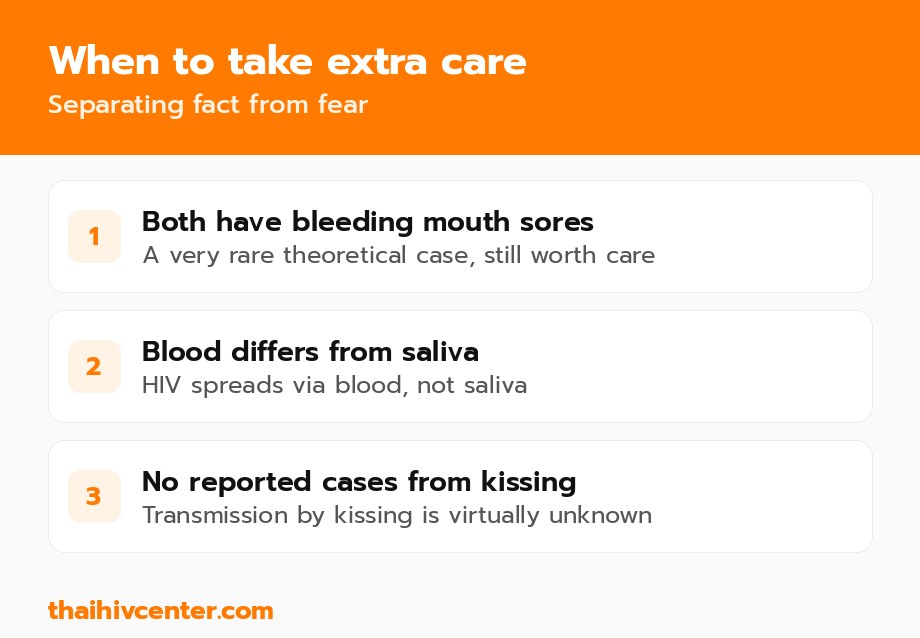
Although kissing is safe, there is a very rare theoretical case worth understanding for clarity.
| Type of kiss | HIV risk |
|---|---|
| Cheek or closed-mouth kiss | No risk |
| Deep kiss exchanging saliva | Negligible |
| Deep kiss while both have bleeding mouth sores | Very low (rare theoretical case) |
The only situation ever discussed in theory is when both partners have open sores or bleeding in the mouth at the same time, in which case any risk comes from "blood," not "saliva." Even so, in reality there are virtually no reported cases of HIV transmission from kissing anywhere in the world.
Accurate understanding reduces stigma
The fear of catching HIV from a kiss makes many people living with HIV feel they cannot have love or closeness, which simply isn't true. What's more, a person with HIV who is treated to an undetectable viral load does not pass HIV on even through sex, the principle of U=U (Undetectable = Untransmittable). Understanding the facts lets everyone enjoy warm relationships without fear.
To understand more myths, read Can mosquito bites transmit HIV?
Frequently asked questions
If my partner has bleeding gums and we kiss, can I get HIV?
The chance is virtually zero. Both partners would need heavy bleeding at the same time for even a theoretical risk, which almost never happens in practice.
Is kissing a person with an undetectable viral load safe?
Extremely safe. Kissing itself is not a risk, and an undetectable viral load confirms safety further.
Is sharing a spoon or glass different from kissing?
Equally safe. Saliva does not spread HIV, whether through kissing or shared items.
Conclusion
Kissing, ordinary or deep, does not transmit HIV, because saliva does not carry the virus and even contains natural antiviral substances. The theoretical risk requiring simultaneous bleeding in both partners almost never occurs. You can enjoy love and closeness with peace of mind. If you have other risks or worries, an HIV test is the best option.
References
- UNAIDS — HIV facts
- HIV.gov — How HIV is transmitted
- National HIV Curriculum (University of Washington)
- TheBody — HIV information
- HIV myths — Thai HIV Center
This article is for educational purposes and is not a medical diagnosis. If in doubt, consult a healthcare provider.